Topic 5.6 Notes – Determining Concavity of Functions over Their Domains
What Concavity Means
Think about how the slopes of tangent lines change as you move left to right.
- Concave up
The graph looks like a cup opening upward.- Slopes are increasing as increases.
- The derivative is increasing.
- Concave down
The graph looks like a cap opening downward.- Slopes are decreasing as increases.
- The derivative is decreasing.
Here’s the visual idea. In each panel, compare the curve to its tangent line and notice how the slopes change as you move to the right.
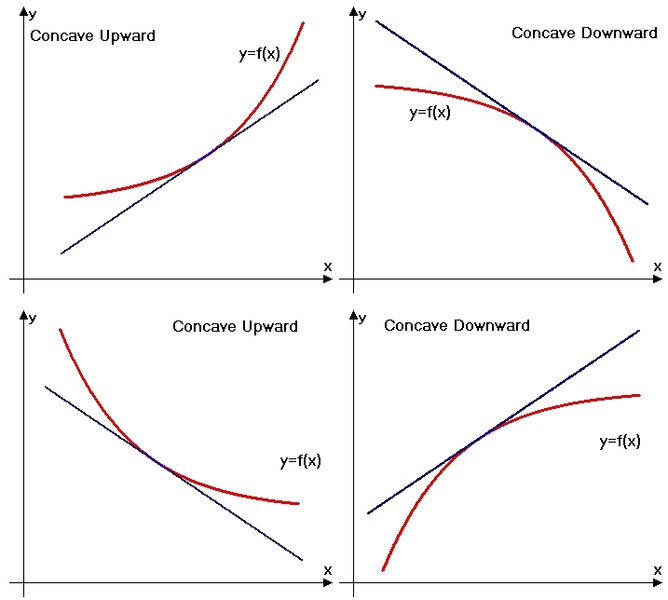
Concave up and concave down, shown with tangent lines
Quick grounding reminder:
- → function increasing
- → function decreasing
Now we care about whether itself is increasing or decreasing. That’s where the second derivative comes in.
The Second Derivative
The second derivative is just the derivative of the derivative:
It measures how the slope is changing.
What the sign of tells you
- → increasing → concave up
- → decreasing → concave down
- → possible change in concavity
On FRQs, graders want to see the logic spelled out. Not just “concave up,” but something like:
Since on the interval, the graph of is concave up there.
That explicit connection earns the point.
Finding Intervals of Concavity
When you’re given a formula, the process is mechanical but easy to mess up if you rush.
- Find .
- Find .
- Solve or find where it’s undefined.
- Use those values to split the number line.
- Test the sign of in each interval.
Example:
Let .
Set → .
Test intervals:
- Pick : → concave down
- Pick : → concave up
Conclusion:
- Concave down on
- Concave up on
Always give answers in interval notation.
Points of Inflection
A point of inflection is where the function changes concavity.
Two conditions must be met:
- or undefined
- changes sign at
Just solving only gives a candidate.
From the example above:
- changes from negative to positive at .
So there is an inflection point at
Students lose points when they forget to check for the sign change. The AP will absolutely give you a case where but concavity does not change.
Concavity from Graphs of or
You won’t always get a formula. Sometimes you get a graph.
If you’re given the graph of
Look at whether the derivative itself is rising or falling.
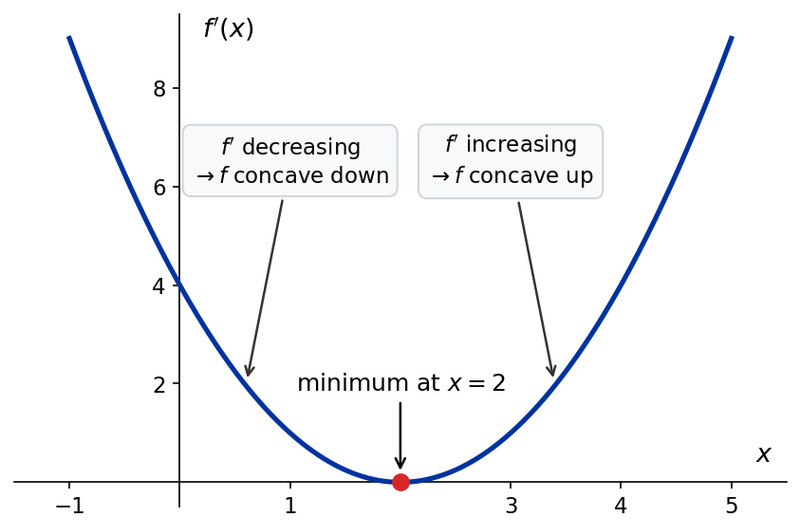
- Where is increasing, is concave up.
- Where is decreasing, is concave down.
You are watching the slope function rise or fall. In the graph above, decreases until and then increases, so changes from concave down to concave up at .
If you’re given the graph of
- Above the x-axis → concave up
- Below the x-axis → concave down
- Crossing with sign change → inflection point
When working from a graph, always reference the derivative’s behavior, not how the original graph “looks.”
