Topic 1.15 Notes – Connecting Limits at Infinity and Horizontal Asymptotes
1. Limits at Infinity and End Behavior
When you see
you are asking:
As gets very large (positive or negative), what does approach?
This is end behavior.
A few possibilities:
→ The function levels off toward a finite number .- or
→ The function grows or decreases without bound. - The function keeps bouncing around (like )
→ The limit does not exist (DNE).
Important:
You are not plugging in infinity. Infinity describes behavior, not a number.
Here’s what this looks like visually. In this example, the function approaches a horizontal line as and as .
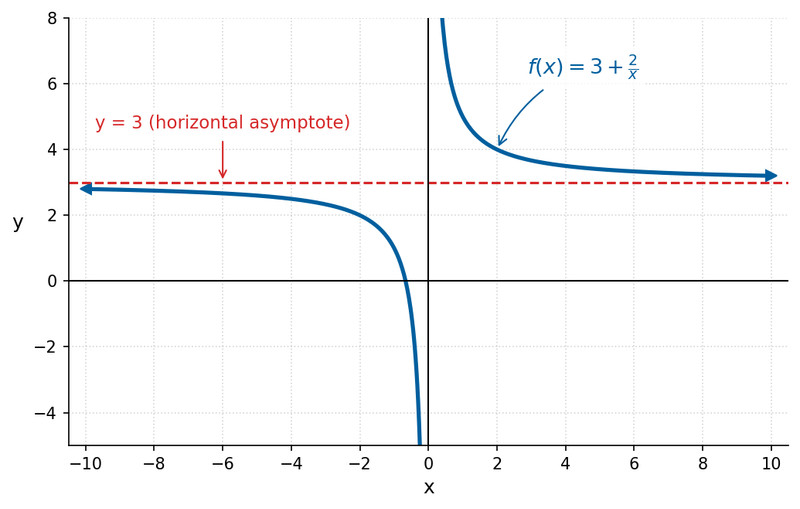
End behavior of
As gets large in either direction, the graph flattens toward . That flattening is what the limit at infinity captures.
2. Horizontal Asymptotes and What They Mean
A horizontal asymptote (HA) is a line that the function approaches as and/or .
The connection is direct:
- If , then is a horizontal asymptote (on the right).
- If , then is a horizontal asymptote (on the left).
A few truths students mix up:
- ✔️ A function can cross a horizontal asymptote.
- ✔️ The left and right limits can be different.
- ✔️ If the limit is not finite, there is no horizontal asymptote in that direction.
On multiple-choice questions, they love giving you a graph and asking for
.
Look at the left tail only. Don’t guess from the right side.
3. Finding Horizontal Asymptotes for Rational Functions
For a rational function
end behavior depends on the degrees of the polynomials.
Case 1: Degree of numerator < degree of denominator
- HA is
Example:
The in the denominator dominates.
Case 2: Degrees are equal
Keep only leading terms.
- HA is ratio of leading coefficients.
Example:
Lower terms become insignificant as grows.
Case 3: Degree of numerator > degree of denominator
The top grows faster.
- Limit is
- No horizontal asymptote
Example:
On free-response, justification usually means writing something like
“highest-degree terms dominate as .”
4. Comparing Growth Rates of Functions
Not all functions grow at the same speed.
From slowest to fastest:
That order explains many limits instantly.
Examples
Exponential beats polynomial → denominator wins.
Exponential in numerator grows much faster.
Lower power divided by higher power.
On calculator MCQs, recognizing growth rate saves time. No heavy algebra needed.
5. Special Cases and Common Errors
Oscillation
The function never settles to one value. No horizontal asymptote.
Squeeze-Type Behavior
The oscillation shrinks because it’s divided by something growing without bound.
Mistakes that cost points
- Thinking horizontal asymptotes can’t be crossed.
- Forgetting to check behavior as .
- Ignoring which term has the highest degree.
- Treating infinity like a number you can substitute.
