Topic 2.9 Notes – The Quotient Rule
The Quotient Rule
If and are differentiable and , then
Using shorter notation, if , then
Two pieces to lock into memory:
- Low d high minus high d low
- All over (denominator)²
“Low” means the denominator. “High” means the numerator.
The subtraction order matters. Switching it changes the sign of your answer.
What the Rule Is Actually Doing
When you differentiate a product, you add two pieces.
When you differentiate a quotient, you subtract two pieces and divide by the square of the denominator.
Here’s the structure visually. This is the full Quotient Rule in both form and form:
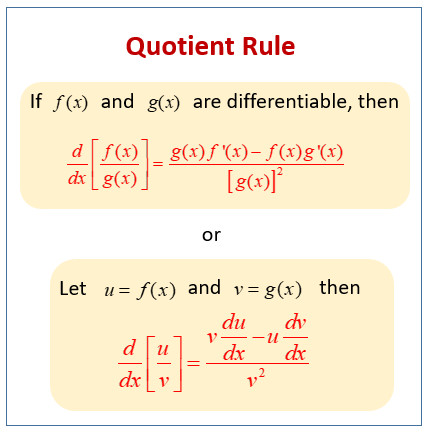
The Quotient Rule in standard notation
Notice:
- The denominator gets squared.
- The numerator keeps the original functions (not squared).
- You multiply before subtracting.
When to Use It vs When to Rewrite
Before jumping into the Quotient Rule, check the algebra.
Rewrite instead if:
- You can split the fraction:
- The denominator is a simple power:
- It’s just a constant multiple:
Rewriting often reduces errors and saves time on no-calculator sections.
Use the Quotient Rule if:
- It’s a true rational function (polynomial over polynomial).
- Rewriting makes things messier.
- You have trig or exponential expressions divided by something nontrivial.
Recognizing when to apply a rule is part of what this unit is testing.
Step-by-Step Example
Differentiate
- Identify
- Differentiate
- Apply the rule:
- Simplify numerator carefully:
On a free-response question, that simplified form is clean and complete. Full expansion beyond this is rarely necessary unless asked.
Mixing in Other Derivative Rules
The Quotient Rule wraps around other rules.
Example with trig
Notice:
- You still follow the same structure.
- Inside derivatives come from Power Rule or trig rules.
If something like appears, you’d use the Chain Rule when finding its derivative, but the outside structure stays the same.
Common Mistakes That Cost Points
- Reversing the order: writing .
- Forgetting to square the entire denominator.
- Dropping parentheses in the numerator, especially when subtracting.
- Expanding too fast and losing negative signs.
- Using the rule when simple algebra would eliminate the fraction.
On multiple-choice, sign errors are common trap answers. On FRQs, a small algebra mistake can cost the derivative point entirely.
