Topic 8.2 Notes – Connecting Position, Velocity, and Acceleration of Functions Using Integrals
Position, Velocity, and Acceleration in Rectilinear Motion
Rectilinear motion means motion along a straight line, described as functions of time .
We use:
So:
- Position tells you where the particle is.
- Velocity tells you how fast and in what direction it’s moving.
- Acceleration tells you how velocity is changing.
Integrals reverse those relationships:
And with definite integrals, you get accumulated change over an interval.
The three graphs below show how these ideas line up for the same moving object.
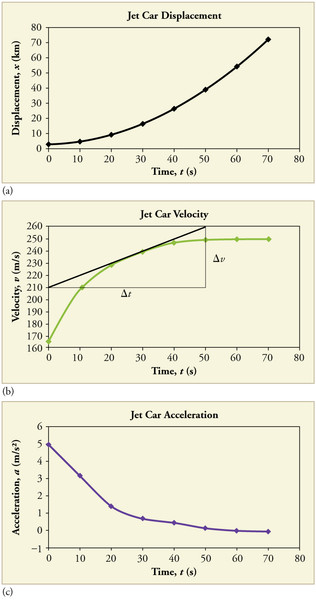
Position, velocity, and acceleration for the same motion
Look vertically across the panels. The slope of the position graph matches the velocity graph. The slope of the velocity graph matches the acceleration graph. The area under the acceleration curve gives change in velocity. The area under the velocity curve gives change in position.
Lock this in:
- Slope = derivative
- Area = accumulated change
That idea runs this entire topic.
Displacement vs Total Distance Traveled
These two are constantly tested together.
Displacement
Displacement is net change in position:
Important:
- It uses the signed area under the velocity curve.
- If velocity is negative, that area subtracts.
- Displacement can be zero even if the particle moved.
If a particle goes right 5 units and left 5 units, displacement is 0.
Total Distance Traveled
Distance measures the entire path length:
Key differences:
- Always positive.
- Uses the absolute value of velocity.
- You must split the integral at points where if the sign changes.
Example idea:
If on , velocity changes sign at .
You would compute:
On FRQs, students lose points by forgetting to split at sign changes. Always check where velocity equals zero.
Using Integrals to Move Between a, v, and s
Most questions give you one function and initial conditions.
From Velocity to Position
If you’re given :
- Displacement on :
- Position function:
Use a condition like to solve for .
Remember:
- Indefinite integral → family of functions.
- Definite integral → numerical change.
From Acceleration to Velocity
If given :
Use an initial velocity like to find .
Then integrate again to get position.
This layering matters:
- Acceleration accumulates into velocity.
- Velocity accumulates into position.
On calculator-active problems, you may not even need a formula. You might just evaluate definite integrals numerically to get velocity or displacement values.
Reading Motion from Graphs
AP loves graph interpretation.
From a Velocity Graph
- Area = displacement
- Total area (absolute value) = distance
- Above x-axis → moving right
- Below x-axis → moving left
- Slope of graph → acceleration
If velocity and acceleration have the same sign, the particle is speeding up. Opposite signs mean slowing down.
From an Acceleration Graph
- Area under curve = change in velocity
- Positive area → velocity increases
- Negative area → velocity decreases
Sometimes you build velocity step-by-step by accumulating areas over subintervals.
