Topic 8.7 Notes – Volumes with Cross Sections: Squares and Rectangles
Volume from Known Cross Sections
Imagine slicing a solid into infinitely thin pieces. Each slice has:
- Area
- Thickness or
Add them up with a definite integral:
What matters:
- is the area formula of the cross section
- The variable matches the slice direction
- The bounds come from the base region
Think of it as area-between-curves, but each “height” is now the area of a shape.
If slices are:
- Perpendicular to the x-axis → integrate with respect to
- Perpendicular to the y-axis → integrate with respect to
Types of Cross Sections on the AP Exam
Square Cross Sections
Area of a square:
The side length comes from the base region.
If using vertical slices:
If using horizontal slices:
So volume becomes:
The vertical segment represents the side of the square cross section.
One common mistake on quizzes is forgetting the parentheses:
Rectangular Cross Sections
Area of a rectangle:
Usually:
- One dimension comes from the distance between curves
- The other is:
- A constant
- A multiple of the base
- Another function
Example structure:
- Base region between and
- Rectangles perpendicular to the x-axis
- Height is 3 times the base
Then:
- Base
- Height
- Area
Volume:
Always identify which dimension comes from the region and which is given.
How to Set Up the Integral
When you see one of these on a test, the setup is everything.
Sketch the base region
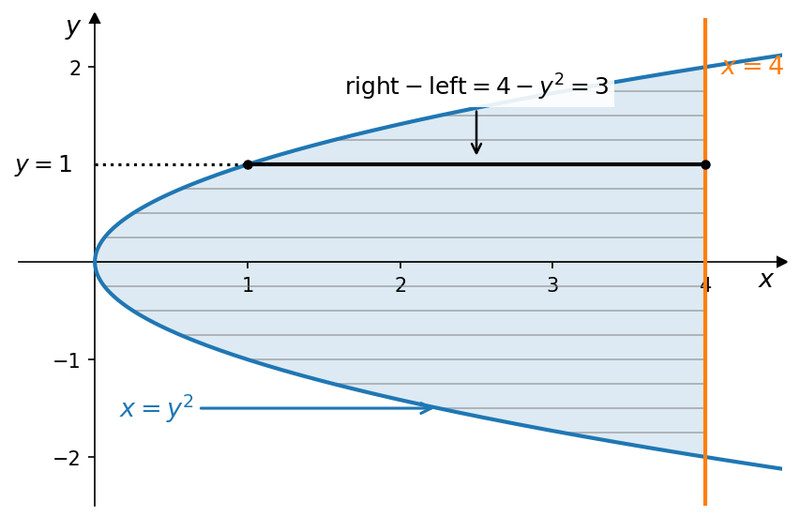
Region bounded by and with a horizontal slice (right − left)
Even rough sketches prevent direction mistakes. Notice how the slice is horizontal, so the distance is measured right − left.
Find bounds
- Solve intersections, or
- Use given boundary lines
Match slice direction to variable
- Perpendicular to x-axis →
- Perpendicular to y-axis →
Write the distance correctly
- Vertical slices → top − bottom
- Horizontal slices → right − left
(If integrating in , rewrite equations as something.)
Plug into the area formula
- Square → distance²
- Rectangle → width × height
Then integrate and evaluate.
Switching Between x and y
This is where students lose easy points.
If integrating with respect to :
- You measure horizontal distance
- Use right − left
- Rewrite equations as
If integrating with respect to :
- You measure vertical distance
- Use top − bottom
Your slice direction, distance expression, and variable must all agree. If one doesn’t match, the setup is wrong.
