Topic 7.6 Notes – Finding General Solutions Using Separation of Variables
What a General Solution to a Differential Equation Is
A differential equation is an equation that involves a function and its derivative, usually written as
A solution is a function that makes the equation true when you plug it in.
A general solution:
- Contains an arbitrary constant
- Represents a whole family of functions
- Comes from antidifferentiation, so it must include “+ C”
- Does not use an initial condition (that’s the next topic)
For example, if
then integrating gives
Every different value of gives a different curve.
Here’s what that family looks like visually:
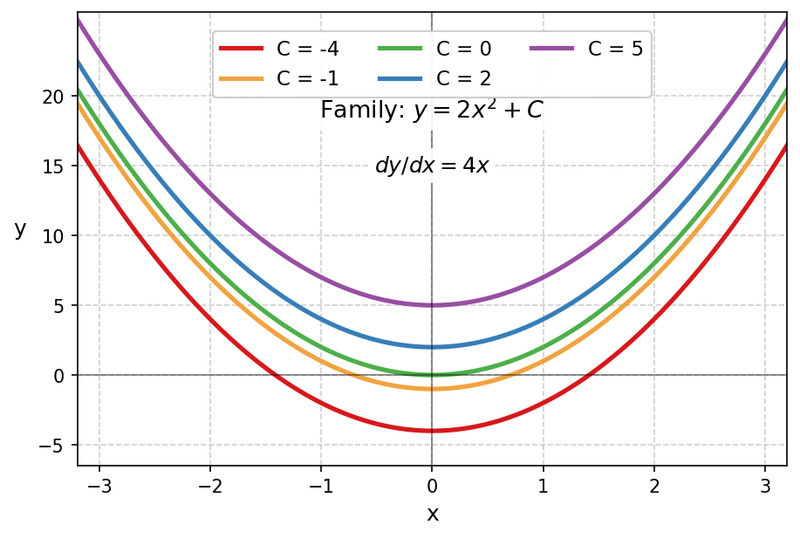
Family of solutions
All of those curves have derivative . That’s what makes them all solutions.
Separable Differential Equations
Some differential equations can be rewritten so that all the -stuff is on one side and all the -stuff is on the other.
A first-order equation is separable if it can be written as
That product structure is the clue.
If you can rearrange it into
then it’s separable.
Example that is separable:
You can rewrite it as:
Example that is not separable:
There’s no way to split that into pure times pure . On a quiz, recognizing when you can’t separate is just as important.
The Separation of Variables Process
Once it’s separable, the steps are mechanical but you need to be clean.
- Rewrite so it looks like .
- Separate variables
Move all ’s with , all ’s with . - Integrate both sides
- Add one constant
(You only need one. Combine constants.) - Solve for if possible.
Let’s walk one through.
Solve:
Separate:
Integrate:
Exponentiate:
Rewrite as a new constant:
That’s the general solution.
Integration Patterns That Show Up a Lot
Power rule forms
If you see or , use the power rule.
Be careful when dividing by .
, which gives a logarithm.
The situation
Two things students lose points on:
- Forgetting the absolute value
- Forgetting to exponentiate to solve for
If you get:
you almost always end with:
This structure shows up constantly on FRQs.
What This Looks Like on Tests
- On free response, you must show the separation and both integrals clearly.
- On multiple choice, they may give you four possible families and ask which satisfies the differential equation.
- Sometimes they test recognition by giving something that looks separable but isn’t.
Also, if you stop at an implicit answer when it’s easy to solve for , you may lose a point. Always check whether you can cleanly isolate .
