Topic 1.2 Notes – Defining Limits and Using Limit Notation
What a Limit Is
Here’s the core statement:
This means:
As gets arbitrarily close to (but not equal to ), the values of get arbitrarily close to .
Two phrases matter:
- Arbitrarily close → as close as we want.
- Near the point, not at the point → the limit is about behavior around , not necessarily the value at .
So three things can be true:
- The limit exists and equals .
- The function value might equal .
- Or might be different from , or even undefined.
Those are separate questions.
The AP does not test the epsilon-delta definition, but you should understand the idea: if you can make as close as you want to by choosing close enough to , the limit is .
Limit Notation and How to Read It
Read it naturally:
“The limit of as approaches is .”
Break it apart:
- → what input is approaching
- → the function
- The whole expression → the output value being approached
You’ll also see one-sided limits.
One-Sided Limits
Left-hand limit:
Right-hand limit:
The full limit exists only if:
If left and right disagree, the limit does not exist. On quizzes, this is one of the fastest ways to lose points.
Representing Limits Three Ways
AP expects you to move between symbolic, numerical, and graphical representations easily.
1. Analytical (Symbolic)
If the function is nice and continuous at , just substitute.
Example:
Polynomials are continuous. Plug in:
That’s it.
If substitution gives something weird like , that signals you need to simplify first. It usually means there’s a hole.
2. Numerical (Tables)
You pick values approaching from both sides and look for a pattern.
Example structure:
| x (left of c) | f(x) | x (right of c) | f(x) |
|---|---|---|---|
| 1.9 | 4.8 | 2.1 | 5.2 |
| 1.99 | 4.98 | 2.01 | 5.02 |
| 1.999 | 4.998 | 2.001 | 5.002 |
If both sides are getting closer to 5, then:
If one side trends toward 3 and the other toward 6, the limit does not exist.
On calculator sections, tables are common. Always check both sides.
3. Graphical
You trace the graph as approaches from left and right.
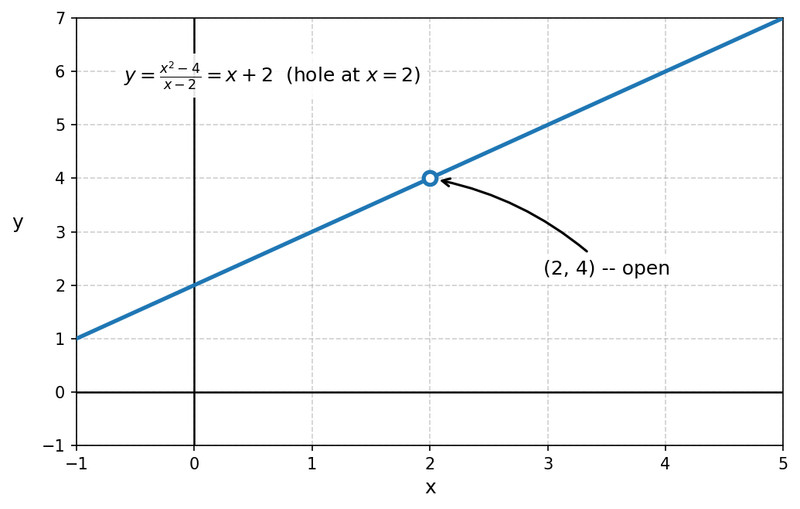
Here’s a classic removable discontinuity example.
Removable discontinuity with a hole at (2, 4)
The graph follows the line but has an open circle at . Even though there’s a hole at , the graph approaches 4 from both sides. So:
The limit exists even though the function is undefined at that point.
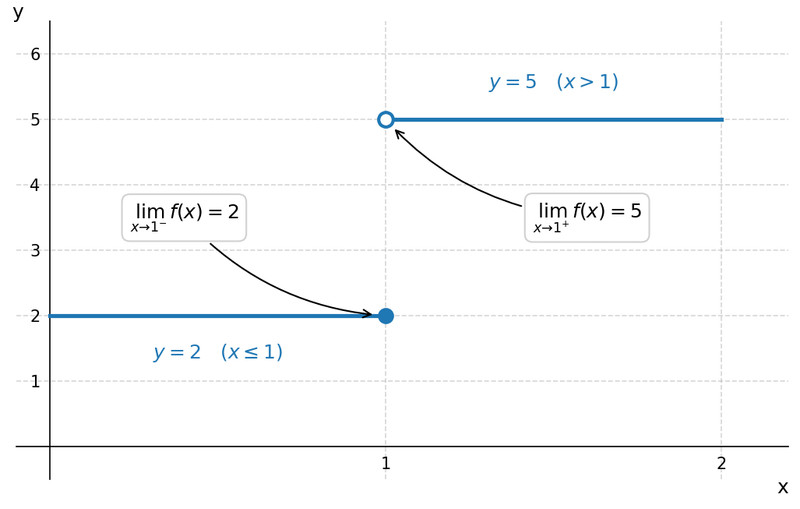
Now compare that with a jump discontinuity.
Jump discontinuity at x = 1
As , the graph approaches 2. As , it approaches 5. No agreement, so the limit does not exist.
What AP Really Cares About
You need to:
- Write limit notation correctly.
- Interpret what a limit statement is saying in words.
- Move between graph, table, and formula.
- Check left and right behavior when necessary.
If a question says “Explain why the limit exists,” they want reasoning like:
“The left-hand and right-hand limits both equal 4.”
That language earns points.
