Topic 2.6 Notes – Facilitated Diffusion
1. How Molecular Structure Determines Membrane Permeability
The plasma membrane is a phospholipid bilayer. Phospholipids have:
- Hydrophilic (polar) heads facing outward toward water
- Hydrophobic (nonpolar) tails facing inward
That creates a nonpolar interior, which acts like a barrier to many substances.
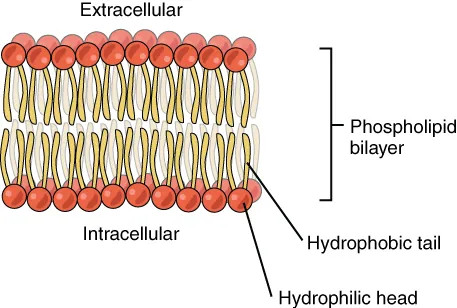
Phospholipid bilayer structure
In the diagram, notice the polar heads facing the extracellular and intracellular fluids, with the nonpolar tails forming the interior core of the membrane.
Whether something crosses easily depends on three things:
- Size
- Polarity
- Charge
a. Small Nonpolar Molecules
Examples: O₂, CO₂, N₂
- Nonpolar → dissolve in the hydrophobic interior
- Small → slip between phospholipids
- Cross by simple diffusion
- Move down their concentration gradient (high → low)
- No protein required
These move directly through the bilayer.
b. Large Polar Molecules
Examples: glucose, amino acids
- Polar → repelled by hydrophobic core
- Large → cannot squeeze through
- Require transport proteins
- Move by facilitated diffusion
- Still go high → low
- No ATP used
The membrane blocks them, so proteins provide a pathway.
c. Charged Ions
Examples: Na⁺, K⁺, Ca²⁺, Cl⁻
- Charged → strongly repelled by nonpolar interior
- Cannot cross alone
- Require channel proteins
- Move by facilitated diffusion (high → low)
- No ATP required
Here’s the pattern you should automatically think of:
- Small + nonpolar → simple diffusion
- Large + polar → facilitated diffusion
- Charged → channel protein required
When a question gives you a molecule, mentally check those three traits.
2. Passive Transport Mechanisms
All passive transport:
- Moves down the concentration gradient
- Requires no ATP
- Helps maintain dynamic homeostasis
Here’s how they compare:
| Type | Protein Required? | What Moves? | Example |
|---|---|---|---|
| Simple Diffusion | No | Small, nonpolar molecules | O₂ entering cells |
| Facilitated Diffusion | Yes (channels or carriers) | Large polar molecules, ions | Glucose transport |
| Osmosis | Usually (aquaporins) | Water | Water entering plant cells |
Even though facilitated diffusion and osmosis use proteins, they are still passive because movement is down the gradient.
Students sometimes see a protein and assume energy is involved. It’s the direction of movement, not the presence of a protein, that tells you whether ATP is used.
3. Transport Proteins in Facilitated Diffusion
Facilitated diffusion depends entirely on membrane proteins.
a. Channel Proteins
- Form hydrophilic pores
- Specific for certain ions
- Allow rapid movement
- Often gated (open or close in response to signals)
Ion Channels and Membrane Polarization
Ions like Na⁺ and K⁺ require channels. When they move across the membrane, they change the distribution of charge.
This can create membrane polarization, meaning:
- One side becomes more positive
- The other becomes more negative
The diagram below shows how Na⁺ and K⁺ channels open and close during resting potential, depolarization, and hyperpolarization, changing the membrane’s charge.
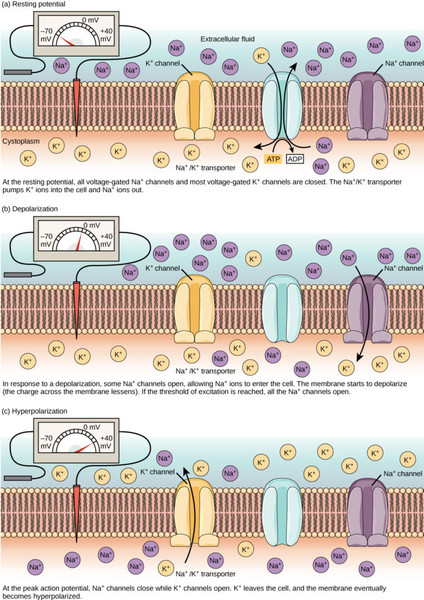
Resting potential, depolarization, and hyperpolarization in a neuron membrane
This electrical difference is essential for:
- Nerve impulses
- Muscle contraction
The AP exam loves giving you data about ion movement and asking how it affects membrane potential. If positive ions move into a cell, the inside becomes more positive.
b. Carrier (Transporter) Proteins
- Bind a specific molecule (like glucose)
- Undergo a conformational change
- Release the molecule on the other side
- Highly specific
- Still move down gradient
- No ATP used in facilitated diffusion
Channels are like tunnels. Carriers are like revolving doors.
4. Aquaporins and Water Movement
Water is small and polar. It can move slowly through the bilayer, but cells often need faster movement.
Aquaporins are specialized channel proteins that:
- Transport large quantities of water
- Increase membrane permeability to water
- Enable rapid osmosis
Water moves toward the area with higher solute concentration until equilibrium.
Aquaporins are critical in:
- Kidney function
- Plant water balance
- Maintaining cell volume
Even though aquaporins are proteins, this is still passive transport because water moves down its gradient.
5. Facilitated Diffusion vs Active Transport
This confusion shows up constantly.
| Feature | Facilitated Diffusion | Active Transport |
|---|---|---|
| Direction | High → Low | Low → High |
| ATP Used? | No | Yes |
| Purpose | Move substances efficiently | Create/maintain gradients |
| Example | Glucose transporter | Na⁺/K⁺ pump |
Active transport builds gradients. Facilitated diffusion uses them.
Key Takeaways
Facilitated Diffusion
Passive movement of polar molecules or ions through membrane proteins down their concentration gradient.
Large Polar Molecules and Membrane Passage
Large polar molecules cannot pass easily through the bilayer and move through transport proteins.
Concentration Gradient
A difference in substance concentration across space that drives net movement from high to low.
Membrane Polarization
An unequal distribution of electrical charge across a membrane caused by ion movement.
Aquaporins
Channel proteins that allow rapid movement of large quantities of water across membranes.
Simple Diffusion vs. Facilitated Diffusion
Simple diffusion crosses the bilayer directly; facilitated diffusion uses proteins, but both move down gradients.
Channel Proteins and Ion Passage
Membrane proteins form hydrophilic pathways that let charged ions cross the hydrophobic bilayer.
Passive Transport
Movement of substances across membranes down their concentration gradient without energy input.
Notes
Facilitated Diffusion
Passive movement of polar molecules or ions through membrane proteins down their concentration gradient.
Large Polar Molecules and Membrane Passage
Large polar molecules cannot pass easily through the bilayer and move through transport proteins.
Concentration Gradient
A difference in substance concentration across space that drives net movement from high to low.
Membrane Polarization
An unequal distribution of electrical charge across a membrane caused by ion movement.
Aquaporins
Channel proteins that allow rapid movement of large quantities of water across membranes.
Simple Diffusion vs. Facilitated Diffusion
Simple diffusion crosses the bilayer directly; facilitated diffusion uses proteins, but both move down gradients.
Channel Proteins and Ion Passage
Membrane proteins form hydrophilic pathways that let charged ions cross the hydrophobic bilayer.
Passive Transport
Movement of substances across membranes down their concentration gradient without energy input.
