Topic 8.2 Notes – Energy Flow Through Ecosystems
Energy Flow and Matter Cycling
Every level of biology in ecology connects to this idea, from a population of one species to a community of interacting species, an ecosystem with living and nonliving parts, and a biome at a large climate scale.
What organisms do with energy:
- Growth means making more biomass.
- Reproduction takes a lot of energy because making gametes, seeds, eggs, or offspring is costly.
- Homeostasis means keeping internal conditions stable, like body temperature or water balance.
- Organization means maintaining ordered biological structures instead of breaking down.
Energy balance matters:
- Net energy gain leads to stored energy, growth, and often more reproduction.
- Net energy loss leads to mass loss, lower reproductive output, and eventually death.
The core distinction you need to keep straight on tests:
- Energy flows through ecosystems and much of it leaves as heat.
- Matter cycles and is conserved, moving between organisms and the environment.
How Organisms Get and Use Energy
Autotrophs
Autotrophs make organic molecules using energy from nonliving sources, so they form the base of ecosystems.
- Photosynthetic autotrophs capture sunlight and convert it into chemical energy. This drives primary productivity, which is the rate at which producers store energy in organic molecules.
- Chemosynthetic autotrophs use energy from inorganic molecules. They can live where sunlight is absent, like deep-sea vent ecosystems.
Heterotrophs
Heterotrophs get energy by eating organic matter made by other organisms.
- They break down carbohydrates, lipids, and proteins for energy.
- They also use food as a source of matter, incorporating atoms from food into their own tissues.
Consumer roles
- Herbivores eat producers.
- Carnivores eat animals.
- Omnivores feed at multiple trophic levels.
- Scavengers eat dead organisms.
- Decomposers chemically break down dead organic matter and return matter to the environment.
Temperature and energy use
Body temperature strategy changes energy demand.
- Endotherms use metabolic heat to keep body temperature stable. That costs a lot of energy.
- Ectotherms depend mostly on external heat sources, so their energy demand is lower.
- Ectotherms often regulate temperature by basking, seeking shade, burrowing, or grouping together.
Trophic Levels and Energy Transfer
A trophic level is a feeding level in an ecosystem.
- Producers
- Primary consumers
- Secondary consumers
- Tertiary consumers
- Quaternary consumers
- Decomposers
A food chain shows one pathway of energy transfer. A food web shows many connected pathways. This aquatic example highlights producers, consumers, decomposers, and detritus feeders in the same system.
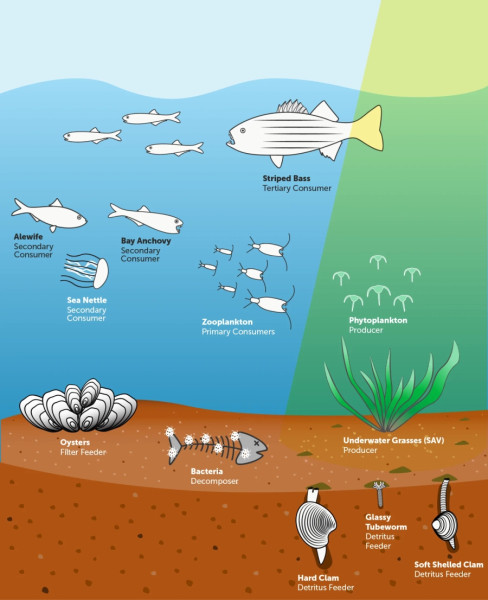
Aquatic food web and trophic levels
One very common AP trap is arrow direction. Arrows point toward the organism receiving energy.
Energy transfer pattern:
- About 10% of energy is transferred to the next trophic level on average.
- About 90% is lost, mostly as heat from metabolism, movement, and other life processes.
- Because of this, food chains usually have only 4 to 5 trophic levels.
- Biomass usually decreases at higher trophic levels.
If sunlight drops, producer biomass drops first. Then herbivores and predators usually decline after that.
The Four Major Biogeochemical Cycles
All four cycles have:
- Abiotic reservoirs such as air, water, soil, rocks
- Biotic reservoirs such as producers, consumers, decomposers
- Processes that move matter between them
Water cycle
Reservoirs include oceans, surface water, atmosphere, and living things.
Key processes:
- Evaporation
- Condensation
- Precipitation
- Transpiration
Carbon cycle
Carbon enters organisms as carbohydrates and returns to the atmosphere as carbon dioxide.
Four major processes:
- Photosynthesis
- Cellular respiration
- Decomposition
- Combustion
Nitrogen cycle
The atmosphere is the largest nitrogen reservoir, but most organisms cannot use directly. Soil microorganisms do the key conversions.
- Nitrogen fixation converts to , which becomes
- Assimilation brings or into plants
- Ammonification returns organic nitrogen to
- Nitrification converts to and then
- Denitrification converts back to
Phosphorus cycle
Phosphate comes mainly from weathering of rocks.
- Producers absorb
- Consumers get it by feeding
- It returns by excretion and decomposition
- There is no major atmospheric reservoir, which makes this cycle different from carbon and nitrogen
How Energy Availability Changes Ecosystems
Changes in available energy ripple upward through ecosystems.
- Energy available to producers changes
- Less sunlight means lower primary productivity.
- Producer biomass changes
- Fewer producers means less energy entering the food web.
- Consumer populations respond
- Herbivores decline first, then predators.
- Community structure shifts
- The number and size of trophic levels can change.
Energy availability also affects reproduction:
- Seasonal reproduction often matches times of abundant resources.
- Biennial plants store energy first, then reproduce later.
- Reproductive diapause pauses development during bad conditions.
- Some organisms switch between asexual and sexual reproduction depending on energy conditions.
Key Takeaways
Energy Flow Through Ecosystems
Energy enters as sunlight or chemicals, moves through trophic levels, and is lost as heat.
Trophic Levels
Feeding positions in a food chain or web based on how organisms obtain energy.
Autotrophs / Producers
Organisms that make organic molecules using energy from sunlight or inorganic chemicals.
Heterotrophs / Consumers
Organisms that obtain energy and carbon by eating other organisms or organic matter.
Consumer Types
Primary eat producers; secondary eat primary consumers; tertiary eat secondary; quaternary are top predators.
Decomposers, Scavengers, and Omnivores
Decomposers chemically break down dead matter; scavengers eat carcasses; omnivores eat plants and animals.
Food Chain and Food Web
A linear feeding path versus an interconnected network of feeding relationships in an ecosystem.
Trophic Pyramid / Energy Pyramid
A diagram showing decreasing available energy and usually decreasing biomass at higher feeding levels.
10% Rule
Only about one-tenth of energy at one trophic level becomes biomass in the next.
Biomass
The total mass of living organic matter in a given area or trophic level.
Primary Productivity
The rate at which autotrophs convert environmental energy into organic compounds.
Photosynthesis and Chemosynthesis
One uses sunlight to build organic molecules; the other uses energy from inorganic chemical reactions.
Endotherms and Ectotherms
One maintains body temperature with metabolic heat; the other relies mainly on external heat sources.
Behavioral Thermoregulation
Temperature control by changing behavior, such as basking, seeking shade, or clustering together.
Net Energy Gain and Net Energy Loss
Surplus energy supports storage, growth, and reproduction; deficit causes mass loss and eventual death.
Life-History Strategies
Patterns of growth, energy use, and reproduction shaped by environmental conditions and resource availability.
Seasonal Reproduction
Breeding timed so offspring develop when environmental conditions and resources are most favorable.
Biennial Plants
Plants that grow vegetatively one year, then flower, reproduce, and die the next.
Reproductive Diapause
A temporary pause in development or reproduction during unfavorable conditions to conserve energy.
Sexual and Asexual Reproduction in Response to Energy Availability
Low energy often favors asexual reproduction; abundant energy can support costlier sexual reproduction.
Ecological Levels of Organization
Population is one species, community is interacting species, ecosystem includes abiotic factors, biome is a major region.
Biogeochemical Cycles
Pathways that move matter between organisms and abiotic reservoirs while conserving atoms.
Abiotic and Biotic Reservoirs
Nonliving storage sites like air, water, and rocks versus living organisms that temporarily store matter.
Carbon Cycle
Carbon moves through photosynthesis, respiration, decomposition, and combustion between organisms and the environment.
Nitrogen Cycle Processes
Fixation makes NH3/NH4+, assimilation builds biomass, ammonification returns NH4+, nitrification makes NO2-/NO3-, denitrification makes N2.
Phosphorus Cycle
Weathering releases phosphate from rocks, organisms incorporate it, and decomposition returns it to soil and water.
Population Effects of Energy Availability
More available energy can increase population size, while less energy reduces survival and reproduction.
Bottom-Up Effects
Changes in producer energy capture or abundance alter all higher trophic levels above them.
Producer Biomass and Trophic Level Size
Higher producer biomass supports more consumers, while producer declines shrink upper trophic levels.
Food Chain Length
The number of trophic transfers in a feeding pathway, limited by energy loss at each step.
Hydrologic Cycle
Water moves among oceans, atmosphere, surface water, and organisms by evaporation, condensation, precipitation, and transpiration.
Nitrogen Cycle
Nitrogen cycles through atmosphere, soil, and organisms, with the atmosphere as the largest reservoir.
Cellular Respiration
Cells break down organic molecules to release energy and return carbon dioxide to the environment.
Notes
Energy Flow Through Ecosystems
Energy enters as sunlight or chemicals, moves through trophic levels, and is lost as heat.
Trophic Levels
Feeding positions in a food chain or web based on how organisms obtain energy.
Autotrophs / Producers
Organisms that make organic molecules using energy from sunlight or inorganic chemicals.
Heterotrophs / Consumers
Organisms that obtain energy and carbon by eating other organisms or organic matter.
Consumer Types
Primary eat producers; secondary eat primary consumers; tertiary eat secondary; quaternary are top predators.
Decomposers, Scavengers, and Omnivores
Decomposers chemically break down dead matter; scavengers eat carcasses; omnivores eat plants and animals.
Food Chain and Food Web
A linear feeding path versus an interconnected network of feeding relationships in an ecosystem.
Trophic Pyramid / Energy Pyramid
A diagram showing decreasing available energy and usually decreasing biomass at higher feeding levels.
10% Rule
Only about one-tenth of energy at one trophic level becomes biomass in the next.
Biomass
The total mass of living organic matter in a given area or trophic level.
Primary Productivity
The rate at which autotrophs convert environmental energy into organic compounds.
Photosynthesis and Chemosynthesis
One uses sunlight to build organic molecules; the other uses energy from inorganic chemical reactions.
Endotherms and Ectotherms
One maintains body temperature with metabolic heat; the other relies mainly on external heat sources.
Behavioral Thermoregulation
Temperature control by changing behavior, such as basking, seeking shade, or clustering together.
Net Energy Gain and Net Energy Loss
Surplus energy supports storage, growth, and reproduction; deficit causes mass loss and eventual death.
Life-History Strategies
Patterns of growth, energy use, and reproduction shaped by environmental conditions and resource availability.
Seasonal Reproduction
Breeding timed so offspring develop when environmental conditions and resources are most favorable.
Biennial Plants
Plants that grow vegetatively one year, then flower, reproduce, and die the next.
Reproductive Diapause
A temporary pause in development or reproduction during unfavorable conditions to conserve energy.
Sexual and Asexual Reproduction in Response to Energy Availability
Low energy often favors asexual reproduction; abundant energy can support costlier sexual reproduction.
Ecological Levels of Organization
Population is one species, community is interacting species, ecosystem includes abiotic factors, biome is a major region.
Biogeochemical Cycles
Pathways that move matter between organisms and abiotic reservoirs while conserving atoms.
Abiotic and Biotic Reservoirs
Nonliving storage sites like air, water, and rocks versus living organisms that temporarily store matter.
Carbon Cycle
Carbon moves through photosynthesis, respiration, decomposition, and combustion between organisms and the environment.
Nitrogen Cycle Processes
Fixation makes NH3/NH4+, assimilation builds biomass, ammonification returns NH4+, nitrification makes NO2-/NO3-, denitrification makes N2.
Phosphorus Cycle
Weathering releases phosphate from rocks, organisms incorporate it, and decomposition returns it to soil and water.
Population Effects of Energy Availability
More available energy can increase population size, while less energy reduces survival and reproduction.
Bottom-Up Effects
Changes in producer energy capture or abundance alter all higher trophic levels above them.
Producer Biomass and Trophic Level Size
Higher producer biomass supports more consumers, while producer declines shrink upper trophic levels.
Food Chain Length
The number of trophic transfers in a feeding pathway, limited by energy loss at each step.
Hydrologic Cycle
Water moves among oceans, atmosphere, surface water, and organisms by evaporation, condensation, precipitation, and transpiration.
Nitrogen Cycle
Nitrogen cycles through atmosphere, soil, and organisms, with the atmosphere as the largest reservoir.
Cellular Respiration
Cells break down organic molecules to release energy and return carbon dioxide to the environment.
