Topic 7.4 Notes – Population Genetics
1. Evolution as Change in Allele Frequencies
In AP Bio, evolution = change in allele frequencies in a population over time.
Break that down clearly:
- Population = members of the same species living in the same area.
- Gene pool = all the alleles present in that population.
- Allele frequency = proportion of a specific allele in the gene pool (for example, 0.3 or 30%).
If the frequency of an allele changes from one generation to the next, evolution has occurred. That’s it. No requirement that the trait is helpful.
One of the most common mistakes is saying “the organism evolved.” Individuals don’t evolve. They either survive or don’t. Populations evolve.
And those changes do not have to be caused by natural selection. Random processes can shift allele frequencies too.
2. The Random Forces That Change Allele Frequencies
Mutation - the source of new alleles
A mutation is a random change in DNA sequence.
Key facts:
- Only source of new genetic variation
- Happens during DNA replication or from environmental damage
- Usually neutral
- Sometimes harmful
- Rarely beneficial
Mutation does not “try” to improve a species. It simply creates new alleles. Natural selection can later act on the phenotypes those alleles produce.
On exams, if you’re asked where variation originally comes from, the answer is mutation.
Genetic Drift - chance changes in allele frequency
Genetic drift is a random change in allele frequencies due to chance, not fitness.
Why it happens:
- Reproduction is random sampling of alleles.
- Small populations exaggerate sampling error.
Think coin flips. Flip a coin 10 times, you might get 7 heads. Flip it 10,000 times, you’ll be closer to 50/50.
Genetic drift can:
- Eliminate alleles entirely
- Fix alleles (frequency becomes 1.0)
- Reduce genetic diversity
- Increase harmful alleles by chance
It is strongest in small populations and can overpower natural selection there.
Bottleneck Effect
The bottleneck effect is genetic drift caused by a drastic population reduction.
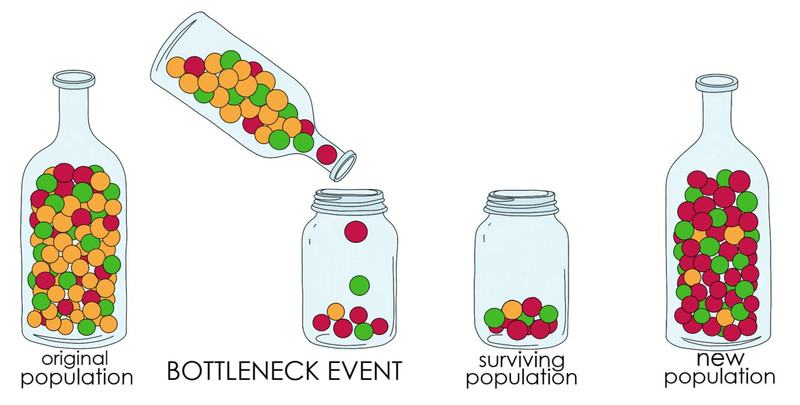
Bottleneck effect reducing genetic variation
In the diagram, notice how the original population contains many different colored alleles. After the bottleneck event, only a few colors make it through to the surviving population.
After a disaster:
- Only a small sample of alleles remains.
- Genetic diversity drops sharply.
- Inbreeding increases.
- Adaptive potential decreases.
Even if population size rebounds, the lost variation does not magically return.
Founder Effect
The founder effect occurs when a small group separates and forms a new population.
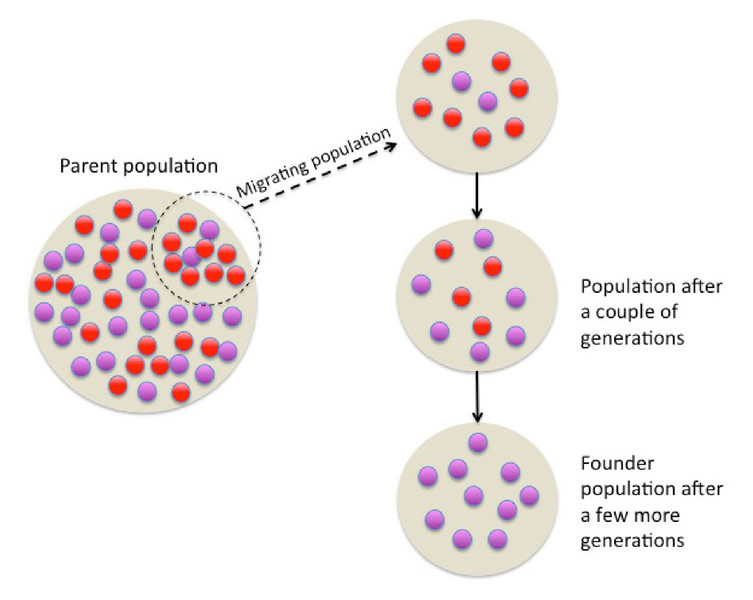
Founder effect from a small migrating group
In the image, a small migrating group leaves the parent population. Because that group carries only some of the original alleles, the new population ends up with a different allele balance after a few generations.
Important points:
- New population reflects the founders’ alleles.
- Rare alleles can become common.
- Genetic variation is reduced.
- The new population may diverge quickly.
This often happens with island colonization or geographic isolation and can contribute to speciation.
Gene Flow
Gene flow is the movement of alleles between populations through migration of individuals or gametes.
Effects:
- Increases genetic variation within a population.
- Decreases genetic differences between populations.
- Can prevent speciation by keeping populations genetically similar.
Gene flow works against divergence caused by drift.
3. Population Size and Random Change
Here’s the pattern you need to internalize:
| Population Size | Effect of Genetic Drift | Impact on Variation |
|---|---|---|
| Small | Strong fluctuations in allele frequencies | High chance of allele loss; drift can override selection |
| Large | Minor random fluctuations | Allele frequencies more stable; selection more effective |
Smaller population → stronger random effects.
This shows up constantly in data analysis questions.
4. Random Processes and Divergence
Random processes can:
- Change allele frequencies without improving adaptation.
- Reduce variation within a population.
- Increase differences between isolated populations.
Here’s how they connect:
- Mutation introduces new alleles.
- Genetic drift randomly shifts their frequencies.
- Isolation + drift → populations diverge.
- Gene flow reconnects populations and slows divergence.
If gene flow stops and drift continues, populations can become genetically distinct enough to eventually form separate species.
Key Takeaways
Allele Frequency
The proportion of a specific allele among all alleles for a gene in a population.
Gene Pool
All alleles present in all individuals of a population.
Mutation
A random change in DNA sequence that creates new alleles.
Point Mutations and Chromosomal Mutations
Point mutations alter one base pair; chromosomal mutations change larger chromosome segments or arrangement.
Genetic Variation
Differences in alleles among individuals in a population.
Genetic Drift
Random changes in allele frequencies caused by chance, especially in small populations.
Bottleneck Effect
Genetic drift after a drastic population reduction leaves survivors with only a small sample of alleles.
Founder Effect
Genetic drift when a few isolated individuals start a new population with limited alleles.
Population Size and Genetic Drift
Smaller populations experience stronger random allele frequency changes than larger populations.
Random Sampling of Alleles
Chance transmission of alleles to offspring can shift frequencies between generations.
Gene Flow and Speciation
Ongoing allele exchange between populations can prevent them from becoming separate species.
Population Genetics and Evolution
Studies how allele frequencies in populations change across generations, which defines evolution.
Gene Flow
Movement of alleles between populations that increases variation and reduces population differences.
Notes
Allele Frequency
The proportion of a specific allele among all alleles for a gene in a population.
Gene Pool
All alleles present in all individuals of a population.
Mutation
A random change in DNA sequence that creates new alleles.
Point Mutations and Chromosomal Mutations
Point mutations alter one base pair; chromosomal mutations change larger chromosome segments or arrangement.
Genetic Variation
Differences in alleles among individuals in a population.
Genetic Drift
Random changes in allele frequencies caused by chance, especially in small populations.
Bottleneck Effect
Genetic drift after a drastic population reduction leaves survivors with only a small sample of alleles.
Founder Effect
Genetic drift when a few isolated individuals start a new population with limited alleles.
Population Size and Genetic Drift
Smaller populations experience stronger random allele frequency changes than larger populations.
Random Sampling of Alleles
Chance transmission of alleles to offspring can shift frequencies between generations.
Gene Flow and Speciation
Ongoing allele exchange between populations can prevent them from becoming separate species.
Population Genetics and Evolution
Studies how allele frequencies in populations change across generations, which defines evolution.
Gene Flow
Movement of alleles between populations that increases variation and reduces population differences.
