Topic 2.5 Notes – Membrane Transport
1. Selective Permeability and Concentration Gradients
The plasma membrane is a phospholipid bilayer with a hydrophobic interior. That hydrophobic core is the gatekeeper. It blocks most charged and polar substances while allowing some small nonpolar molecules to slip through.
Selective permeability means:
- Some substances cross easily.
- Others need specific transport proteins.
- This allows the cell to keep its internal conditions different from outside.
That difference creates something powerful: a concentration gradient.
A concentration gradient is simply a difference in concentration across space, often across a membrane.
Why gradients matter:
- They store potential energy.
- They drive passive transport.
- Cells often use ATP to build them in the first place.
If a question shows ions more concentrated on one side of a membrane, your brain should immediately think “stored energy.”
What Can and Cannot Cross the Membrane
| Molecule Type | Examples | Cross Alone? | Needs Protein? |
|---|---|---|---|
| Small nonpolar | O₂, CO₂, N₂ | Yes (simple diffusion) | No |
| Small polar (uncharged) | H₂O | Slowly | Usually (aquaporins) |
| Large polar | Glucose, amino acids | No | Yes |
| Ions (charged) | Na⁺, K⁺, Cl⁻, Ca²⁺ | No | Yes |
The hydrophobic fatty acid tails are what block ions and large polar molecules. Charge and size are everything here.
2. Passive Transport Moves Down the Gradient
Passive transport is net movement from high → low concentration with no ATP required. The gradient itself provides the energy.
Types of Passive Transport
Simple diffusion
- Directly through the bilayer
- Only small nonpolar molecules
- Continues until equilibrium (no net movement)
Facilitated diffusion
- Uses channel or carrier proteins
- Still high → low
- Protein provides a hydrophilic pathway
Channel proteins form pores.
Carrier proteins change shape to move the molecule.
Compare the two side by side below. On the left, molecules pass directly through the phospholipid bilayer. On the right, they move through a membrane protein.

Simple diffusion vs. facilitated diffusion across a cell membrane
Osmosis and Tonicity
Osmosis is diffusion of water across a selectively permeable membrane.
Water moves toward the side with higher solute concentration.
That wording trips people up. It helps to think: water moves where there is less free water.
| Solution Type | Solute Outside Cell | Water Movement | Cell Result |
|---|---|---|---|
| Isotonic | Equal | No net movement | Normal |
| Hypertonic | Higher outside | Out of cell | Shrinks |
| Hypotonic | Lower outside | Into cell | Swells |
On exams, they love giving you data showing cell mass increasing or decreasing. Increased mass means water entered. Always connect it to relative solute concentration.
3. Active Transport Moves Against the Gradient
Active transport moves substances low → high concentration and requires energy, usually ATP.
It uses membrane proteins called pumps.
How It Works
- Molecule binds to pump.
- ATP is hydrolyzed.
- Protein changes shape.
- Molecule is moved across.
- Protein resets.
Active transport builds gradients. Passive transport uses them.
Sodium-Potassium Pump
This is the classic example. The diagram below walks through one full cycle of the pump embedded in the membrane.
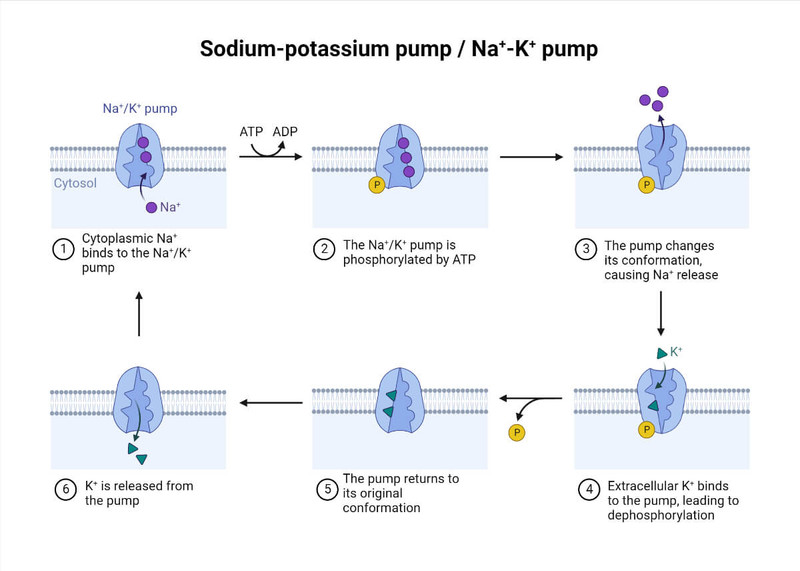
Sodium-potassium pump cycle
- 3 Na⁺ out
- 2 K⁺ in
- Uses ATP
- Maintains membrane potential
If you see nerve signaling or membrane voltage in a question, think ion gradients maintained by active transport.
4. Bulk Transport of Large Molecules
Large particles cannot fit through proteins. The cell moves them using vesicles, which requires energy.
Endocytosis (into the cell)
The membrane folds inward and pinches off.
Types:
- Phagocytosis: “cell eating” large particles (like bacteria).
- Pinocytosis: non-specific uptake of fluid.
- Receptor-mediated endocytosis: specific binding to receptors before vesicle forms (like cholesterol uptake).
Exocytosis (out of the cell)
- Vesicle fuses with membrane.
- Contents released outside.
- Used for hormones, neurotransmitters, digestive enzymes.
Both processes:
- Require ATP.
- Change membrane surface area.
- Are essential for communication and secretion.
5. How Cells Maintain Solute and Water Balance
Cells coordinate everything:
- Selective permeability allows gradients to exist.
- Active transport builds and maintains gradients.
- Passive transport allows controlled movement down gradients.
- Osmosis regulates water.
- Bulk transport handles large materials.
Cell Walls and Water Balance
In plants, fungi, and bacteria, the cell wall provides structure and prevents bursting in hypotonic environments.
Composition varies:
- Plants: cellulose
- Fungi: chitin
- Bacteria: peptidoglycan
The wall is protective but not selectively permeable like the membrane. The plasma membrane still controls solute movement.
Key Takeaways
Selective Permeability
Membrane property that allows some substances to cross more easily than others.
Concentration Gradient
A difference in a substance's concentration across space or across a membrane.
Osmosis
Diffusion of water across a selectively permeable membrane toward the side with higher solute concentration.
Passive Transport
Net movement of substances down their concentration gradient without direct energy input.
Active Transport
Movement of substances across a membrane using energy, often against their concentration gradient.
Transport Proteins
Membrane proteins that move specific substances across the bilayer through channels, carriers, or pumps.
Aquaporins
Channel proteins that allow rapid movement of water across cell membranes.
Sodium-Potassium Pump
ATP-powered membrane pump that exports Na+ and imports K+ against their gradients.
Membrane Permeability by Molecule Type
Small nonpolar cross freely; water crosses slowly or via aquaporins; large polar molecules and ions need proteins.
Cell Wall and Membrane Transport
Rigid outer layer that provides support and filtering, while the plasma membrane remains the selective barrier.
Diffusion
Passive movement of molecules from high to low concentration, directly or through transport proteins.
Endocytosis and Exocytosis
Energy-requiring vesicle transport moves materials into cells by endocytosis and out by exocytosis.
Tonicity
The relative solute concentration that determines water movement across a selectively permeable membrane.
Notes
Selective Permeability
Membrane property that allows some substances to cross more easily than others.
Concentration Gradient
A difference in a substance's concentration across space or across a membrane.
Osmosis
Diffusion of water across a selectively permeable membrane toward the side with higher solute concentration.
Passive Transport
Net movement of substances down their concentration gradient without direct energy input.
Active Transport
Movement of substances across a membrane using energy, often against their concentration gradient.
Transport Proteins
Membrane proteins that move specific substances across the bilayer through channels, carriers, or pumps.
Aquaporins
Channel proteins that allow rapid movement of water across cell membranes.
Sodium-Potassium Pump
ATP-powered membrane pump that exports Na+ and imports K+ against their gradients.
Membrane Permeability by Molecule Type
Small nonpolar cross freely; water crosses slowly or via aquaporins; large polar molecules and ions need proteins.
Cell Wall and Membrane Transport
Rigid outer layer that provides support and filtering, while the plasma membrane remains the selective barrier.
Diffusion
Passive movement of molecules from high to low concentration, directly or through transport proteins.
Endocytosis and Exocytosis
Energy-requiring vesicle transport moves materials into cells by endocytosis and out by exocytosis.
Tonicity
The relative solute concentration that determines water movement across a selectively permeable membrane.
