Topic 1.6 Notes – Nucleic Acids
What Nucleic Acids Are
Nucleic acids are macromolecules made of repeating subunits called nucleotides. Their core job is to store, transmit, and express genetic information.
There are two types:
- DNA (deoxyribonucleic acid)
- Long-term information storage
- Found in chromosomes
- RNA (ribonucleic acid)
- Carries and helps use that information
- Central in protein synthesis
A gene is a specific segment of DNA with a particular nucleotide sequence that codes for a functional product, usually a protein.
The key idea for this whole topic:
The order of nucleotides is the biological instruction manual of the cell.
Change the sequence → change the instructions → change the protein → change the trait.
The Structure of a Nucleotide
All nucleic acids are built from nucleotides, and each nucleotide has three parts.
1. Five-Carbon Sugar
- DNA → deoxyribose
- RNA → ribose
- Carbons are numbered 1′ to 5′
- 3′ carbon has a hydroxyl group (-OH)
- 5′ carbon attaches to a phosphate group
You don’t need to memorize the full chemical structure for AP, but you must understand the 3′ and 5′ positions because they determine strand direction.
2. Phosphate Group
- Links nucleotides together via covalent phosphodiester bonds
- Forms part of the sugar-phosphate backbone
These covalent bonds are strong. They hold each strand together.
3. Nitrogenous Base
There are five total bases:
- Adenine (A)
- Guanine (G)
- Cytosine (C)
- Thymine (T) - DNA only
- Uracil (U) - RNA only
Two categories:
- Purines (double ring): A, G
- Pyrimidines (single ring): C, T, U
A purine always pairs with a pyrimidine. That keeps the width of DNA consistent.
DNA and RNA Structure
Linear Sequence and Directionality
Nucleotides form a linear chain, but it’s not random. The strand has direction.
- 5′ end → free phosphate
- 3′ end → free -OH
New nucleotides are always added to the 3′ end during synthesis.
So strands grow 5′ → 3′.
Here’s what that orientation looks like at the level of a single nucleotide and its sugar carbons:
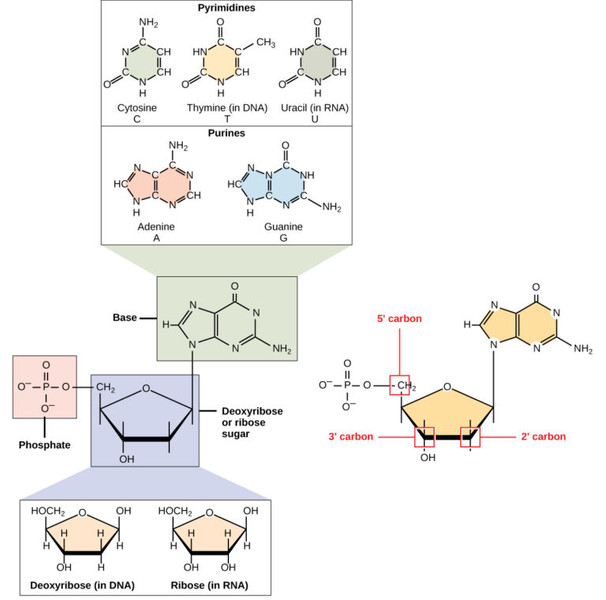
If you see a question about replication or transcription direction, this is what it’s testing. Always identify the 5′ and 3′ ends first.
DNA Structure
DNA is:
- Double-stranded
- Twisted into a double helix
- Antiparallel
Antiparallel means:
- One strand runs 5′ → 3′
- The other runs 3′ → 5′
Base pairing follows specific rules (Chargaff’s rule):
- A pairs with T (2 hydrogen bonds)
- G pairs with C (3 hydrogen bonds)
Hydrogen bonds hold the two strands together.
Covalent bonds hold each strand together.
Here’s the overall structure, including the antiparallel 5′ and 3′ ends and complementary base pairing:
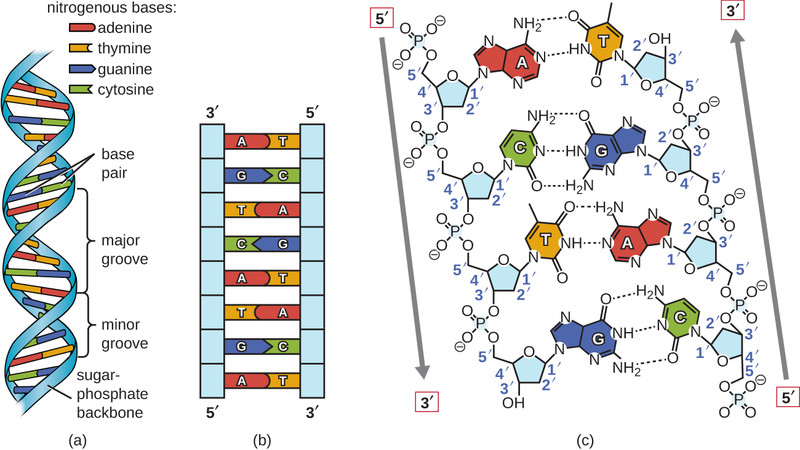
Consequences you must know:
- %A = %T
- %G = %C
- The sequence of one strand determines the other.
If an MCQ gives base percentages, use those equalities.
RNA Structure
RNA is usually:
- Single-stranded
- Has a sugar-phosphate backbone
- Uses uracil instead of thymine
Base pairing:
- A pairs with U
- G pairs with C
Three major types:
- mRNA - carries instructions from DNA
- tRNA - brings amino acids
- rRNA - structural part of ribosomes
Even though RNA is single-stranded, it can fold and base-pair with itself.
Structural Differences Between DNA and RNA
| Feature | DNA | RNA |
|---|---|---|
| Sugar | Deoxyribose (one less oxygen) | Ribose |
| Bases | A, T, G, C | A, U, G, C |
| Strands | Usually double-stranded | Usually single-stranded |
| Function | Long-term information storage | Information transfer and protein synthesis roles |
DNA is more chemically stable, which makes it ideal for long-term storage.
RNA is more reactive and flexible, which makes it useful for temporary messages and functional roles.
How Nucleic Acids Store and Transmit Information
Everything comes back to sequence.
Information Storage
- The sequence of bases encodes instructions.
- Groups of three bases (codons, later topic) specify amino acids.
- Changing the base sequence can change the protein’s structure and function.
This is where mutations matter. A single base change can alter a trait.
Complementary Base Pairing Preserves Information
During DNA replication:
- The two strands separate.
- Each serves as a template.
- Complementary base pairing ensures accurate copying.
Because A only pairs with T and G only with C, the sequence is reliably preserved.
When the AP gives you an experiment about replication errors, think about how base pairing maintains fidelity.
Flow of Genetic Information
The overall direction of information flow is:
DNA → RNA → Protein
- DNA stores the information.
- RNA carries and helps interpret it.
- Proteins carry out most cellular functions.
The structure of nucleic acids makes this flow possible.
Key Takeaways
Nucleic Acids
Polymers of nucleotides that store and transmit hereditary information as DNA or RNA.
Nucleotide
A monomer made of a five-carbon sugar, phosphate group, and nitrogenous base.
DNA and RNA
DNA usually has deoxyribose, thymine, and two strands; RNA usually has ribose, uracil, and one strand.
Nitrogenous Bases
Adenine, guanine, cytosine, thymine, and uracil are the base components of nucleotides.
Purines and Pyrimidines
Purines are adenine and guanine; pyrimidines are cytosine, thymine, and uracil.
Sugar-Phosphate Backbone
Alternating sugars and phosphates form the covalently bonded outer framework of a nucleic acid strand.
5 Prime and 3 Prime Ends
Strand direction is defined by a 5' phosphate end and a 3' hydroxyl end.
Phosphodiester Bond Formation
Adjacent nucleotides are joined by covalent bonds when new nucleotides are added to the 3' end.
Antiparallel Double Helix
Two DNA strands run in opposite 5' to 3' directions and twist around each other.
Complementary Base Pairing
A pairs with T in DNA or U in RNA, and C pairs with G.
Hydrogen Bonds in Base Pairs
A-T and A-U form two hydrogen bonds, while C-G forms three hydrogen bonds.
Chargaff's Rule
In double-stranded DNA, the amount of adenine equals thymine and guanine equals cytosine.
Gene
A DNA sequence that contains instructions for making a specific protein or functional product.
Types of RNA
mRNA carries coding information, tRNA brings amino acids, and rRNA forms part of ribosomes.
Functions of DNA and RNA
DNA stores hereditary information, while RNA helps transmit and express that information.
Notes
Nucleic Acids
Polymers of nucleotides that store and transmit hereditary information as DNA or RNA.
Nucleotide
A monomer made of a five-carbon sugar, phosphate group, and nitrogenous base.
DNA and RNA
DNA usually has deoxyribose, thymine, and two strands; RNA usually has ribose, uracil, and one strand.
Nitrogenous Bases
Adenine, guanine, cytosine, thymine, and uracil are the base components of nucleotides.
Purines and Pyrimidines
Purines are adenine and guanine; pyrimidines are cytosine, thymine, and uracil.
Sugar-Phosphate Backbone
Alternating sugars and phosphates form the covalently bonded outer framework of a nucleic acid strand.
5 Prime and 3 Prime Ends
Strand direction is defined by a 5' phosphate end and a 3' hydroxyl end.
Phosphodiester Bond Formation
Adjacent nucleotides are joined by covalent bonds when new nucleotides are added to the 3' end.
Antiparallel Double Helix
Two DNA strands run in opposite 5' to 3' directions and twist around each other.
Complementary Base Pairing
A pairs with T in DNA or U in RNA, and C pairs with G.
Hydrogen Bonds in Base Pairs
A-T and A-U form two hydrogen bonds, while C-G forms three hydrogen bonds.
Chargaff's Rule
In double-stranded DNA, the amount of adenine equals thymine and guanine equals cytosine.
Gene
A DNA sequence that contains instructions for making a specific protein or functional product.
Types of RNA
mRNA carries coding information, tRNA brings amino acids, and rRNA forms part of ribosomes.
Functions of DNA and RNA
DNA stores hereditary information, while RNA helps transmit and express that information.
