Topic 4.2 Notes – Introduction to Signal Transduction
1. Signal Transduction Pathways
Cells are constantly receiving information. A signal transduction pathway connects the moment a signal is detected to the final cellular effect.
All pathways follow three core steps:
- Reception
A signaling molecule binds to a receptor. - Transduction
The signal is relayed through a series of intracellular changes, often involving multiple proteins. - Response
The cell changes its behavior. This could mean altering gene expression, activating enzymes, secreting molecules, or triggering growth.
The diagram below shows this overall flow from signal binding at the membrane to the final cellular response inside the cell.
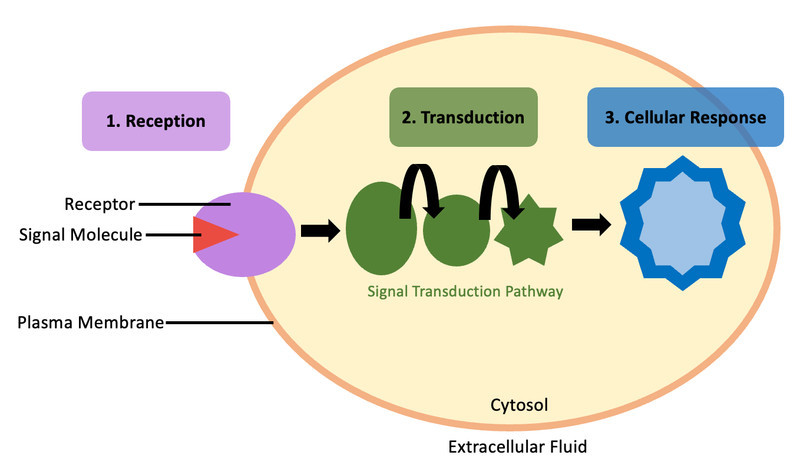
The most important idea here is amplification. A single ligand binding event can activate many molecules inside the cell, creating a much larger response than the original signal.
2. Components of a Signal Transduction Pathway
Ligands
A ligand is the signaling molecule. It binds specifically to a receptor protein on or in the target cell.
Ligands can be:
- Peptides or proteins (like many hormones)
- Small molecules
- Hormones that travel long distances through the bloodstream
Only cells with the correct receptor respond. Two cells in the same environment can behave completely differently because they have different receptors.
The receptor’s ligand-binding domain has a shape that matches a specific chemical messenger. That specificity is huge on tests. If the receptor changes shape or the ligand changes structure, signaling can fail.
Receptors
Receptors detect the signal and start the pathway. When a ligand binds, the receptor undergoes a conformational change. That shape change is what initiates transduction.
There are two main locations:
Cell Surface Receptors
Used for hydrophilic (water-soluble) ligands that cannot cross the membrane.
- Embedded in the plasma membrane
- Ligand binds outside
- Intracellular portion changes shape and activates internal signaling
Examples:
- G protein-coupled receptors (GPCRs)
- Common in eukaryotes
- Activate a G protein inside the cell
- Often trigger production of second messengers
- Ligand-gated ion channels
- Binding causes the channel to open or close
- Ions flow across the membrane
- Rapid change in membrane potential
The diagram below walks through a typical GPCR pathway from ligand binding to activation of a second messenger and a cellular response.
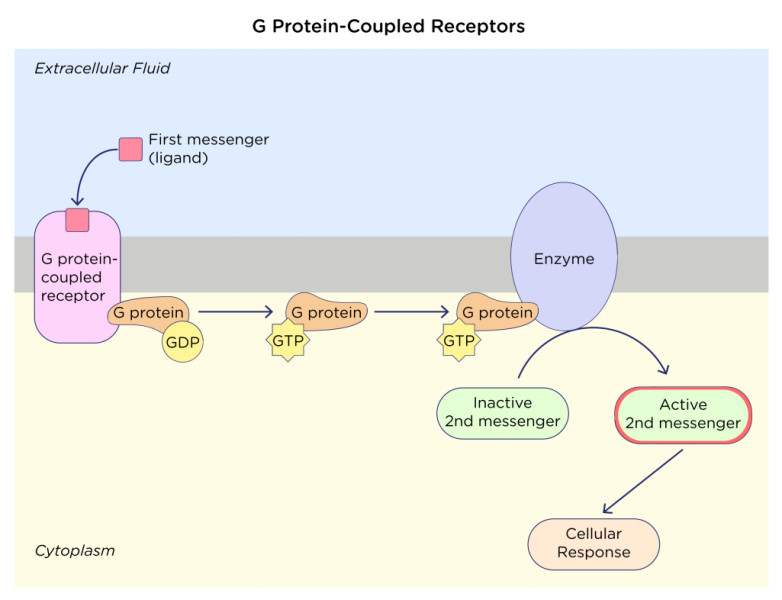
G protein-coupled receptor signaling pathway
Focus on the GDP to GTP exchange on the G protein and the production of an active second messenger. Those steps are commonly tested.
Ligand-gated channels are often tested with neuron-style questions. Binding directly changes ion flow, which quickly alters cell activity.
Intracellular Receptors
Used for hydrophobic (lipid-soluble) ligands, like steroid hormones.
- Ligand diffuses through the membrane
- Receptor is in the cytoplasm or nucleus
- Ligand-receptor complex often acts as a transcription factor
This means the response is frequently a direct change in gene expression.
A classic AP-style question will describe a hormone that crosses membranes and binds inside the cell. That’s your clue it’s an intracellular receptor.
Relay Molecules and Signaling Cascades
After reception, the signal must travel inside the cell.
Two major mechanisms show up over and over:
Protein Modification and Phosphorylation Cascades
A kinase adds a phosphate group (using ATP).
A phosphatase removes it.
In a phosphorylation cascade:
- Kinase 1 activates kinase 2
- Kinase 2 activates kinase 3
- And so on
Each activated kinase can activate many downstream proteins. That’s amplification.
Many AP questions describe a mutation in a kinase. If that kinase is always active, the pathway may be permanently “on,” even without ligand binding.
Second Messengers
These are small, non-protein molecules that spread the signal.
A classic example is cAMP (cyclic AMP).
- Receptor activation → enzyme produces many cAMP molecules
- Each cAMP activates target proteins
- Huge amplification effect
Second messengers move quickly through the cytoplasm, allowing the signal to spread efficiently.
3. Amplification and Specific Responses
Amplification can occur at multiple steps:
- One ligand activates one receptor
- One receptor activates many G proteins
- One enzyme makes many second messengers
- One kinase activates many proteins
The result is a strong response from a tiny signal.
The final cellular response depends on:
- Which receptor is present
- Which relay proteins are in the cell
- Which genes are available to be turned on
The same ligand can cause:
- Cell growth in one cell type
- Secretion in another
- Gene activation in a third
Specificity comes from the entire pathway, not just the ligand.
Key Takeaways
Ligand
A signaling molecule that binds specifically to a receptor protein on or in a target cell.
Receptor Protein
A protein that binds a specific signal and initiates a cellular change.
Ligand-Binding Domain
The receptor region that specifically recognizes and binds a particular chemical messenger.
Cell Surface, Cytoplasmic, And Nuclear Receptors
Membrane receptors bind external signals; intracellular receptors bind signals inside the cell.
Conformational Change
A shape change in a receptor that starts intracellular signaling after ligand binding.
G Protein-Coupled Receptors (GPCRs)
Seven-pass membrane receptors that activate G proteins to relay external signals inward.
Phosphorylation Cascade
A sequence of protein activations caused by adding phosphate groups at each step.
Signal Amplification
One signaling event activates many molecules, producing a much larger cellular effect.
Second Messengers
Small intracellular molecules that relay and amplify signals from activated receptors.
Cyclic AMP (cAMP)
A common second messenger that activates intracellular proteins and amplifies signaling.
Cellular Responses To Signaling
Outcomes include cell growth, molecule secretion, gene expression, or altered enzyme activity.
Hormones
Chemical messengers that travel long distances through the bloodstream to target cells.
Ligand-Gated Ion Channels
Membrane channels that open or close when a signaling molecule binds.
Signal Transduction Pathway
A series of reception, transduction, and response steps linking a signal to cellular change.
Notes
Ligand
A signaling molecule that binds specifically to a receptor protein on or in a target cell.
Receptor Protein
A protein that binds a specific signal and initiates a cellular change.
Ligand-Binding Domain
The receptor region that specifically recognizes and binds a particular chemical messenger.
Cell Surface, Cytoplasmic, And Nuclear Receptors
Membrane receptors bind external signals; intracellular receptors bind signals inside the cell.
Conformational Change
A shape change in a receptor that starts intracellular signaling after ligand binding.
G Protein-Coupled Receptors (GPCRs)
Seven-pass membrane receptors that activate G proteins to relay external signals inward.
Phosphorylation Cascade
A sequence of protein activations caused by adding phosphate groups at each step.
Signal Amplification
One signaling event activates many molecules, producing a much larger cellular effect.
Second Messengers
Small intracellular molecules that relay and amplify signals from activated receptors.
Cyclic AMP (cAMP)
A common second messenger that activates intracellular proteins and amplifies signaling.
Cellular Responses To Signaling
Outcomes include cell growth, molecule secretion, gene expression, or altered enzyme activity.
Hormones
Chemical messengers that travel long distances through the bloodstream to target cells.
Ligand-Gated Ion Channels
Membrane channels that open or close when a signaling molecule binds.
Signal Transduction Pathway
A series of reception, transduction, and response steps linking a signal to cellular change.
