Topic 8.5 Notes – Community Ecology
1. What a Community Is
A community is all the interacting populations of different species living in the same area.
- It includes only biotic (living) components.
- Abiotic factors like temperature and rainfall matter, but those are ecosystem-level.
- Communities are dynamic. Species move in or out. Populations rise and fall. Interactions shift over time.
Community structure depends on:
- Species composition → who is present
- Species diversity → how many species and how evenly distributed
Underneath all of this is energy flow. Species interact because they need energy and matter. How they access it determines which species thrive and which decline.
2. How Community Structure Is Measured
Species Composition
Species composition is simply the list of species present.
If two ponds both contain frogs, algae, insects, and fish, they have the same composition.
But that does not tell you how many of each there are.
Composition answers one question: Who lives here?
Species Diversity
Diversity adds abundance into the picture. It has two parts:
Species Richness
- Total number of different species.
- 12 species > 5 species in richness.
Species Evenness
- How evenly individuals are distributed.
- If each species has ~50 individuals → high evenness.
- If one species has 400 and the rest have 5 → low evenness.
High diversity = high richness + high evenness.
Students often forget evenness. On AP questions, two communities may have the same richness but very different diversity because one is dominated by a single species.
Simpson’s Diversity Index
To quantify diversity, we use:
Where:
- = individuals of one species
- = total individuals
- Sum across all species
Interpretation:
- Value close to 1 → high diversity
- Value close to 0 → low diversity
Why it works:
- Squaring emphasizes dominant species.
- If one species dominates, the sum gets large, and diversity decreases.
On tests, you may be asked to:
- Calculate it
- Compare two communities
- Explain why higher diversity often increases stability (more species means more backup if one declines)
3. Types of Species Interactions
Interactions determine how species gain access to energy and matter. They can be described by their effect on each species.
| Interaction | Effect on Species 1 | Effect on Species 2 | Example |
|---|---|---|---|
| Competition | − | − | Two birds using same nesting sites |
| Predation | + | − | Shark eating fish |
| Mutualism | + | + | Plant and pollinator |
| Commensalism | + | 0 | Epiphyte growing on tree |
| Parasitism | + | − | Tapeworm in host |
Competition (−/−)
Occurs when species use the same limited resource.
Possible outcomes:
- Lower population sizes
- Competitive exclusion (one eliminates the other)
Niche Partitioning
Species divide resources to coexist. A classic example is several warbler species feeding in different parts of the same tree.
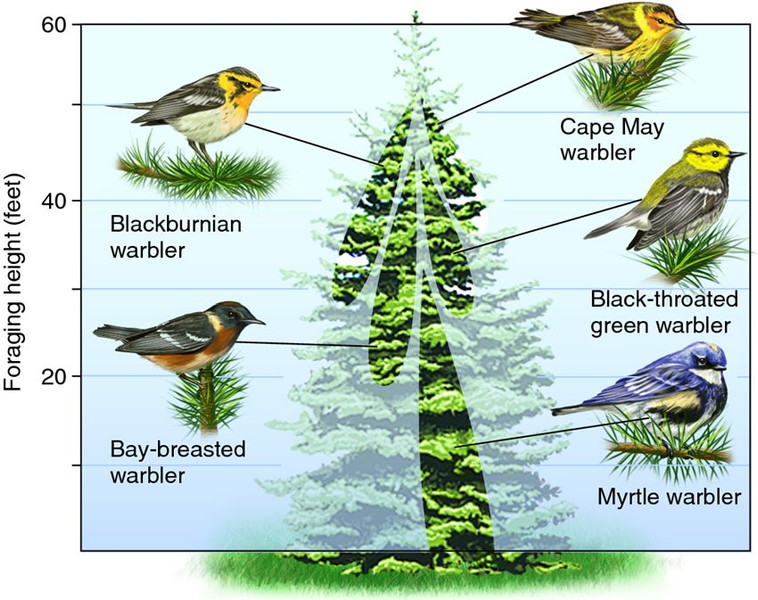
Niche partitioning in warblers
Each species feeds at a different height or zone of the tree, reducing overlap in resource use.
Examples:
- Different feeding heights
- Different active times
- Different prey sizes
Partitioning reduces direct competition and increases diversity.
Predation (+/−)
Predators consume prey and transfer energy up trophic levels.
Predators can exert top-down control, shaping lower levels.
Trophic Cascades
When predator changes ripple downward through multiple trophic levels, a trophic cascade occurs.
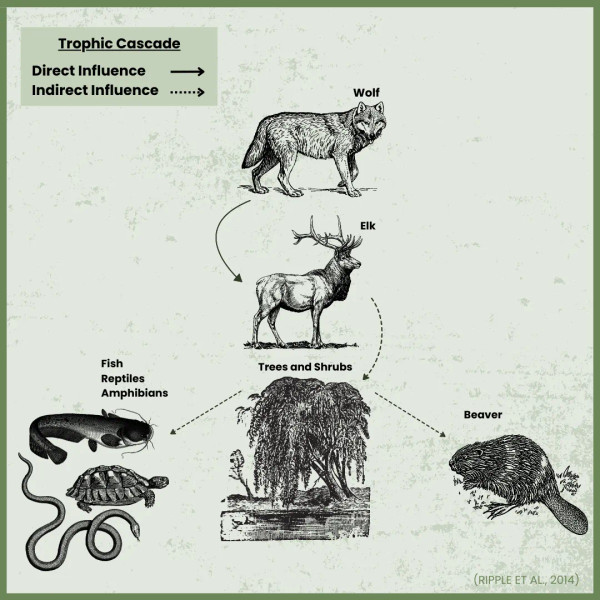
Example of a trophic cascade
In this example, wolves reduce elk populations, which allows trees and shrubs to recover. That vegetation change then affects other organisms such as beavers and aquatic species.
The wolf example shows what happens when a predator is restored:
- Predator present → Herbivore ↓ → Producers ↑
The reverse pattern shows what happens when a predator is removed:
- Predator ↓ → Herbivore ↑ → Producers ↓
Either direction, removing or adding a top predator can restructure the entire community.
Symbiosis
Long-term close interactions.
- Mutualism (+/+): both benefit (coral and algae)
- Commensalism (+/0): one benefits, other unaffected
- Parasitism (+/−):
- Parasite smaller than host
- Long-term relationship
- Host usually not killed immediately
Parasitism differs from predation because the parasite depends on keeping the host alive.
4. How Interactions Shape Community Structure
Species interactions drive:
- Population dynamics (predator-prey cycles, host-parasite shifts)
- Energy flow efficiency
- Stability
If one population changes, others respond predictably. That cause-and-effect reasoning shows up constantly in AP questions.
High diversity often increases:
- Resistance to disturbance
- Resilience after disturbance
Loss of a keystone predator can trigger a trophic cascade and drastically alter species composition and diversity.
When you see a scenario on a test, think:
- Who gains or loses energy?
- How will that affect population size?
- How does that shift diversity and overall structure?
Community structure is the result of those interaction patterns over time.
Key Takeaways
Community
All interacting populations of different species living in the same area.
Community Structure
The organization of species in a community based on composition and diversity.
Species Composition
The identity or list of species present in a community.
Simpson's Diversity Index
Calculated as 1 - Σ(n/N)^2 to estimate community diversity from richness and evenness.
Competition
A minus-minus interaction in which organisms use the same limited resource.
Niche Partitioning
Resource use differences that reduce competition and allow species to coexist.
Cooperation
Behavior in which organisms work together to improve access to resources or energy.
Species Diversity, Richness, and Evenness
Includes the number of species present and how evenly individuals are distributed.
Predator-Prey Relationships and Trophic Cascades
Interactions where consumers limit prey populations and can indirectly affect other trophic levels.
Symbiosis: Mutualism, Commensalism, and Parasitism
A close interspecific relationship that benefits both, benefits one, or harms a host.
Notes
Community
All interacting populations of different species living in the same area.
Community Structure
The organization of species in a community based on composition and diversity.
Species Composition
The identity or list of species present in a community.
Simpson's Diversity Index
Calculated as 1 - Σ(n/N)^2 to estimate community diversity from richness and evenness.
Competition
A minus-minus interaction in which organisms use the same limited resource.
Niche Partitioning
Resource use differences that reduce competition and allow species to coexist.
Cooperation
Behavior in which organisms work together to improve access to resources or energy.
Species Diversity, Richness, and Evenness
Includes the number of species present and how evenly individuals are distributed.
Predator-Prey Relationships and Trophic Cascades
Interactions where consumers limit prey populations and can indirectly affect other trophic levels.
Symbiosis: Mutualism, Commensalism, and Parasitism
A close interspecific relationship that benefits both, benefits one, or harms a host.
