Topic 7.12 Notes – Origins of Life on Earth
Earth’s Early Environment and the Window for Life
Earth formed about 4.6 billion years ago (bya). At first, it was not even close to livable.
Early Earth had:
- A molten surface
- Constant volcanic eruptions
- Intense meteorite impacts (the Late Heavy Bombardment)
- No long-term stable liquid water
Here’s the key timeline showing when Earth formed, when conditions stabilized, and the window for life’s origin:
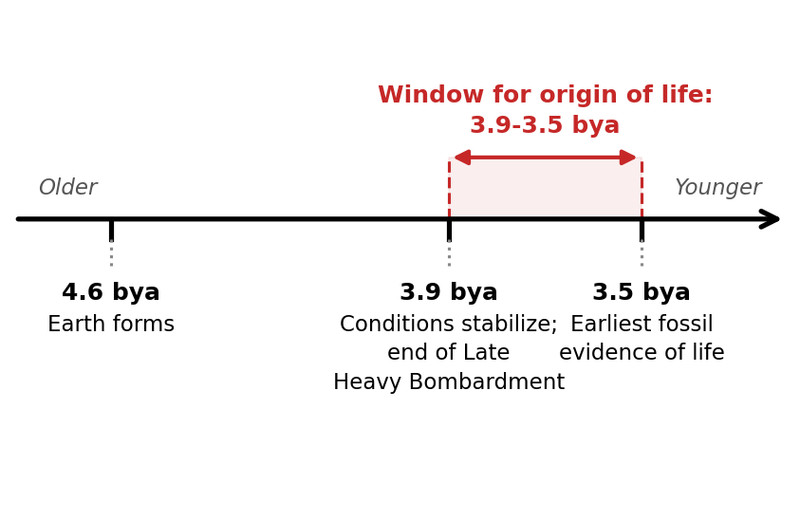
Timeline of early Earth and the window for life’s origin
By about 3.9 bya, conditions changed:
- Surface cooled
- Liquid water became stable
- Meteorite impacts decreased
Only then could the chemistry of life realistically begin.
The earliest fossil evidence of life is ~3.5 bya. That means life must have originated sometime between 3.9 and 3.5 bya.
That reasoning shows up on tests. You may be asked to explain how these dates constrain when life evolved. The logic matters more than memorizing numbers.
Geological and Fossil Evidence for Early Life
Scientists don’t guess about early life. They use physical evidence from rocks and fossils.
Fossil Evidence
Two major types:
- Microfossils (~3.5 bya)
- Tiny, cell-like structures preserved in ancient sedimentary rock
- Show that cellular organisms already existed
- Stromatolites
- Layered rock formations built by microbial communities (often photosynthetic bacteria)
- Still form today in some shallow marine environments
Below is a fossil stromatolite. Notice the distinct, layered structure built up over time by microbial mats.
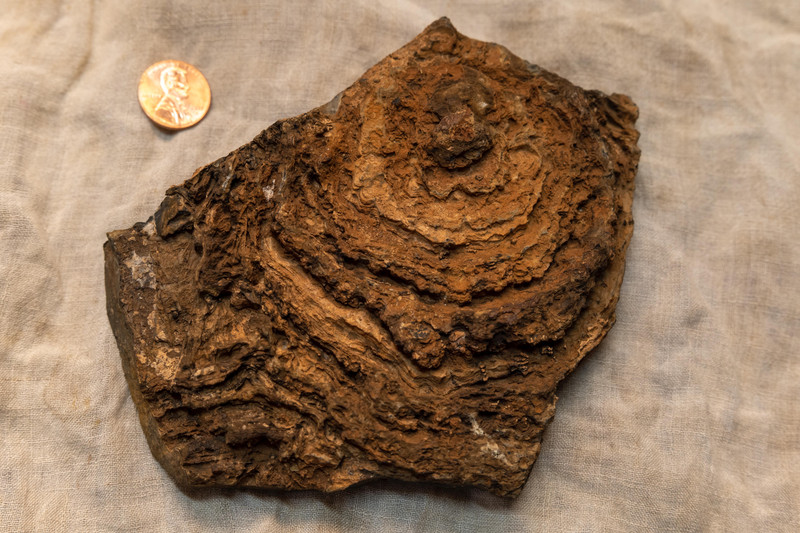
Fossil stromatolite (~3.5 bya)
Stromatolites are especially powerful evidence because they show organized, community-level biological activity.
If life was complex enough to build stromatolites by 3.5 bya, it had already been evolving for some time.
Geological Evidence
Rocks also preserve chemical clues.
- Ancient sedimentary rocks show that liquid water was present.
- Carbon isotope ratios in very old rocks match patterns produced by biological metabolism.
- The end of the Late Heavy Bombardment (~3.9 bya) marks the shift from a hostile surface to potentially habitable conditions.
This is a Big Idea 4 connection. Earth systems (atmosphere, hydrosphere, lithosphere) interacted in ways that allowed biological systems to emerge.
On an FRQ, you might see isotope data or rock age data and be asked how it supports early life. The answer needs to connect evidence to biological activity, not just restate the graph.
The RNA World Hypothesis
Now we shift from when life appeared to how it might have started.
Today:
- DNA stores genetic information
- RNA transfers information
- Proteins act as enzymes (catalysts)
The RNA world hypothesis proposes that RNA came first and did both jobs.
It rests on three assumptions.
1. RNA Replication Ensured Genetic Continuity
At some point, RNA molecules were able to replicate themselves.
Self-replication means:
- Information is copied
- Variations can occur
- Natural selection becomes possible
Without replication, there is no heredity and no evolution.
2. Base Pairing Allowed Template-Based Copying
RNA uses complementary base pairing:
- A pairs with U
- G pairs with C
Complementary pairing allows one strand to serve as a template for building another by forming specific hydrogen bonds between matching bases. That chemical property makes replication plausible.
If base pairing didn’t exist, accurate inheritance wouldn’t be possible.
3. Proteins Were Not Genetically Encoded Catalysts
In the RNA world:
- The genetic code had not evolved.
- Ribosomes did not exist.
- Proteins were not genetically encoded enzymes.
Instead, RNA molecules called ribozymes acted as catalysts.
This solves a major problem. Today:
- DNA needs proteins to replicate.
- Proteins require DNA instructions.
RNA can both store information and catalyze reactions, so it could have functioned independently at first.
Why the RNA World Model Is Supported
Several observations make this hypothesis reasonable:
- Ribozymes exist today.
- The ribosome’s catalytic core is RNA, not protein.
- RNA can store information through nucleotide sequences.
- A simpler RNA-only system logically could have preceded the more complex DNA-protein system.
You are not expected to explain every step of abiogenesis. You are expected to connect:
- Geological timeline
- Fossil and isotopic evidence
- RNA’s dual function
Evidence → time window → plausible molecular mechanism.
That chain of reasoning is what earns points.
Key Takeaways
Geological Evidence For Life's Origin
Ancient rocks and minerals reveal early Earth conditions such as atmosphere, temperature, and liquid water.
Early Earth Conditions
Young Earth was initially hot, volcanic, and heavily bombarded, then later cooled and stabilized.
Late Heavy Bombardment
An early period of intense meteorite impacts that made Earth's surface largely uninhabitable.
Ribozyme
An RNA molecule that catalyzes chemical reactions without being a protein enzyme.
Geological Timeline And Earliest Fossil Evidence
Earth formed 4.6 bya, became habitable by 3.9 bya, and fossils show life by 3.5 bya.
RNA World Hypothesis
Early life may have relied on RNA because it stores information and catalyzes reactions.
Assumptions Of The RNA World Hypothesis
RNA replication ensured continuity, base-pairing enabled copying, and proteins were not yet catalysts.
Stromatolites
Layered rock structures formed by ancient microbial communities that provide early fossil evidence of life.
Notes
Geological Evidence For Life's Origin
Ancient rocks and minerals reveal early Earth conditions such as atmosphere, temperature, and liquid water.
Early Earth Conditions
Young Earth was initially hot, volcanic, and heavily bombarded, then later cooled and stabilized.
Late Heavy Bombardment
An early period of intense meteorite impacts that made Earth's surface largely uninhabitable.
Ribozyme
An RNA molecule that catalyzes chemical reactions without being a protein enzyme.
Geological Timeline And Earliest Fossil Evidence
Earth formed 4.6 bya, became habitable by 3.9 bya, and fossils show life by 3.5 bya.
RNA World Hypothesis
Early life may have relied on RNA because it stores information and catalyzes reactions.
Assumptions Of The RNA World Hypothesis
RNA replication ensured continuity, base-pairing enabled copying, and proteins were not yet catalysts.
Stromatolites
Layered rock structures formed by ancient microbial communities that provide early fossil evidence of life.
