Topic 6.4 Notes – Translation
1. From Gene to Protein to Trait
Everything in this topic connects back to one pathway:
DNA (gene) → mRNA → protein → phenotype
A gene is a sequence of DNA that encodes a polypeptide. That polypeptide folds into a protein, and the protein’s structure determines its function.
Here’s the cause-and-effect chain you need to see clearly:
- Change in DNA sequence
- → changes the mRNA codons
- → changes the amino acid sequence
- → changes protein structure
- → changes protein function
- → changes the organism’s phenotype
Examples of how this shows up:
- A mutation changes an enzyme’s active site, lowering reaction rate.
- A structural protein becomes unstable.
- A signaling protein is made in the wrong amount.
On tests, you’re often given a mutation and asked to predict the effect on phenotype. Always walk it through the protein. The protein is the bridge between genotype and trait.
Translation is the step where that bridge is built.
2. The Molecular Machinery of Translation
Translation happens on ribosomes, and it requires three main players: mRNA, tRNA, and ribosomes.
mRNA
- Carries genetic instructions from DNA.
- Read 5′ → 3′.
- Read in triplets called codons.
- Each codon codes for one amino acid.
- Start codon: AUG (codes for methionine).
- Stop codons: UAA, UAG, UGA (no amino acid added).
The ribosome moves along the mRNA one codon at a time.
tRNA
tRNA is the adapter between nucleotides and amino acids.
Each tRNA has:
- An anticodon (complementary to an mRNA codon).
- A specific amino acid attached.
When the anticodon base-pairs with the codon, the correct amino acid is delivered.
If the anticodon doesn’t match, that amino acid won’t be added. That pairing is what keeps translation accurate.
Ribosomes
Ribosomes are made of rRNA and proteins.
Location:
- Prokaryotes: cytoplasm.
- Eukaryotes: cytoplasm and rough ER.
Function:
- Bind mRNA.
- Hold tRNAs in place.
- Catalyze peptide bond formation.
They have three key sites:
- A site → incoming tRNA.
- P site → growing polypeptide.
- E site → exit of empty tRNA.
You don’t need to memorize enzyme names. Just understand what each site does.
3. The Genetic Code
Here’s a standard codon chart you’d use on an exam. It shows mRNA codons, so the bases are U, C, A, and G.
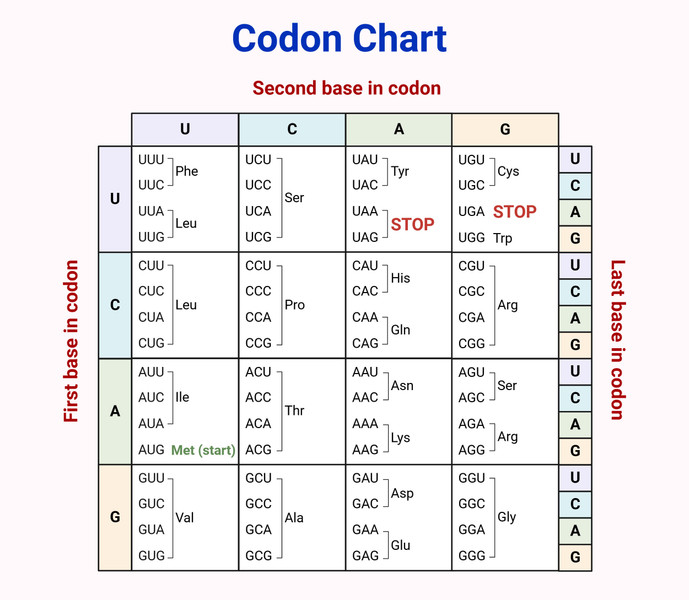
Standard mRNA codon chart
To use it, choose the first base from the left side, the second base across the top, and then the third base from the right side to find the amino acid.
Important rules:
- Read in non-overlapping triplets.
- One codon = one amino acid.
- Redundant (degenerate): multiple codons can code for the same amino acid.
- Nearly universal across organisms → strong evidence for common ancestry.
You do not need to memorize the whole chart. You do need to:
- Translate an mRNA sequence into amino acids.
- Predict how a codon change affects the protein.
For example, AUG codes for methionine and also serves as the start codon. UAA, UAG, and UGA are stop codons.
If a mutation changes one base, check whether it changes the amino acid. Because of redundancy, sometimes it doesn’t.
4. The Three Stages of Translation
Translation occurs in three stages.
Initiation
- Small ribosomal subunit binds mRNA.
- rRNA recognizes the AUG start codon.
- Initiator tRNA carrying methionine binds.
- Large subunit joins.
The start codon sets the reading frame. If that frame shifts, everything downstream changes.
Elongation
This cycle repeats:
- tRNA enters the A site.
- Anticodon pairs with codon.
- Peptide bond forms.
- Ribosome shifts forward one codon.
- Empty tRNA exits from E site.
The polypeptide grows from N-terminus to C-terminus.
Energy from ATP and GTP drives the process.
Termination
- Ribosome reaches a stop codon.
- No tRNA matches it.
- A release factor binds.
- Polypeptide is released.
- Ribosome dissociates.
Translation ends with a complete polypeptide.
5. Where and When Translation Occurs
Prokaryotes
- Occurs in cytoplasm.
- Transcription and translation happen simultaneously.
Ribosomes can attach to mRNA while it’s still being transcribed. This allows rapid protein production.
You’ll often see diagrams showing multiple ribosomes on one mRNA strand at the same time.
Eukaryotes
- Transcription occurs in the nucleus.
- mRNA is processed and exported.
- Translation occurs:
- On free ribosomes (cytoplasmic proteins).
- On rough ER (secreted, membrane, lysosomal proteins).
Location determines where the protein will function.
6. Special Case: Retroviruses
The typical flow of information is:
DNA → RNA → Protein
Retroviruses use:
RNA → DNA → RNA → Protein
They use reverse transcriptase to make DNA from RNA.
That viral DNA:
- Integrates into the host genome.
- Is transcribed and translated by host machinery.
- Produces new viral proteins and viral particles.
This alternate flow is an exception to the usual pattern and shows that information flow can vary.
Key Takeaways
Translation
Synthesis of a polypeptide from an mRNA template at a ribosome.
Ribosome Location in Prokaryotes and Eukaryotes
Occurs on cytoplasmic ribosomes in both cell types and on rough ER ribosomes in eukaryotes.
Free Ribosomes vs Rough ER-Bound Ribosomes
Free ribosomes make cytosolic proteins; rough ER ribosomes make secreted or membrane proteins.
Co-Transcriptional Translation
In prokaryotes, ribosomes begin translating mRNA while it is still being transcribed.
Stages of Translation
Initiation starts synthesis, elongation adds amino acids, and termination releases the finished polypeptide.
Initiation
rRNA binds mRNA at AUG, and the first tRNA carrying methionine starts polypeptide synthesis.
Codon
A three-nucleotide mRNA sequence that specifies an amino acid or translation stop signal.
Genetic Code
The rules matching mRNA codons to amino acids during protein synthesis.
Degeneracy of the Genetic Code
Most amino acids are specified by more than one codon.
Nearly Universal Genetic Code
Almost all organisms use the same codon-to-amino acid assignments.
tRNA
RNA that carries a specific amino acid and pairs its anticodon with an mRNA codon.
Anticodon
A three-nucleotide tRNA sequence complementary to an mRNA codon.
Elongation
Repeated codon recognition and peptide bond formation extend the growing polypeptide chain.
Peptide Bond Formation
A covalent bond joins adjacent amino acids as the polypeptide grows.
Termination
A stop codon ends translation and the completed polypeptide is released.
Stop Codons
UAA, UAG, and UGA signal the end of translation rather than an amino acid.
Genotype to Phenotype Through Translation
Gene sequences determine amino acid sequences, which shape proteins and influence observable traits.
Mutation Effects on Translation
Changes in mRNA codons can alter amino acid sequence, protein structure, and phenotype.
Reverse Transcription in Retroviruses
Reverse transcriptase copies viral RNA into DNA, reversing the usual information flow.
Retroviral Integration and Protein Production
Viral DNA inserts into the host genome, then is transcribed and translated to make new viruses.
Reading Frame and Genetic Code Chart
Translation begins at AUG, then each mRNA codon is matched to an amino acid.
Common Ancestry Evidence from the Genetic Code
The shared genetic code across organisms supports that all life evolved from common ancestors.
Notes
Translation
Synthesis of a polypeptide from an mRNA template at a ribosome.
Ribosome Location in Prokaryotes and Eukaryotes
Occurs on cytoplasmic ribosomes in both cell types and on rough ER ribosomes in eukaryotes.
Free Ribosomes vs Rough ER-Bound Ribosomes
Free ribosomes make cytosolic proteins; rough ER ribosomes make secreted or membrane proteins.
Co-Transcriptional Translation
In prokaryotes, ribosomes begin translating mRNA while it is still being transcribed.
Stages of Translation
Initiation starts synthesis, elongation adds amino acids, and termination releases the finished polypeptide.
Initiation
rRNA binds mRNA at AUG, and the first tRNA carrying methionine starts polypeptide synthesis.
Codon
A three-nucleotide mRNA sequence that specifies an amino acid or translation stop signal.
Genetic Code
The rules matching mRNA codons to amino acids during protein synthesis.
Degeneracy of the Genetic Code
Most amino acids are specified by more than one codon.
Nearly Universal Genetic Code
Almost all organisms use the same codon-to-amino acid assignments.
tRNA
RNA that carries a specific amino acid and pairs its anticodon with an mRNA codon.
Anticodon
A three-nucleotide tRNA sequence complementary to an mRNA codon.
Elongation
Repeated codon recognition and peptide bond formation extend the growing polypeptide chain.
Peptide Bond Formation
A covalent bond joins adjacent amino acids as the polypeptide grows.
Termination
A stop codon ends translation and the completed polypeptide is released.
Stop Codons
UAA, UAG, and UGA signal the end of translation rather than an amino acid.
Genotype to Phenotype Through Translation
Gene sequences determine amino acid sequences, which shape proteins and influence observable traits.
Mutation Effects on Translation
Changes in mRNA codons can alter amino acid sequence, protein structure, and phenotype.
Reverse Transcription in Retroviruses
Reverse transcriptase copies viral RNA into DNA, reversing the usual information flow.
Retroviral Integration and Protein Production
Viral DNA inserts into the host genome, then is transcribed and translated to make new viruses.
Reading Frame and Genetic Code Chart
Translation begins at AUG, then each mRNA codon is matched to an amino acid.
Common Ancestry Evidence from the Genetic Code
The shared genetic code across organisms supports that all life evolved from common ancestors.
