Topic 3.5 Notes – Cellular Respiration
1. What Cellular Respiration Is
At its core, cellular respiration is energy transfer. The chemical energy in glucose is not used directly. Instead, electrons are removed from glucose and passed through a series of carriers to eventually make ATP, the cell’s usable energy currency.
Big picture flow:
Glucose → NADH/FADH₂ → Electron Transport Chain → Proton Gradient → ATP
Key features you need to know:
- Occurs in all organisms
- Eukaryotes use mitochondria
- Prokaryotes use their plasma membrane
- Involves oxidation-reduction (redox) reactions
- Glucose is oxidized
- Electron carriers like NAD⁺ and FAD are reduced
- In aerobic respiration, oxygen is the terminal electron acceptor, forming water
ATP yield per glucose:
- Aerobic respiration: about 30-36 ATP
- Fermentation: 2 ATP (from glycolysis only)
That huge difference in ATP output is why oxygen matters so much.
2. The Stages of Cellular Respiration
Each stage extracts more energy and passes electrons forward.
a. Glycolysis (Cytoplasm)
Glycolysis splits one 6‑carbon glucose into two 3‑carbon pyruvate molecules.
Per glucose:
- 2 ATP (net)
- 2 NADH
- 2 pyruvate
Important details:
- Does not require oxygen
- NAD⁺ is reduced to NADH
- Happens in the cytosol of all cells
This is the only ATP you get if oxygen is absent.
b. Pyruvate Oxidation
Pyruvate moves into the mitochondrion (in eukaryotes).
Each pyruvate:
- Is converted to acetyl CoA
- Releases CO₂
- Produces NADH
This step links glycolysis to the Krebs cycle.
c. Krebs Cycle (Mitochondrial Matrix)
The Krebs cycle fully oxidizes acetyl CoA.
Per glucose (2 turns of the cycle):
- 6 NADH
- 2 FADH₂
- 2 ATP
- 4 CO₂
Most of the energy is now stored in NADH and FADH₂, not ATP yet. That sets up the most important stage.
d. Electron Transport Chain and Oxidative Phosphorylation
This happens in the inner mitochondrial membrane and produces most ATP.
Electron flow
- NADH and FADH₂ donate electrons
- Electrons move through protein complexes via redox reactions
- Oxygen accepts the electrons at the end → forms H₂O
Proton gradient formation
As electrons move, protons (H⁺) are pumped:
- From matrix → intermembrane space
- Intermembrane space = high H⁺
- Matrix = low H⁺, higher pH
Chemiosmosis
Protons flow back through ATP synthase, driving:
This ATP production powered by an electron-driven gradient is called oxidative phosphorylation.
Students often mix this up:
- Electron transport builds the gradient
- Chemiosmosis uses the gradient to make ATP
They are connected but not the same thing.
3. Mitochondrial Structure and Why It Matters
Structure directly enables function here. As you review the diagram, connect each labeled region to the step of cellular respiration it supports.
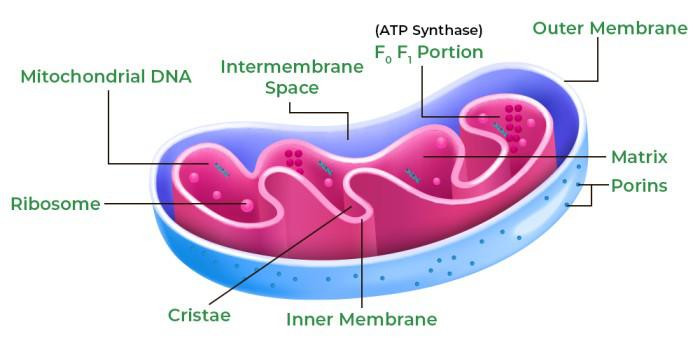
Structure of a mitochondrion
Outer membrane
- Encloses the organelle
Inner membrane
- Contains ETC proteins and ATP synthase
- Folded into cristae
- More folds = more surface area = more ATP production
Intermembrane space
- Stores pumped H⁺
- High proton concentration
Matrix
- Contains enzymes for Krebs cycle
- Lower H⁺ concentration (higher pH)
Compartmentalization allows a proton gradient to exist. Without separate spaces, chemiosmosis would not work.
In prokaryotes, there is no mitochondrion. The ETC is embedded in the plasma membrane, and the proton gradient forms across it.
4. Fermentation and Anaerobic Respiration
If oxygen is unavailable, the ETC stops. That creates a problem.
Glycolysis requires NAD⁺. Without oxygen, NADH cannot unload electrons to the ETC. Cells must regenerate NAD⁺ another way.
Lactic acid fermentation
- Pyruvate + NADH → Lactate + NAD⁺
- Occurs in muscle cells during low O₂
- Still only 2 ATP per glucose
Alcoholic fermentation
- Pyruvate → Ethanol + CO₂
- Regenerates NAD⁺
- Used by yeast
Fermentation keeps glycolysis running but does not increase ATP yield.
5. Key Concepts About Electron Transport and Heat
Redox basics
- Oxidation = loss of electrons
- Reduction = gain of electrons
- Oxygen is reduced at the end of the ETC
Anaerobic prokaryotes may use other molecules as terminal electron acceptors, but you do not need to memorize specific ones for AP.
Heat generation
If the proton gradient is dissipated without ATP synthase making ATP, the energy is released as heat.
Endotherms use this mechanism for thermoregulation.
Key Takeaways
Cellular Respiration
Process that breaks down organic molecules to make ATP through enzyme-catalyzed energy transfer.
Aerobic Respiration vs. Fermentation
Aerobic uses oxygen and yields much more ATP; fermentation regenerates NAD+ without oxygen and yields 2 ATP.
Mitochondrion
Double-membraned organelle where pyruvate oxidation, the Krebs cycle, and oxidative phosphorylation occur in eukaryotes.
Inner Mitochondrial Membrane / Cristae
Highly folded membrane containing the ETC and ATP synthase; folds increase surface area for ATP production.
Mitochondrial Matrix
Innermost compartment of the mitochondrion where pyruvate oxidation and the Krebs cycle occur.
Intermembrane Space
Compartment between mitochondrial membranes where protons accumulate during electron transport.
Glycolysis
Cytoplasmic pathway that splits glucose into two pyruvate, producing net 2 ATP and 2 NADH.
Pyruvate Oxidation
Conversion of pyruvate to acetyl CoA in mitochondria, releasing CO2 and producing NADH.
Krebs Cycle / Citric Acid Cycle
Matrix pathway that oxidizes acetyl CoA, releasing CO2 and producing ATP, NADH, and FADH2.
NAD+ / NADH
Electron carrier that accepts high-energy electrons and hydrogen, then delivers them to the ETC.
FAD / FADH2
Electron carrier reduced during the Krebs cycle that transfers electrons to the ETC.
Electron Transport Chain
Series of membrane proteins that pass electrons through redox reactions and pump protons across a membrane.
Proton Gradient / Electrochemical Gradient
Difference in H+ concentration and charge across a membrane created by electron transport.
Chemiosmosis
Diffusion of protons through ATP synthase down their gradient, driving ATP formation.
ATP Synthase
Membrane enzyme that uses proton flow to phosphorylate ADP into ATP.
Oxidative Phosphorylation
ATP production powered by chemiosmosis and linked to electron transport in aerobic respiration.
Matrix pH vs. Intermembrane Space pH
The matrix has lower H+ concentration and higher pH than the intermembrane space.
Substrate-Level Phosphorylation
Direct enzymatic transfer of a phosphate group to ADP to form ATP.
Lactic Acid Fermentation
Anaerobic pathway that reduces pyruvate to lactate and regenerates NAD+ for glycolysis.
Alcoholic Fermentation
Anaerobic pathway that converts pyruvate to ethanol and CO2 while regenerating NAD+.
Decoupling of Electron Transport and Oxidative Phosphorylation
When proton gradient energy is released as heat instead of being used to make ATP.
Prokaryotic Cellular Respiration
In prokaryotes, electron transport and proton pumping occur across the plasma membrane.
Terminal Electron Acceptor
Final molecule that receives electrons; in aerobic respiration, oxygen forms water.
Acetyl CoA
Two-carbon molecule formed from pyruvate that enters the Krebs cycle.
Notes
Cellular Respiration
Process that breaks down organic molecules to make ATP through enzyme-catalyzed energy transfer.
Aerobic Respiration vs. Fermentation
Aerobic uses oxygen and yields much more ATP; fermentation regenerates NAD+ without oxygen and yields 2 ATP.
Mitochondrion
Double-membraned organelle where pyruvate oxidation, the Krebs cycle, and oxidative phosphorylation occur in eukaryotes.
Inner Mitochondrial Membrane / Cristae
Highly folded membrane containing the ETC and ATP synthase; folds increase surface area for ATP production.
Mitochondrial Matrix
Innermost compartment of the mitochondrion where pyruvate oxidation and the Krebs cycle occur.
Intermembrane Space
Compartment between mitochondrial membranes where protons accumulate during electron transport.
Glycolysis
Cytoplasmic pathway that splits glucose into two pyruvate, producing net 2 ATP and 2 NADH.
Pyruvate Oxidation
Conversion of pyruvate to acetyl CoA in mitochondria, releasing CO2 and producing NADH.
Krebs Cycle / Citric Acid Cycle
Matrix pathway that oxidizes acetyl CoA, releasing CO2 and producing ATP, NADH, and FADH2.
NAD+ / NADH
Electron carrier that accepts high-energy electrons and hydrogen, then delivers them to the ETC.
FAD / FADH2
Electron carrier reduced during the Krebs cycle that transfers electrons to the ETC.
Electron Transport Chain
Series of membrane proteins that pass electrons through redox reactions and pump protons across a membrane.
Proton Gradient / Electrochemical Gradient
Difference in H+ concentration and charge across a membrane created by electron transport.
Chemiosmosis
Diffusion of protons through ATP synthase down their gradient, driving ATP formation.
ATP Synthase
Membrane enzyme that uses proton flow to phosphorylate ADP into ATP.
Oxidative Phosphorylation
ATP production powered by chemiosmosis and linked to electron transport in aerobic respiration.
Matrix pH vs. Intermembrane Space pH
The matrix has lower H+ concentration and higher pH than the intermembrane space.
Substrate-Level Phosphorylation
Direct enzymatic transfer of a phosphate group to ADP to form ATP.
Lactic Acid Fermentation
Anaerobic pathway that reduces pyruvate to lactate and regenerates NAD+ for glycolysis.
Alcoholic Fermentation
Anaerobic pathway that converts pyruvate to ethanol and CO2 while regenerating NAD+.
Decoupling of Electron Transport and Oxidative Phosphorylation
When proton gradient energy is released as heat instead of being used to make ATP.
Prokaryotic Cellular Respiration
In prokaryotes, electron transport and proton pumping occur across the plasma membrane.
Terminal Electron Acceptor
Final molecule that receives electrons; in aerobic respiration, oxygen forms water.
Acetyl CoA
Two-carbon molecule formed from pyruvate that enters the Krebs cycle.
