Topic 3.1 Notes – Enzymes
1. What Enzymes Are and What They Do
An enzyme is a biological catalyst. Most enzymes are proteins made of one or more polypeptide chains. Their job is to speed up chemical reactions in cells without being used up.
After a reaction:
- The enzyme is still there.
- It can be reused.
- It has not been permanently changed.
Why cells need enzymes
Many chemical reactions that are thermodynamically possible are too slow on their own. If cells relied on uncatalyzed reactions:
- Metabolism would be too slow.
- ATP production would lag.
- Molecules needed for growth and repair wouldn’t form fast enough.
Enzymes allow these reactions to happen quickly enough to maintain dynamic homeostasis.
Activation energy and reaction rate
Every reaction has an activation energy (Ea). This is the energy required to start the reaction.
- High Ea → few molecules can reach the transition state → slow reaction.
- Low Ea → more molecules can react → faster reaction.
Enzymes:
- Lower activation energy
- Increase reaction rate
- Do not change ΔG
- Do not change equilibrium
- Help the system reach equilibrium faster
Here’s what that looks like on an energy vs. reaction coordinate graph:
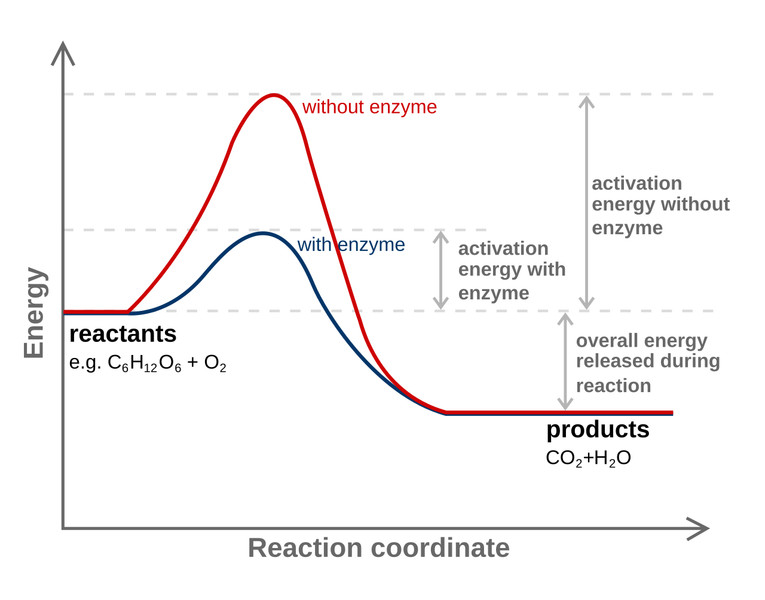
Energy vs. reaction coordinate with and without an enzyme
The red curve shows the reaction without an enzyme and has a much higher activation energy peak. The blue curve shows the same reaction with an enzyme. Notice that the starting energy of the reactants and the ending energy of the products are the same in both cases. ΔG does not change. Only the height of the energy barrier changes.
On tests, students often think enzymes “add energy.” They don’t. They simply lower the energy barrier.
2. Enzyme Structure and the Active Site
Enzyme function depends completely on structure.
Protein structure refresher
- Primary structure = amino acid sequence
- Secondary structure = alpha helices and beta sheets
- Tertiary structure = overall 3D folding
- Quaternary structure = multiple subunits (if present)
The tertiary (and sometimes quaternary) structure creates the active site.
If the amino acid sequence changes, folding may change. If folding changes, function may change.
The active site
The active site is a specific pocket or cleft where:
- The substrate binds
- The reaction occurs
It has:
- A specific shape
- Specific chemical properties (charge, polarity, hydrophobic regions)
Only substrates with compatible shape and charge can bind.
When binding occurs, an enzyme-substrate complex forms. This is often tested in diagrams. If you see E + S → ES → E + P, that ES complex is the key intermediate.
Induced fit model
The active site is flexible.
When the substrate binds:
- The enzyme changes shape slightly.
- The active site molds around the substrate.
- The transition state is stabilized.
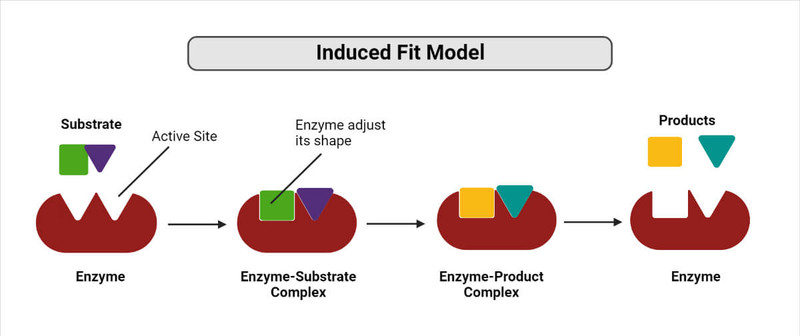
Induced fit model of enzyme action
In the diagram, notice how the enzyme adjusts its shape as the substrate binds, forming an enzyme-substrate complex before releasing products and returning to its original form.
Induced fit improves:
- Proper orientation of reactants
- Bond strain
- Transition state stabilization
The AP loves asking how structure supports function. Induced fit is a classic example.
3. How Enzymes Lower Activation Energy
Enzymes speed reactions by stabilizing the transition state and reducing the energy barrier.
They may:
- Bring substrates together in the correct orientation
- Strain bonds in the substrate, making them easier to break
- Provide a favorable microenvironment (acidic/basic side chains)
- Form temporary bonds with the substrate
Notice the pattern: all of these reduce the energy required to reach the transition state.
Again, enzymes:
- Do not change the reactants or products.
- Do not change whether a reaction is spontaneous.
- Only change how fast equilibrium is reached.
4. Regulation of Enzyme Activity
Cells control enzymes to regulate metabolism.
Substrate concentration
As substrate increases:
- More collisions occur.
- Reaction rate increases.
Eventually, enzymes become saturated:
- All active sites are occupied.
- The reaction reaches a maximum rate.
- Adding more substrate does nothing.
If you see a graph that plateaus at high substrate concentration, that’s enzyme saturation.
Inhibitors
Here’s a comparison you should be able to recognize quickly:
| Feature | Competitive Inhibitor | Noncompetitive Inhibitor |
|---|---|---|
| Where it binds | Active site | Allosteric (different) site |
| Resembles substrate | Yes | No |
| Effect of adding more substrate | Can overcome inhibition | Does not restore full activity |
| Effect on enzyme shape | Blocks active site | Changes enzyme conformation |
Be careful: many students mix these up when analyzing data. If increasing substrate restores rate, it’s competitive.
Allosteric regulation
An allosteric regulator binds to an allosteric site and changes enzyme shape.
It can:
- Activate the enzyme
- Inhibit the enzyme
This allows cells to control entire metabolic pathways efficiently.
5. Why Enzyme Structure Matters
Enzyme function depends on precise 3D shape.
Changes that affect structure:
- Mutations (change amino acid sequence)
- Extreme pH
- High temperature → denaturation
When structure changes:
- Active site shape may change.
- Substrate may not bind.
- Reaction rate decreases or stops.
Any FRQ asking how a mutation affects metabolism is testing this idea. Connect sequence → structure → function → cellular process.
Key Takeaways
Enzyme
A protein catalyst that speeds cellular reactions by lowering activation energy.
Activation Energy
The minimum energy required for reactants to reach the transition state and react.
Active Site
The specific region where substrate binds and catalysis occurs.
Substrate
The reactant molecule an enzyme binds and acts on.
Enzyme-Substrate Complex
The temporary association formed when a substrate binds an enzyme's active site.
Enzyme Specificity
The property that allows only particular substrates to bind and be catalyzed.
Induced Fit
A model where substrate binding causes the enzyme to change shape for tighter binding.
Primary, Secondary, Tertiary, and Quaternary Structure
Primary amino acid sequence; secondary local folding; tertiary overall shape; quaternary subunit arrangement.
Allosteric Regulation
Control of activity by binding at another site that changes the active site's shape.
Denaturation
A change in protein shape that disrupts the active site and reduces activity.
Notes
Enzyme
A protein catalyst that speeds cellular reactions by lowering activation energy.
Activation Energy
The minimum energy required for reactants to reach the transition state and react.
Active Site
The specific region where substrate binds and catalysis occurs.
Substrate
The reactant molecule an enzyme binds and acts on.
Enzyme-Substrate Complex
The temporary association formed when a substrate binds an enzyme's active site.
Enzyme Specificity
The property that allows only particular substrates to bind and be catalyzed.
Induced Fit
A model where substrate binding causes the enzyme to change shape for tighter binding.
Primary, Secondary, Tertiary, and Quaternary Structure
Primary amino acid sequence; secondary local folding; tertiary overall shape; quaternary subunit arrangement.
Allosteric Regulation
Control of activity by binding at another site that changes the active site's shape.
Denaturation
A change in protein shape that disrupts the active site and reduces activity.
