Topic 6.8 Notes – Biotechnology
1. Genetic Engineering and Recombinant DNA
Genetic engineering means directly changing or analyzing DNA to study genes or create new traits.
It depends on recombinant DNA (rDNA), which is DNA formed by combining genetic material from different sources.
If a gene from one organism is inserted into another, that receiving organism now carries new instructions. That can be used to:
- Study gene function (What happens if this gene is expressed?)
- Produce useful proteins (like human insulin made by bacteria)
- Create GMOs
- Compare DNA across individuals or species
Gene Cloning
Gene cloning makes many identical copies of a specific gene.
Basic idea:
- A gene of interest is inserted into a vector (often a plasmid).
- The vector enters a host cell, usually bacteria.
- As the bacteria divide, they copy the plasmid.
- Result → many copies of that gene.
Think of bacteria as tiny copy machines. This is how we mass-produce specific DNA fragments or proteins.
This matters for AP questions because changing DNA changes the information being stored and expressed. That’s the core concept behind this entire topic.
2. Core Biotechnology Techniques
You need to recognize what each technique does and why it’s used. The exam won’t ask for tiny lab details, but it will expect you to understand the purpose and outcome.
Polymerase Chain Reaction (PCR)
PCR amplifies a specific DNA sequence. It takes a tiny starting sample and makes millions of copies.
Each cycle has three steps:
Denaturation
Heat separates the DNA strands.Annealing
Primers bind to complementary sequences.Extension
DNA polymerase builds new strands by adding nucleotides.
These cycles repeat. Each round doubles the target DNA, leading to exponential growth.
PCR is used in:
- Disease detection
- Forensics
- Identifying organisms
- Phylogenetic analysis
If you see “very small DNA sample” in a question, PCR is almost always involved.
Gel Electrophoresis
Gel electrophoresis separates DNA fragments by size and charge.
DNA is negatively charged, so when an electric current is applied, fragments move toward the positive electrode. Smaller fragments move faster and travel farther through the gel.
In the diagram below, notice that the wells are at the top near the negative electrode. The DNA fragments migrate downward toward the positive electrode, with shorter fragments traveling farther than longer ones.
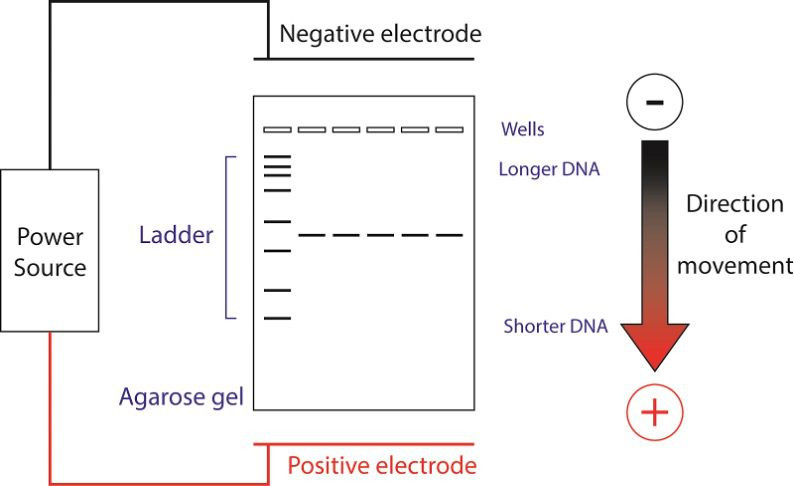
Agarose gel electrophoresis setup and band pattern
What you interpret from a gel:
- Each band represents DNA fragments of a certain size.
- A DNA ladder provides size reference bands for comparison.
- More matching bands between samples means more similar DNA.
- If bands don’t match, that sample can be excluded.
The AP loves giving you gel images and asking which samples are related or match a suspect.
Bacterial Transformation
Transformation introduces foreign DNA into bacteria.
- Usually uses plasmids.
- Bacteria take up the plasmid.
- As they reproduce, they copy that DNA.
This is how cloned genes are amplified and how proteins are produced in large amounts.
DNA Sequencing
DNA sequencing determines the exact order of nucleotides (A, T, C, G).
This allows scientists to:
- Identify mutations
- Compare species
- Study evolutionary relationships
- Confirm successful genetic modification
Unlike gel electrophoresis, which separates fragments by size, sequencing gives you the actual nucleotide order.
3. DNA Fingerprinting and Comparing DNA Samples
A DNA fingerprint is a unique DNA pattern created using PCR and gel electrophoresis (and sometimes sequencing).
General process:
- Amplify highly variable regions (often short tandem repeats).
- Separate fragments using gel electrophoresis.
- Compare banding patterns.
If two samples share the same banding pattern at multiple loci, they likely came from the same individual.
Applications:
- Forensic identification
- Paternity testing
- Identifying species
- Phylogenetic analysis
On exam questions:
- More shared bands → closer genetic similarity.
- Complete mismatch → exclusion.
4. Genetically Modified Organisms and Applications of Biotechnology
A GMO has DNA altered using genetic engineering, not natural reproduction.
Includes:
- Transgenic animals (contain genes from another species)
- Modified crops
- Engineered bacteria
Applications
Medicine
- Insulin production
- Vaccines
- Diagnostic tests
- Gene therapy research
Agriculture
- Pest-resistant crops
- Herbicide tolerance
- Improved nutritional content
- Increased yield
Research
- Studying gene function
- Modeling human diseases
Forensics
- DNA analysis in criminal investigations
Benefits vs Concerns
| Benefits | Concerns |
|---|---|
| Higher crop yields | Possible environmental impact |
| Reduced pesticide use | Gene flow to wild populations |
| Disease resistance | Ethical concerns |
| Improved nutrition | Regulation and equity issues |
Expect scenario-based questions where you predict what happens if a gene is inserted, removed, or mutated.
5. Connection to Big Idea 3
Biotechnology proves that:
- DNA stores information.
- DNA can be copied (PCR),
- Moved (transformation),
- Separated and compared (gel electrophoresis),
- Read (sequencing).
- Changing DNA changes traits.
When you see these tools, always think about information storage, transmission, and expression.
Key Takeaways
Biotechnology
The use of living systems or cells to develop useful products and technologies.
Recombinant DNA
DNA formed by joining genetic material from different sources into one molecule.
Gene Cloning
Isolating a DNA fragment and making many identical copies, often using a vector.
Polymerase Chain Reaction
Amplifies specific DNA sequences through repeated denaturation, primer annealing, and extension cycles.
Gel Electrophoresis
Separates DNA fragments by size and charge as they move through a gel.
Bacterial Transformation
The introduction of foreign DNA into bacterial cells for replication or expression.
DNA Sequencing
Determining the exact order of nucleotides in a DNA molecule.
DNA Fingerprinting
A unique banding pattern used to compare DNA samples from different individuals or organisms.
Genetically Modified Organisms
Organisms whose genetic material has been altered using biotechnology rather than natural reproduction.
Transgenic Animals
Animals engineered to contain and express genes from another species.
Forensic Identification Using DNA
Comparing DNA samples to identify individuals from biological evidence.
Phylogenetic Analysis Using DNA
Comparing DNA sequences to infer evolutionary relationships among organisms.
Notes
Biotechnology
The use of living systems or cells to develop useful products and technologies.
Recombinant DNA
DNA formed by joining genetic material from different sources into one molecule.
Gene Cloning
Isolating a DNA fragment and making many identical copies, often using a vector.
Polymerase Chain Reaction
Amplifies specific DNA sequences through repeated denaturation, primer annealing, and extension cycles.
Gel Electrophoresis
Separates DNA fragments by size and charge as they move through a gel.
Bacterial Transformation
The introduction of foreign DNA into bacterial cells for replication or expression.
DNA Sequencing
Determining the exact order of nucleotides in a DNA molecule.
DNA Fingerprinting
A unique banding pattern used to compare DNA samples from different individuals or organisms.
Genetically Modified Organisms
Organisms whose genetic material has been altered using biotechnology rather than natural reproduction.
Transgenic Animals
Animals engineered to contain and express genes from another species.
Forensic Identification Using DNA
Comparing DNA samples to identify individuals from biological evidence.
Phylogenetic Analysis Using DNA
Comparing DNA sequences to infer evolutionary relationships among organisms.
