Topic 4.4 Notes – Feedback
What Feedback Does in Homeostasis
Homeostasis means keeping internal conditions within a stable range, even when the outside world or the body itself changes. That range is built around a set point, which is the target value the body tends to regulate around.
Feedback mechanisms make that possible.
- Negative feedback reduces the original change.
- If a variable rises too high or drops too low, the response pushes it back toward the set point.
- Positive feedback increases the original change.
- The response makes the change stronger and keeps the process going until something stops it.
This works at more than one level:
- Molecular level
Hormones like insulin bind receptors and trigger signaling pathways. - Cellular level
Cells change what they take in, release, or do. - Organismal level
The whole body stays stable enough to survive.
The Two Types of Feedback
Negative feedback
This is the main pattern for maintaining homeostasis. A disturbance happens, the system detects it, and the response counteracts it.
A good way to picture it is a thermostat. If temperature rises above the target, cooling brings it down. In biology, the idea is the same.
- response counteracts the stimulus
- returns the system toward the set point
- usually supports stability
Positive feedback
Positive feedback does the opposite directionally. It does not stabilize a variable around a set point. It amplifies the change.
- response intensifies the stimulus
- moves the system farther from the starting point
- helps drive a process to completion
How to tell them apart quickly
Ask one question.
Does the response reverse the change or increase it?
- Reverse it = negative feedback
- Increase it = positive feedback
Do not mix up positive with good or negative with bad. Those words only describe the direction of the response.
Blood Glucose Regulation by Insulin and Glucagon
This is the classic AP Bio negative feedback example. The diagram traces both directions of the loop, starting at homeostasis in the middle.
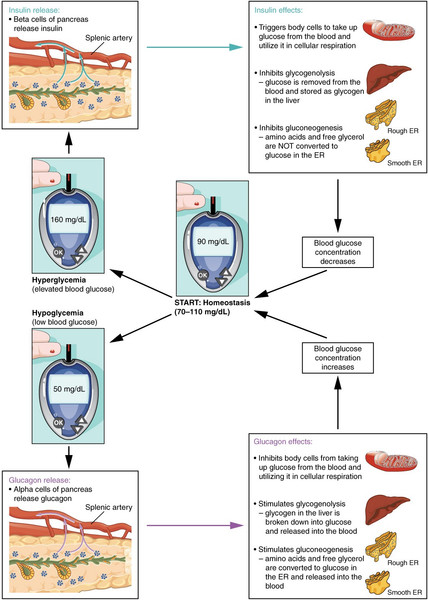
When blood glucose is too high
- Blood glucose rises after eating.
- The pancreas detects the increase.
- Beta cells in the pancreas release insulin.
- Insulin signals body cells, especially liver cells, to take up glucose.
- The liver stores glucose as glycogen.
- Blood glucose falls back toward the set point.
When blood glucose is too low
- Blood glucose drops.
- The pancreas detects the decrease.
- Alpha cells in the pancreas release glucagon.
- Glucagon signals the liver to break down glycogen.
- The liver releases glucose into the blood.
- Blood glucose rises back toward the set point.
What ties this together is scale.
- Molecular: insulin and glucagon bind receptors
- Cellular: liver and other cells change glucose uptake or release
- Organismal: blood glucose stays in a normal range
If insulin is missing or cells do not respond to insulin, blood glucose stays high instead of returning efficiently toward the set point.
Positive Feedback Examples That Drive a Process Forward
Onset of labor in childbirth
The childbirth loop is a classic positive feedback example because each contraction increases the stimulus that triggers the next one.
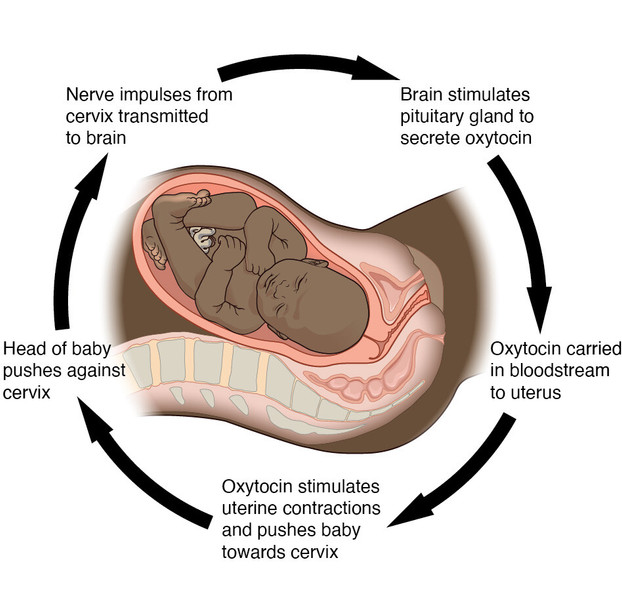
Positive feedback during labor
- Baby’s head pushes on the cervix.
- Signals cause oxytocin release.
- Oxytocin increases uterine contractions.
- Stronger contractions increase pressure on the cervix.
- The loop continues until birth removes the stimulus.
Lactation in mammals
- A baby suckles.
- Nerve signals go to the brain.
- Hormones stimulate milk production and milk release.
- More feeding causes more milk release and continued production.
- The loop stops when nursing stops.
Ripening of fruit
- Ripe fruit releases ethylene.
- Ethylene causes nearby fruit to ripen.
- Ripening fruit releases more ethylene.
- The ripening spreads as a cascade.
How to Explain Feedback on the Exam
When you explain a feedback loop, include these parts:
- Stimulus or change
- Sensor or detecting structure, if given
- Signal
- Response
- Result
Strong AP-style explanations sound like this:
- Negative feedback: the response counteracts the change and returns the variable toward the set point.
- Positive feedback: the response amplifies the change until the process is completed or interrupted.
A very common test move is disruption.
- If part of a negative feedback loop is disrupted, predict that the variable will fail to return toward set point.
- If part of a positive feedback loop is disrupted, predict that the process will fail to continue or finish.
Key Takeaways
Homeostasis
Maintenance of a relatively stable internal environment despite internal or external changes.
Feedback Mechanisms
Regulatory loops in which a system's output influences its own activity.
Negative Feedback
A response that counteracts a change and returns conditions toward a set point.
Positive Feedback
A response that amplifies a change and moves conditions farther from a set point.
Set Point
The target value or normal range a regulated condition tends to return to.
Blood Glucose Regulation by Insulin and Glucagon
Insulin lowers blood sugar by promoting storage; glucagon raises it by stimulating glycogen breakdown.
Labor and Childbirth Feedback Loop
Cervical stretching triggers oxytocin release, which intensifies contractions until birth ends the loop.
Oxytocin
A hormone that stimulates uterine contractions and milk release during positive feedback responses.
Lactation in Mammals
Suckling stimulates hormone release, increasing milk production and release until nursing stops.
Fruit Ripening
Ethylene from ripening fruit stimulates nearby fruits to ripen and release more ethylene.
Molecular, Cellular, and Organismal Levels of Feedback
Regulation occurs through molecule interactions, cell responses, and coordinated whole-body system changes.
Insulin and Glucagon
Pancreatic hormones that lower or raise blood glucose to maintain homeostasis.
Diabetes and Feedback Disruption
A disorder in which insulin production or response fails, disrupting blood glucose homeostasis.
Positive vs. Negative Feedback
One amplifies change, while the other reverses change to restore a set point.
Notes
Homeostasis
Maintenance of a relatively stable internal environment despite internal or external changes.
Feedback Mechanisms
Regulatory loops in which a system's output influences its own activity.
Negative Feedback
A response that counteracts a change and returns conditions toward a set point.
Positive Feedback
A response that amplifies a change and moves conditions farther from a set point.
Set Point
The target value or normal range a regulated condition tends to return to.
Blood Glucose Regulation by Insulin and Glucagon
Insulin lowers blood sugar by promoting storage; glucagon raises it by stimulating glycogen breakdown.
Labor and Childbirth Feedback Loop
Cervical stretching triggers oxytocin release, which intensifies contractions until birth ends the loop.
Oxytocin
A hormone that stimulates uterine contractions and milk release during positive feedback responses.
Lactation in Mammals
Suckling stimulates hormone release, increasing milk production and release until nursing stops.
Fruit Ripening
Ethylene from ripening fruit stimulates nearby fruits to ripen and release more ethylene.
Molecular, Cellular, and Organismal Levels of Feedback
Regulation occurs through molecule interactions, cell responses, and coordinated whole-body system changes.
Insulin and Glucagon
Pancreatic hormones that lower or raise blood glucose to maintain homeostasis.
Diabetes and Feedback Disruption
A disorder in which insulin production or response fails, disrupting blood glucose homeostasis.
Positive vs. Negative Feedback
One amplifies change, while the other reverses change to restore a set point.
