Topic 7.3 Notes – Artificial Selection
1. What Artificial Selection Is
Artificial selection is human-directed evolution. Humans choose organisms with desirable traits and allow them to reproduce more than others. That choice changes the population’s allele frequencies over time.
Quick connection to what you already know:
- Evolution = change in allele frequencies in a population over generations.
- Selection requires
- Heritable variation (traits must be genetic)
- Differential reproduction (some individuals leave more offspring)
In artificial selection:
- Humans are the selective pressure
- Individuals with preferred phenotypes reproduce more
- Alleles for those traits increase in frequency
This is still evolution. The mechanism is the same as natural selection. The only difference is who is doing the selecting.
A key AP idea here is that artificial selection directly affects genetic diversity within a population. It can increase certain alleles while decreasing others at the same time.
2. How Artificial Selection Changes Genetic Diversity
Artificial selection doesn’t just “add traits.” It reshapes variation in multiple ways.
Increasing the Frequency of Specific Traits
When breeders repeatedly choose individuals with a certain phenotype:
- The alleles underlying that trait increase in frequency.
- The trait becomes more common each generation.
- Change can happen quickly because mating is controlled.
Examples:
- Cows selected for higher milk production
- Plants bred for larger fruit size
- Dogs bred for specific behaviors like herding
If a question gives you data showing a steady increase in one phenotype across generations after selective breeding, that’s artificial selection changing allele frequency.
Reducing Overall Genetic Variation
Here’s the trade-off.
If only a small subset of individuals are allowed to reproduce:
- The gene pool shrinks
- Some alleles are lost entirely
- Inbreeding becomes more likely
This can create:
- Reduced heterozygosity
- Increased expression of harmful recessive alleles
- Less ability to respond to environmental change
On FRQs, if you’re asked how artificial selection might affect a population’s ability to adapt, the answer often connects to reduced genetic diversity.
Maintaining Traits That Would Not Survive in Nature
Humans often protect organisms from environmental pressures.
That allows traits to persist that might reduce survival in the wild:
- Very large fruits that can’t disperse naturally
- Dog breeds with extreme body shapes
- Livestock bred for rapid growth but poor mobility
In nature, those traits might be selected against. Under human care, they increase.
Combining Traits from Different Populations
Breeders sometimes cross individuals from different populations to introduce new alleles.
This can:
- Increase variation for a specific trait
- Still narrow overall diversity if only select offspring are bred
So artificial selection can both increase and decrease variation depending on what humans choose.
3. Examples of Artificial Selection Over Time
Seeing real examples makes the mechanism clearer.
Dogs from Wolves
All modern dog breeds descended from wolves.
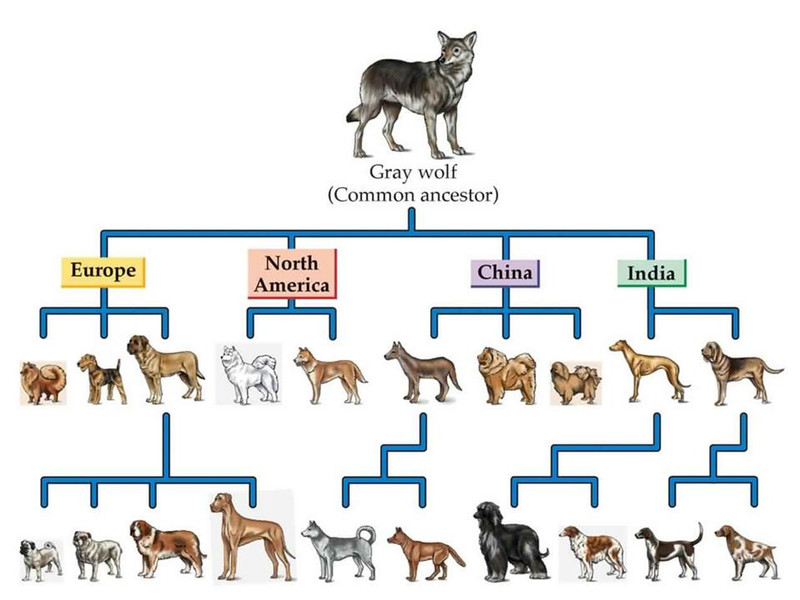
Descent of modern dog breeds from the gray wolf
The branching pattern above shows the gray wolf as the common ancestor, with different regional lineages giving rise to many modern breeds.
Humans selected for:
- Size
- Behavior (herding, guarding, companionship)
- Coat type and color
- Skull and facial structure
Result:
- Huge phenotypic diversity
- Often very low genetic diversity within individual breeds
Purebred dogs are a classic example of how strong selection plus small breeding pools can increase health problems.
Crop Plants
Corn from Teosinte
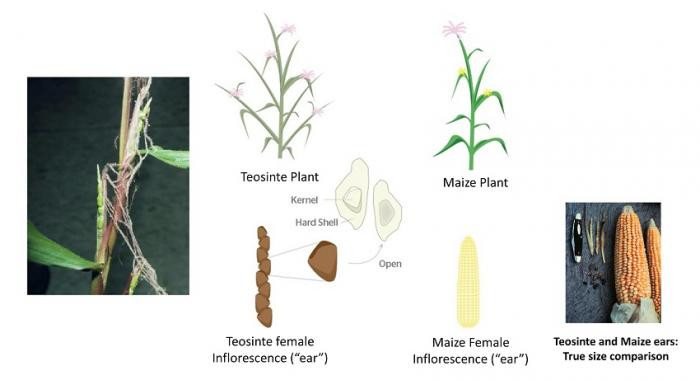
Teosinte compared with modern maize (corn)
The image compares the small wild teosinte plant and its hard, few-seeded ears with modern maize, which has large ears packed with exposed kernels.
Teosinte was a small wild grass. Through repeated selection for:
- Larger kernels
- More kernels per cob
- Softer seed coverings
Humans transformed it into modern corn.
Wild Mustard to Many Vegetables
One wild mustard species was selectively bred into:
- Cabbage (leaves)
- Broccoli (flower buds)
- Cauliflower (flower clusters)
- Kale (leaves)
- Brussels sprouts (lateral buds)
Different plant parts were targeted. Same ancestor, very different phenotypes.
If the AP gives you a diagram of multiple vegetables from one ancestor, they’re testing your understanding that selection on different traits can cause divergence within a species.
4. Artificial Selection vs Natural Selection
Both processes change allele frequencies. The difference is the source of selection pressure.
| Feature | Natural Selection | Artificial Selection |
|---|---|---|
| Selective pressure | Environment (predators, climate, competition) | Humans |
| Trait advantage | Improves survival and reproduction in nature | Useful or desirable to humans |
| Speed | Often gradual (can be rapid) | Often rapid due to controlled breeding |
Both require:
- Heritable variation
- Differential reproductive success
- Multiple generations
If a question asks whether artificial selection is “evolution,” the answer is yes because allele frequencies change over time.
5. Consequences and Trade-Offs of Artificial Selection
Artificial selection demonstrates how powerful selection can be.
Rapid Evolution
Because humans:
- Control mating
- Prevent unwanted individuals from reproducing
- Apply consistent selection each generation
Populations can change dramatically in relatively few generations.
Trade-Offs and Health Problems
Selecting strongly for one trait can affect others.
Examples:
- Dog breeds with breathing problems due to skull shape
- Crops bred for yield but more susceptible to disease
- Livestock with reduced fertility
Reasons include:
- Gene linkage
- Pleiotropy (one gene affects multiple traits)
- Energy trade-offs
Increased Dependence on Humans
Some domesticated species:
- Cannot disperse seeds effectively
- Cannot compete in the wild
- Require assistance to reproduce
Artificial selection can reduce fitness outside of human-managed environments.
Key Takeaways
Artificial Selection vs. Natural Selection
Human preferences drive one; environmental pressures drive the other, though both change allele frequencies.
Selection Pressure
A factor that causes some traits to be favored and reproduced more than others.
Genetic Variation in Artificial Selection
Breeding for a few traits often narrows the range of alleles within a population.
Genetic Bottleneck from Selective Breeding
A loss of diversity caused when only a small subset of individuals contributes genes.
Domestication
The long-term human shaping of species through repeated selection for useful or preferred traits.
Rapid Change Under Artificial Selection
Noticeable trait shifts can occur in few generations because humans control mating consistently.
Trade-Offs of Artificial Selection
Selected traits may increase usefulness while also causing health, fertility, or disease-susceptibility problems.
Dependence on Humans
Some domesticated populations become unable to survive or reproduce effectively without human assistance.
Dog Breeding from Wolves
Many dog breeds arose by repeatedly selecting wolf descendants for size, behavior, and body traits.
Crop Domestication Examples
Teosinte to maize, wild mustard to brassicas, and wild watermelon to larger sweeter forms.
Artificial Selection (Selective Breeding)
Human-directed breeding that makes chosen inherited traits more common in a population.
Notes
Artificial Selection vs. Natural Selection
Human preferences drive one; environmental pressures drive the other, though both change allele frequencies.
Selection Pressure
A factor that causes some traits to be favored and reproduced more than others.
Genetic Variation in Artificial Selection
Breeding for a few traits often narrows the range of alleles within a population.
Genetic Bottleneck from Selective Breeding
A loss of diversity caused when only a small subset of individuals contributes genes.
Domestication
The long-term human shaping of species through repeated selection for useful or preferred traits.
Rapid Change Under Artificial Selection
Noticeable trait shifts can occur in few generations because humans control mating consistently.
Trade-Offs of Artificial Selection
Selected traits may increase usefulness while also causing health, fertility, or disease-susceptibility problems.
Dependence on Humans
Some domesticated populations become unable to survive or reproduce effectively without human assistance.
Dog Breeding from Wolves
Many dog breeds arose by repeatedly selecting wolf descendants for size, behavior, and body traits.
Crop Domestication Examples
Teosinte to maize, wild mustard to brassicas, and wild watermelon to larger sweeter forms.
Artificial Selection (Selective Breeding)
Human-directed breeding that makes chosen inherited traits more common in a population.
