Topic 2.9 Notes – Cell Compartmentalization
1. What Cell Compartmentalization Is
In eukaryotic cells, membranes divide the inside of the cell into distinct regions called organelles. Each organelle has:
- A specific set of enzymes
- A specific pH and ion concentration
- Specific substrates and products
That means metabolic pathways are physically separated. A reaction in one compartment doesn’t automatically interfere with another.
Prokaryotes vs. Eukaryotes
This is a major contrast point.
Prokaryotes
- No membrane-bound organelles
- Transcription and translation occur in the same space
Eukaryotes
- DNA enclosed in a nucleus
- Transcription (nucleus) and translation (cytoplasm) are separated
That separation allows tighter regulation of gene expression and supports greater cellular complexity.
Compartmentalization directly supports:
- Efficient energy use
- Specialization of function
- Maintenance of homeostasis
2. Membrane-Bound Organelles of Eukaryotic Cells
You should know both structure and function for each.
Nucleus
- Surrounded by a double membrane called the nuclear envelope
- Contains nuclear pores for regulated transport
- Houses DNA
Functions:
- Protects genetic material
- Separates transcription from translation
- Enables controlled gene expression
This separation is a frequent test point. If a question asks how eukaryotes regulate gene expression more precisely than prokaryotes, the nucleus is part of that answer.
Endoplasmic Reticulum
The ER is continuous with the nuclear envelope.
Rough ER
- Studded with ribosomes
- Synthesizes proteins for:
- Secretion
- Membranes
- Organelles
- Performs protein folding and quality control
Smooth ER
- No ribosomes
- Functions:
- Lipid synthesis
- Detoxification
- Calcium storage
The distinction between rough and smooth ER shows up constantly. Rough = proteins. Smooth = lipids and detox.
Golgi Apparatus
- Flattened membrane sacs called cisternae
- Organized from cis → medial → trans
Functions:
- Modifies proteins (ex: glycosylation)
- Sorts and packages them into vesicles
- Directs them to correct destinations
Each region has different enzymes, so proteins are processed step by step as they move through.
Lysosomes
- Membrane-bound sacs with digestive enzymes
- Maintain an acidic interior
Functions:
- Break down macromolecules
- Recycle organelles (autophagy)
- Destroy pathogens
The membrane prevents enzymes from digesting the cytoplasm. If that membrane fails, cell damage occurs.
Mitochondria
Mitochondria have a distinctive double membrane structure, shown below.
- Outer membrane
- Inner membrane folded into cristae
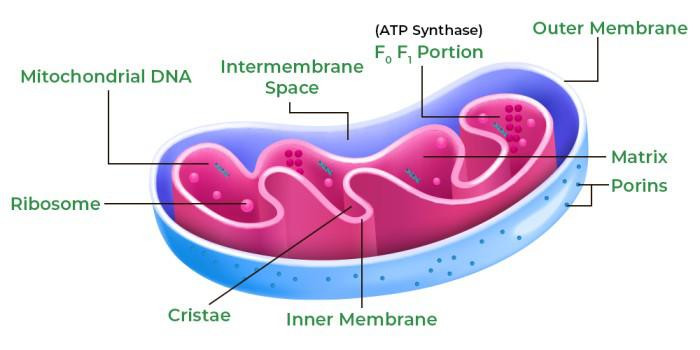
Structure of a mitochondrion
Functions:
- Cellular respiration
- ATP production
The inner membrane folds form cristae, which increase surface area for the electron transport chain and ATP synthase. More surface area means more ATP can be produced at once.
The diagram also shows the matrix, which contains mitochondrial DNA and ribosomes. Mitochondria have their own genetic material, which supports the endosymbiotic theory.
Peroxisomes
Contain oxidative enzymes.
Functions:
- Break down fatty acids
- Detoxify harmful substances
- Convert hydrogen peroxide into water and oxygen
They isolate potentially dangerous oxidative reactions.
Vacuoles
Membrane-bound storage compartments.
- Large central vacuole in plant cells
Functions:
- Store water, nutrients, waste
- Maintain turgor pressure in plants
- Isolate harmful materials
Loss of turgor pressure leads to wilting.
3. How Internal Membranes Improve Efficiency
Compartmentalization improves efficiency in three key ways.
Creating Specialized Environments
Different organelles maintain different internal conditions:
- Lysosome → acidic pH
- Cytoplasm → near neutral
- Mitochondrial matrix → specific ion gradients
Enzymes work best under specific conditions. Separation keeps each pathway operating optimally.
Increasing Surface Area
Internal membranes dramatically expand available reaction space.
Examples:
- Mitochondrial cristae
- Extensive ER membrane network
More membrane surface means:
- More embedded enzymes
- More electron transport chains
- More ATP synthase
More surface area equals higher reaction capacity.
Separating Incompatible Reactions
Some reactions would interfere with others if mixed.
Examples:
- DNA replication vs. protein synthesis
- Digestive enzymes vs. cytoplasmic proteins
- Oxidative reactions vs. sensitive molecules
Membranes isolate harmful intermediates and reduce unwanted interactions.
If you see a free-response question asking why a mutation disrupting an organelle membrane decreases efficiency, think: loss of separation, loss of optimal conditions, increased interference.
4. Why Compartmentalization Supports Complex Life
By localizing enzymes and substrates, eukaryotic cells:
- Run multiple pathways simultaneously
- Reduce random molecular collisions
- Increase reaction rates
- Coordinate energy flow
- Maintain stable internal conditions
This organization supports the energetic demands of multicellular organisms.
The core idea tying this topic together is simple: membrane-bound organelles isolate processes, increase surface area, and create optimal environments, which increases efficiency and supports complex cellular functions.
Key Takeaways
Membrane-Bound Organelles
Specialized eukaryotic structures enclosed by membranes that isolate specific metabolic processes and reactions.
Rough ER and Smooth ER
Rough ER synthesizes and folds proteins; smooth ER makes lipids, detoxifies, and stores calcium.
Golgi Apparatus
Stack of membrane sacs that modifies, sorts, and packages molecules into vesicles.
Lysosome
Acidic membrane-bound sac containing hydrolytic enzymes that digest macromolecules and worn-out cell parts.
Mitochondrion
Double-membraned organelle that carries out cellular respiration and produces most cellular ATP.
Cristae
Folds of the inner mitochondrial membrane that increase surface area for ATP-producing reactions.
Peroxisome
Membrane-bound organelle that breaks down fatty acids and detoxifies harmful compounds using oxidative enzymes.
Vacuole
Membrane-bound storage compartment for water, ions, nutrients, and wastes; large in many plant cells.
Protein Localization in Membranes
Placement of specific enzymes, receptors, and transport proteins in particular membranes for specialized functions.
Eukaryotes vs. Prokaryotes in Compartmentalization
Eukaryotes use membrane-bound organelles to separate functions; prokaryotes lack most internal membrane compartments.
Cell Compartmentalization
Organization of eukaryotic cells into membrane-bound compartments that separate reactions and increase surface area.
Nucleus
Double-membraned organelle with pores that stores DNA and separates transcription from translation.
Chloroplast
Double-membraned plant organelle whose internal membranes carry out photosynthesis and increase reaction surface area.
Notes
Membrane-Bound Organelles
Specialized eukaryotic structures enclosed by membranes that isolate specific metabolic processes and reactions.
Rough ER and Smooth ER
Rough ER synthesizes and folds proteins; smooth ER makes lipids, detoxifies, and stores calcium.
Golgi Apparatus
Stack of membrane sacs that modifies, sorts, and packages molecules into vesicles.
Lysosome
Acidic membrane-bound sac containing hydrolytic enzymes that digest macromolecules and worn-out cell parts.
Mitochondrion
Double-membraned organelle that carries out cellular respiration and produces most cellular ATP.
Cristae
Folds of the inner mitochondrial membrane that increase surface area for ATP-producing reactions.
Peroxisome
Membrane-bound organelle that breaks down fatty acids and detoxifies harmful compounds using oxidative enzymes.
Vacuole
Membrane-bound storage compartment for water, ions, nutrients, and wastes; large in many plant cells.
Protein Localization in Membranes
Placement of specific enzymes, receptors, and transport proteins in particular membranes for specialized functions.
Eukaryotes vs. Prokaryotes in Compartmentalization
Eukaryotes use membrane-bound organelles to separate functions; prokaryotes lack most internal membrane compartments.
Cell Compartmentalization
Organization of eukaryotic cells into membrane-bound compartments that separate reactions and increase surface area.
Nucleus
Double-membraned organelle with pores that stores DNA and separates transcription from translation.
Chloroplast
Double-membraned plant organelle whose internal membranes carry out photosynthesis and increase reaction surface area.
