Topic 5.1 Notes – Meiosis
What Meiosis Is and Why It Matters
In humans and most animals, body cells are diploid (2n). That means they have two sets of chromosomes, one from each parent. Gametes (sperm and eggs) are haploid (n) and carry only one set.
Meiosis is the process that turns one diploid cell into haploid gametes.
The structure of the process matters:
- One round of DNA replication in S phase
- Followed by two cell divisions
- Meiosis I
- Meiosis II
That combination is what cuts the chromosome number in half.
Chromosome Transmission Across Generations
Think about what would happen without reduction. If sperm and egg were both diploid, fertilization would double chromosome number every generation.
Instead, the life cycle works like this:
- Parent organism is 2n (diploid).
- Meiosis produces n (haploid) gametes.
- Fertilization fuses two haploid gametes → 2n zygote.
- The zygote grows by mitosis into the next diploid organism.
In the diagram below, notice how meiosis reduces chromosome number from diploid adults to haploid gametes, and fertilization restores the diploid state.
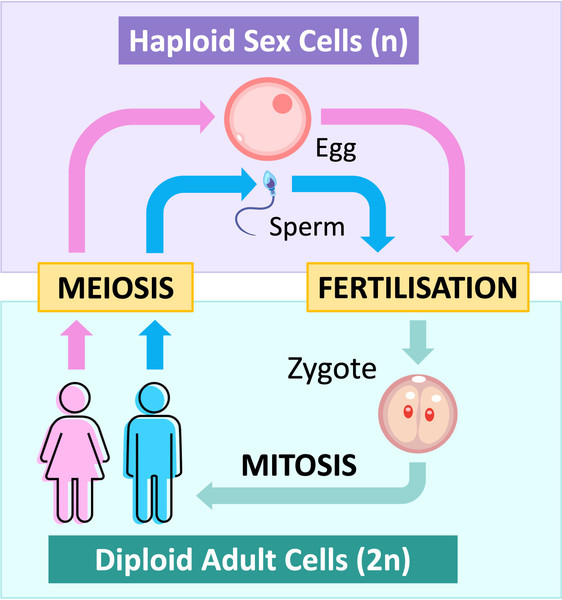
Sexual life cycle showing meiosis, fertilization, and mitosis
This cycle:
- Keeps chromosome number constant in a species.
- Ensures each parent contributes one full set of chromosomes.
That transmission of genetic information across generations is the core idea of this topic.
The Phases of Meiosis
There are two divisions. The key difference between them is what gets separated.
Meiosis I
Meiosis I is the reduction division. It separates homologous chromosomes, cutting the chromosome number in half.
Prophase I
This is the most unique stage in all of cell division.
- Chromosomes condense.
- Homologous chromosomes pair up in a process called synapsis.
- Paired chromosomes form structures called tetrads.
- Chiasmata may form where crossing over occurs.
- Spindle begins forming.
- Centrosomes move to opposite poles.
- Nuclear envelope breaks down.
The diagram below shows homologous chromosomes pairing into a tetrad, forming a chiasma, and producing recombinant chromatids after crossing over.
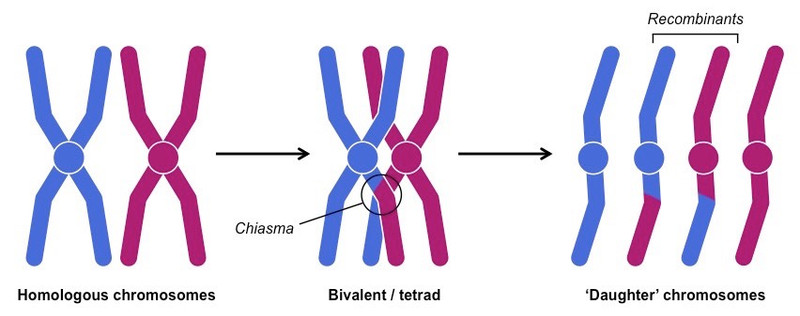
Crossing over during Prophase I
Metaphase I
- Homologous pairs align at the metaphase plate.
- Spindle fibers attach to kinetochores.
Important: chromosomes line up as pairs, not single file like mitosis.
Anaphase I
- Homologous chromosomes separate.
- Sister chromatids stay attached.
This is a major test point. If homologs separate, it is Meiosis I.
Telophase I and Cytokinesis
- Spindle breaks down.
- Nuclear envelope may reform.
- Cleavage furrow (animals) or cell plate (plants) forms.
- Result: two haploid cells, but chromosomes are still duplicated.
Meiosis II
Meiosis II looks very similar to mitosis, except it starts with haploid cells.
Prophase II
- Spindle forms.
- Chromosomes attach to spindle at centromeres.
Metaphase II
- Chromosomes align single file at the metaphase plate.
- Each chromatid’s kinetochore attaches to microtubules from opposite poles.
Anaphase II
- Proteins at centromeres break down.
- Sister chromatids separate.
Telophase II and Cytokinesis
- Spindle breaks down.
- Nuclear envelopes reform.
- Cytokinesis occurs.
- Result: four haploid cells, each with unduplicated chromosomes.
If you’re looking at a diagram and chromatids are separating in a haploid cell, that is Meiosis II.
Mitosis and Meiosis
They share machinery but produce very different outcomes.
Both:
- Follow DNA replication in S phase.
- Use a spindle apparatus to move chromosomes.
- Have prophase, metaphase, anaphase, telophase.
The outcomes are very different.
| Feature | Mitosis | Meiosis |
|---|---|---|
| Number of divisions | 1 | 2 |
| Number of daughter cells | 2 | 4 |
| Chromosome number | 2n → 2n | 2n → n |
| Genetic identity | Identical | Genetically unique |
| Homolog pairing | No | Yes (Prophase I) |
| What separates first | Sister chromatids | Homologous chromosomes |
A common mistake is mixing up Anaphase of mitosis with Anaphase I.
Mitosis separates sister chromatids.
Meiosis I separates homologs.
On tests, they often show you a cell with chromosomes moving and ask which phase it is. Focus on what is separating.
Key Takeaways
Meiosis
A two-division process that produces four haploid gametes from one diploid cell.
Diploid And Haploid
Diploid cells have two chromosome sets; haploid cells have one chromosome set.
Prophase I
Homologs pair, synapsis and crossing over occur, spindle forms, and nuclear envelope breaks down.
Synapsis
The pairing of homologous chromosomes during prophase I of meiosis.
Chiasmata
Visible crossover points where nonsister chromatids of homologs exchange DNA.
Crossing Over
Exchange of DNA between nonsister chromatids that creates new allele combinations.
Metaphase I
Homologous chromosome pairs line up together at the cell's equator.
Anaphase I
Homologous chromosomes separate to opposite poles while sister chromatids remain joined.
Telophase I And Cytokinesis
Chromosomes reach poles, nuclei may reform, and two haploid cells are produced.
Prophase II
A spindle forms in each haploid cell, and chromosomes attach for the second division.
Metaphase II
Individual chromosomes align at the metaphase plate in each haploid cell.
Anaphase II
Centromeres split and sister chromatids separate toward opposite poles.
Telophase II And Cytokinesis
Nuclei reform, chromosomes decondense, and four haploid cells with unduplicated chromosomes form.
Homologous Chromosomes Vs. Sister Chromatids
Homologs are matching maternal and paternal chromosomes; sister chromatids are identical copies of one chromosome.
Spindle Apparatus
A microtubule structure that attaches to chromosomes and moves them during cell division.
Kinetochore
A protein structure at the centromere where spindle microtubules attach.
Meiosis Vs. Mitosis
Meiosis has two divisions and makes four unique haploid cells; mitosis makes two identical diploid cells.
Fertilization And Chromosome Number
Fusion of two haploid gametes restores the diploid chromosome number in offspring.
Meiosis I Vs. Meiosis II
The first division separates homologous chromosomes and halves chromosome number; the second separates sister chromatids.
Sources Of Genetic Diversity In Meiosis
Variation arises from crossing over, independent assortment in metaphase I, and random fertilization.
Homologous Chromosomes
A maternal and paternal chromosome pair with the same genes at corresponding loci.
Cytokinesis
Division of the cytoplasm that physically separates daughter cells after nuclear division.
Notes
Meiosis
A two-division process that produces four haploid gametes from one diploid cell.
Diploid And Haploid
Diploid cells have two chromosome sets; haploid cells have one chromosome set.
Prophase I
Homologs pair, synapsis and crossing over occur, spindle forms, and nuclear envelope breaks down.
Synapsis
The pairing of homologous chromosomes during prophase I of meiosis.
Chiasmata
Visible crossover points where nonsister chromatids of homologs exchange DNA.
Crossing Over
Exchange of DNA between nonsister chromatids that creates new allele combinations.
Metaphase I
Homologous chromosome pairs line up together at the cell's equator.
Anaphase I
Homologous chromosomes separate to opposite poles while sister chromatids remain joined.
Telophase I And Cytokinesis
Chromosomes reach poles, nuclei may reform, and two haploid cells are produced.
Prophase II
A spindle forms in each haploid cell, and chromosomes attach for the second division.
Metaphase II
Individual chromosomes align at the metaphase plate in each haploid cell.
Anaphase II
Centromeres split and sister chromatids separate toward opposite poles.
Telophase II And Cytokinesis
Nuclei reform, chromosomes decondense, and four haploid cells with unduplicated chromosomes form.
Homologous Chromosomes Vs. Sister Chromatids
Homologs are matching maternal and paternal chromosomes; sister chromatids are identical copies of one chromosome.
Spindle Apparatus
A microtubule structure that attaches to chromosomes and moves them during cell division.
Kinetochore
A protein structure at the centromere where spindle microtubules attach.
Meiosis Vs. Mitosis
Meiosis has two divisions and makes four unique haploid cells; mitosis makes two identical diploid cells.
Fertilization And Chromosome Number
Fusion of two haploid gametes restores the diploid chromosome number in offspring.
Meiosis I Vs. Meiosis II
The first division separates homologous chromosomes and halves chromosome number; the second separates sister chromatids.
Sources Of Genetic Diversity In Meiosis
Variation arises from crossing over, independent assortment in metaphase I, and random fertilization.
Homologous Chromosomes
A maternal and paternal chromosome pair with the same genes at corresponding loci.
Cytokinesis
Division of the cytoplasm that physically separates daughter cells after nuclear division.
