Topic 3.3 Notes – Cellular Energy
1. Energy in Living Systems
Every living system requires a continuous input of energy. Your cells are never “off.”
Cells use energy to:
- Build molecules (DNA, proteins, membranes)
- Transport substances across membranes (active transport)
- Move (muscle contraction, cilia/flagella)
- Repair damage and replace worn-out parts
- Maintain organization (homeostasis)
If energy flow stops, organized structure breaks down. When that breakdown becomes significant, the cell dies. Death at the cellular level is the loss of controlled energy flow.
The First Law of Thermodynamics
Energy cannot be created or destroyed. It can only be transformed.
Cells do this constantly:
- Light energy → chemical energy (photosynthesis)
- Chemical energy in glucose → chemical energy in ATP (cellular respiration)
They aren’t making energy. They are converting it.
The Second Law of Thermodynamics
The universe trends toward increasing entropy (disorder).
Cells are highly ordered. So how is that allowed?
They maintain internal order by increasing disorder in their surroundings. For example:
- Cellular respiration releases heat
- Heat increases entropy in the environment
Order inside the cell is maintained as long as energy input exceeds energy loss. If energy loss outpaces input, organization collapses.
You do not need the Gibbs free energy equation for AP Bio. Just understand that reactions either release usable energy or require an input of it.
2. Energy Coupling and ATP
Cells connect reactions that release energy with reactions that require energy. This is called energy coupling.
Exergonic Reactions
These reactions:
- Release free energy
- Often involve breaking down molecules (catabolism)
- Have products with less stored energy than reactants
Example: Breaking down glucose during respiration.
Endergonic Reactions
These reactions:
- Require energy input
- Often involve building molecules (anabolism)
- Have products with more stored energy than reactants
Example: Building a protein from amino acids.
On their own, endergonic reactions would not proceed. They need help.
ATP as the Energy Intermediary
ATP (adenosine triphosphate) is the cell’s immediate energy currency.
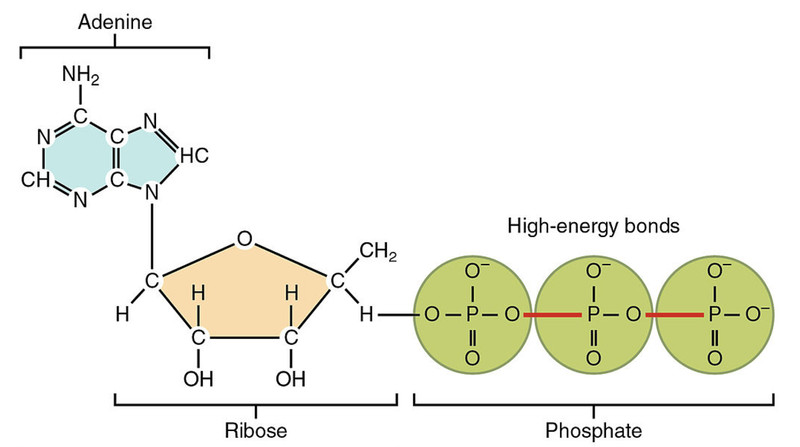
Structure of ATP showing adenine, ribose, and three phosphate groups
ATP is made of adenine, a ribose sugar, and three phosphate groups. The bonds between the phosphate groups are often called “high-energy” bonds because breaking the terminal phosphate bond releases usable energy.
Key idea:
When the terminal phosphate is removed (hydrolysis), energy is released.
Cells use this released energy to:
- Power active transport (like sodium-potassium pumps)
- Drive muscle contraction
- Fuel biosynthesis (making DNA, RNA, proteins)
Here’s the flow:
- Exergonic reactions (like glucose breakdown) → generate ATP
- ATP hydrolysis → powers endergonic reactions
That coupling is one of the most testable ideas in this unit. When you see a question asking how a non-spontaneous process occurs, the answer usually involves ATP hydrolysis.
3. Sequential Metabolic Pathways
Energy transformations happen in stepwise pathways, not one giant reaction.
A metabolic pathway is a series of enzyme-catalyzed reactions where:
- The product of one reaction becomes the reactant for the next.
Think of it as a chain of reactions, where each enzyme modifies the molecule slightly before passing it to the next step.
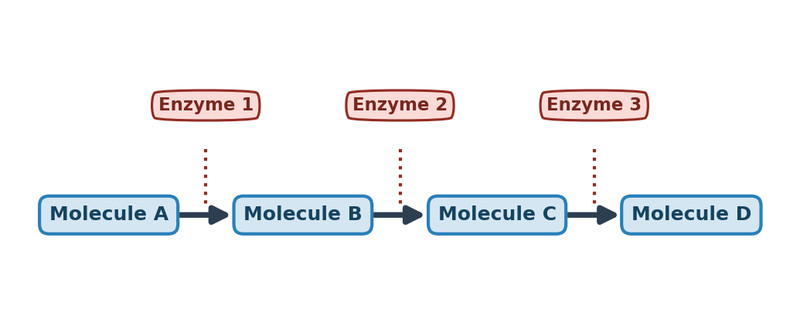
Sequential enzyme-catalyzed metabolic pathway
Why stepwise?
- Prevents a massive, uncontrolled energy release
- Allows gradual capture of energy in ATP or electron carriers
- Provides multiple regulation points (cells can speed up or slow down specific steps)
Examples you’ll see repeatedly:
- Glycolysis
- Citric acid cycle
- Oxidative phosphorylation
When working through pathway questions, trace:
- The original energy source (like glucose).
- Intermediate molecules formed.
- Where ATP or electron carriers are produced.
- Where most ATP is finally generated.
Students often forget that control happens at specific enzymes within the pathway. If an enzyme is inhibited, the whole pathway can slow or stop.
4. Conserved Metabolic Pathways and Common Ancestry
Core energy pathways are shared across:
- Bacteria
- Archaea
- Eukarya
Examples:
- Glycolysis (in the cytosol of almost all organisms)
- Electron transport chains
- ATP synthase machinery
These processes are conserved, meaning they have remained fundamentally similar across evolution.
If organisms that look completely different use the same biochemical energy systems, the most logical explanation is that they inherited them from a common ancestor.
On exam questions, thisoften shows up as: “Explain how shared metabolic pathways support the theory of evolution.” The connection is inheritance of core processes from an early ancestral cell.
Key Takeaways
First And Second Laws Of Thermodynamics
Energy is conserved, and every energy transfer increases entropy in the universe.
Energy Input And Energy Loss In Living Systems
Cells must gain more usable energy than they lose to maintain order and function.
Energy Coupling
Exergonic reactions drive endergonic reactions, often through ATP as an intermediate.
Exergonic And Endergonic Reactions
Exergonic reactions release free energy; endergonic reactions require an energy input.
ATP
The cell's main energy carrier, storing usable energy in phosphate bonds.
Loss Of Order Or Energy Flow And Death
Severe disruption of internal organization or energy transfer causes cells and organisms to die.
Glycolysis
A conserved pathway that splits glucose into pyruvate and captures energy in ATP and NADH.
Oxidative Phosphorylation
ATP production using an electron transport chain and chemiosmosis powered by redox reactions.
Electron Transport Chain
A series of membrane proteins that pass electrons and pump protons to build a gradient.
Sequential Metabolic Pathways
A series of reactions where each product becomes the next reactant, enabling controlled energy transfer.
Conserved Metabolic Pathways And Common Ancestry
Shared energy-processing pathways across all domains of life provide evidence of common ancestry.
Entropy
A measure of disorder that increases in the universe during energy transfers.
Notes
First And Second Laws Of Thermodynamics
Energy is conserved, and every energy transfer increases entropy in the universe.
Energy Input And Energy Loss In Living Systems
Cells must gain more usable energy than they lose to maintain order and function.
Energy Coupling
Exergonic reactions drive endergonic reactions, often through ATP as an intermediate.
Exergonic And Endergonic Reactions
Exergonic reactions release free energy; endergonic reactions require an energy input.
ATP
The cell's main energy carrier, storing usable energy in phosphate bonds.
Loss Of Order Or Energy Flow And Death
Severe disruption of internal organization or energy transfer causes cells and organisms to die.
Glycolysis
A conserved pathway that splits glucose into pyruvate and captures energy in ATP and NADH.
Oxidative Phosphorylation
ATP production using an electron transport chain and chemiosmosis powered by redox reactions.
Electron Transport Chain
A series of membrane proteins that pass electrons and pump protons to build a gradient.
Sequential Metabolic Pathways
A series of reactions where each product becomes the next reactant, enabling controlled energy transfer.
Conserved Metabolic Pathways And Common Ancestry
Shared energy-processing pathways across all domains of life provide evidence of common ancestry.
Entropy
A measure of disorder that increases in the universe during energy transfers.
