Topic 3.4 Notes – Photosynthesis
1. What Photosynthesis Is
At its core, photosynthesis uses light energy to convert carbon dioxide and water into carbohydrates and oxygen.
What that actually means:
- Carbon dioxide (CO₂) → carbon source for building sugars
- Water (H₂O) → source of electrons and hydrogen
- Light energy → powers the reactions
- Glucose (C₆H₁₂O₆) → stored chemical energy
- Oxygen (O₂) → released as a byproduct
This happens in chloroplasts of plants and algae. It first evolved in prokaryotes, specifically cyanobacteria. Their oxygen-producing photosynthesis led to the oxygenation of Earth’s atmosphere, which allowed aerobic respiration and complex life to evolve.
Chloroplasts themselves came from cyanobacteria through endosymbiosis. That’s why they have their own DNA and ribosomes. When the AP gives you evidence about circular DNA or double membranes, they’re pointing at this evolutionary origin.
2. Chloroplast Structure and Where Each Stage Happens
Structure explains function here. If you can picture the chloroplast, you can predict where each reaction occurs.
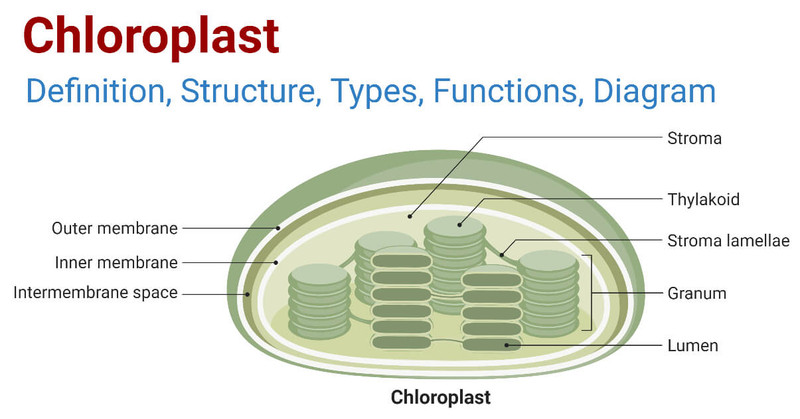
Chloroplast structure and internal membranes
Stroma
- Fluid inside the inner membrane
- Surrounds the thylakoids
- Site of the Calvin cycle (carbon fixation)
- Contains enzymes that build carbohydrates
Thylakoids
- Flattened membrane sacs
- Contain chlorophyll pigments
- Contain photosystems I and II
- Contain electron transport chain (ETC) proteins
- Site of the light reactions
Grana
- Stacks of thylakoids
- Increase membrane surface area
- Major location of light reactions
Big spatial rule to memorize:
- Light reactions → thylakoid membrane
- Calvin cycle → stroma
If a question asks where a proton gradient forms, think thylakoid membrane. If it asks where CO₂ becomes organic, think stroma.
3. The Light Reactions How Light Energy Becomes ATP and NADPH
The goal is to convert light energy into ATP and NADPH, which are usable forms of energy for the cell.
As you read through the steps below, use the diagram to trace the path of electrons from water to NADPH and the movement of H+ across the thylakoid membrane.
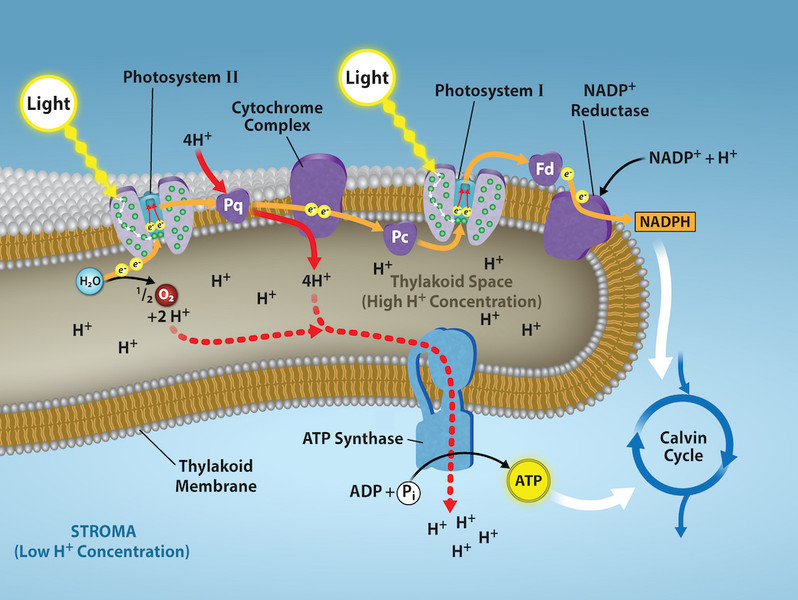
Light-dependent reactions across the thylakoid membrane
Step 1: Light excites electrons
- Chlorophyll absorbs photons.
- Electrons jump to a higher energy level.
- Happens in Photosystem II (PSII) and Photosystem I (PSI).
Step 2: Water is split (photolysis)
- Replaces electrons lost from PSII
- Releases oxygen
- Adds H⁺ to the thylakoid space
Students often forget this: the O₂ we breathe comes from water, not CO₂.
Step 3: Electron transport chain
- Electrons move PSII → plastoquinone (Pq) → cytochrome complex → plastocyanin (Pc) → PSI
- Each transfer is a redox reaction
- Energy released pumps H⁺ into the thylakoid space
This builds an electrochemical (proton) gradient:
- High H⁺ inside thylakoid
- Low H⁺ in stroma
Step 4: NADPH formation
- Electrons re-excited in PSI
- Passed to ferredoxin (Fd) and then to NADP⁺ reductase, forming NADPH
Step 5: ATP synthesis (photophosphorylation)
- H⁺ flows through ATP synthase
- Chemiosmosis drives ATP production
Outputs of light reactions:
- ATP
- NADPH
- O₂
The AP loves asking you to connect proton gradients across systems. The same logic appears in mitochondria and even prokaryotic membranes.
4. The Calvin Cycle How Carbon Is Fixed into Sugar
The Calvin cycle uses ATP and NADPH to build carbohydrates from CO₂.
- Occurs in the stroma
- Does not directly require light
- Requires ATP and NADPH from light reactions
Core idea:
- Carbon fixation converts inorganic CO₂ into organic molecules.
- Energy from ATP and high-energy electrons from NADPH become stored in sugar bonds.
You do not need to memorize enzyme names or every intermediate. Focus on the purpose:
Light reactions capture energy.
Calvin cycle stores that energy in stable carbohydrate molecules.
No ATP or NADPH means no carbon fixation.
5. How Photosynthesis Captures and Stores Energy
Energy flow looks like this:
- Light excites electrons.
- Electron energy drives proton pumping.
- Proton gradient powers ATP synthesis.
- Electrons reduce NADP⁺ → NADPH.
- ATP and NADPH power carbon fixation.
- Energy ends up stored in glucose bonds.
Photosynthesis is anabolic because it builds molecules.
Here’s how it complements respiration:
| Photosynthesis | Cellular Respiration |
|---|---|
| Chloroplast | Mitochondrion |
| Uses CO₂ | Produces CO₂ |
| Stores energy in glucose | Releases energy from glucose |
| Produces O₂ | Uses O₂ |
Energy entering ecosystems almost always starts with photosynthesis. When you analyze food webs or productivity data, you’re tracing stored solar energy.
Key Takeaways
Photosynthesis
Process that uses light, CO2, and H2O to produce carbohydrates and O2.
Overall Equation of Photosynthesis
6CO2 + 6H2O + light energy -> C6H12O6 + 6O2.
Chloroplast
Organelle where photosynthesis occurs, containing stroma and thylakoid membranes.
Stroma
Fluid inside the inner chloroplast membrane where the Calvin cycle occurs.
Thylakoids and Grana
Flattened membrane sacs stacked into grana where the light reactions occur.
Calvin Cycle
Stroma reactions that use ATP and NADPH to fix CO2 into carbohydrates.
Chlorophyll
Primary photosynthetic pigment that absorbs light and excites electrons.
Electron Transport Chain in Photosynthesis
Series of thylakoid membrane carriers that pass electrons from PSII to PSI.
NADP+ and NADPH
Electron carrier pair where NADP+ gains electrons and becomes high-energy NADPH.
Proton Gradient Across the Thylakoid Membrane
Higher H+ concentration inside thylakoids than in the stroma after electron transport.
Carbon Fixation
Incorporation of inorganic CO2 into organic molecules during the Calvin cycle.
Photosynthesis in Prokaryotes
Earliest form of this process, first evolving in bacteria before eukaryotes.
Cyanobacteria and the Oxygenated Atmosphere
Photosynthetic prokaryotes whose oxygen production helped create Earth's oxygen-rich atmosphere.
Endosymbiotic Origin of Chloroplasts
Idea that chloroplasts evolved from engulfed photosynthetic cyanobacteria in early eukaryotes.
Light Reactions
Thylakoid reactions that use light energy to produce ATP and NADPH.
Photosystems I and II
Thylakoid complexes that absorb light, excite electrons, and replace PSII electrons using water.
ATP Synthase and Photophosphorylation
Membrane protein that uses proton flow to make ATP during the light reactions.
Notes
Photosynthesis
Process that uses light, CO2, and H2O to produce carbohydrates and O2.
Overall Equation of Photosynthesis
6CO2 + 6H2O + light energy -> C6H12O6 + 6O2.
Chloroplast
Organelle where photosynthesis occurs, containing stroma and thylakoid membranes.
Stroma
Fluid inside the inner chloroplast membrane where the Calvin cycle occurs.
Thylakoids and Grana
Flattened membrane sacs stacked into grana where the light reactions occur.
Calvin Cycle
Stroma reactions that use ATP and NADPH to fix CO2 into carbohydrates.
Chlorophyll
Primary photosynthetic pigment that absorbs light and excites electrons.
Electron Transport Chain in Photosynthesis
Series of thylakoid membrane carriers that pass electrons from PSII to PSI.
NADP+ and NADPH
Electron carrier pair where NADP+ gains electrons and becomes high-energy NADPH.
Proton Gradient Across the Thylakoid Membrane
Higher H+ concentration inside thylakoids than in the stroma after electron transport.
Carbon Fixation
Incorporation of inorganic CO2 into organic molecules during the Calvin cycle.
Photosynthesis in Prokaryotes
Earliest form of this process, first evolving in bacteria before eukaryotes.
Cyanobacteria and the Oxygenated Atmosphere
Photosynthetic prokaryotes whose oxygen production helped create Earth's oxygen-rich atmosphere.
Endosymbiotic Origin of Chloroplasts
Idea that chloroplasts evolved from engulfed photosynthetic cyanobacteria in early eukaryotes.
Light Reactions
Thylakoid reactions that use light energy to produce ATP and NADPH.
Photosystems I and II
Thylakoid complexes that absorb light, excite electrons, and replace PSII electrons using water.
ATP Synthase and Photophosphorylation
Membrane protein that uses proton flow to make ATP during the light reactions.
