Topic 7.5 Notes – Hardy–Weinberg Equilibrium
1. What Hardy-Weinberg Equilibrium Is
Hardy-Weinberg equilibrium (HWE) describes a population where:
- Allele frequencies stay constant from one generation to the next.
- Genotype frequencies follow a predictable pattern based on those allele frequencies.
It’s a model of a non-evolving population. That matters because in AP Bio, evolution is defined very specifically as:
Evolution = change in allele frequencies over time.
So if allele frequencies do not change, the population is not evolving at that gene.
HWE works as a null hypothesis:
- If observed genotype frequencies match HWE predictions → no evidence of evolution.
- If they differ → something is disrupting equilibrium.
You are basically asking: Is this population behaving like it’s not evolving?
2. The Five Conditions Required for Hardy-Weinberg Equilibrium
All five conditions must be met for equilibrium. In real life, they never are perfectly met. That’s why evolution happens.
1. Large population size
Prevents genetic drift.
In small populations, allele frequencies can change just by chance.
2. No migration
Also called no gene flow.
If individuals enter or leave, they bring or remove alleles.
3. No mutations
Mutation creates new alleles.
New alleles change allele frequencies.
4. Random mating
Individuals mate without preference for genotype or phenotype.
If mating is nonrandom, genotype frequencies shift.
5. No natural selection
All genotypes have equal survival and reproductive success.
If one genotype leaves more offspring, its alleles increase.
Here’s a clean way to see how each condition connects to evolution:
| HWE Condition | If Violated, What Happens? | Evolutionary Force |
|---|---|---|
| Large population | Random allele shifts | Genetic drift |
| No migration | Alleles move between populations | Gene flow |
| No mutation | New alleles appear | Mutation |
| Random mating | Genotype ratios shift | Nonrandom mating |
| No selection | Some alleles favored | Natural selection |
Any violation can cause allele frequencies to change.
3. The Hardy-Weinberg Equations
These equations let you predict genotype frequencies from allele frequencies.
Allele Frequency Equation
- = frequency of one allele
- = frequency of the other allele
- Only works for two alleles at one gene
Genotype Frequency Equation
- = homozygous dominant
- = heterozygous
- = homozygous recessive
These represent proportions of the whole population.
You can picture this as a Punnett square built from allele frequencies:
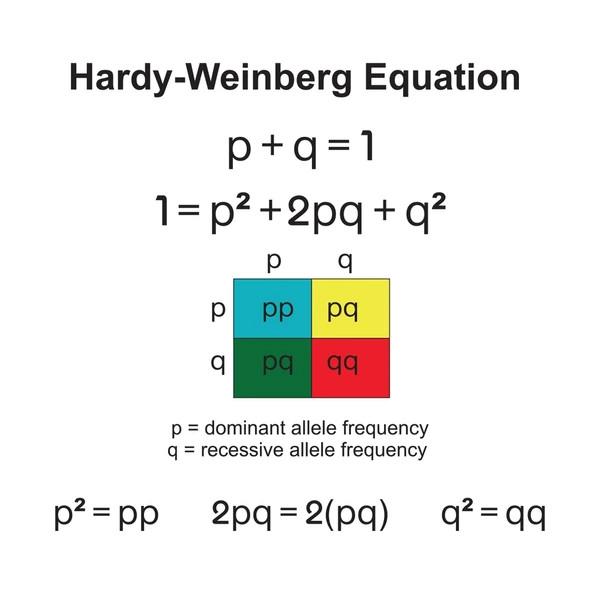
Hardy-Weinberg equations shown as a Punnett square
The sides are labeled and , and the four boxes give you , , , and . When you combine the two heterozygous boxes, you get .
The key idea is that allele frequencies determine genotype frequencies in a predictable way.
4. How to Solve Hardy-Weinberg Problems
On tests, you are usually given phenotype data.
Let’s walk through the logic.
Step 1: Identify the recessive phenotype
Only the recessive phenotype guarantees genotype (aa).
So its frequency = .
Step 2: Solve for
Step 3: Solve for
Step 4: Find genotype frequencies
- Homozygous dominant =
- Heterozygous =
- Homozygous recessive =
Step 5: Compare expected vs observed
If expected genotype frequencies do not match actual data, at least one HWE condition is violated.
A common AP move is giving you observed counts and asking whether evolution is occurring. That question is really asking whether the data fit HWE predictions.
5. When and Why Allele Frequencies Change
If allele frequencies change, evolution is happening.
Here’s how each force disrupts equilibrium:
- Genetic drift
Random changes, strongest in small populations. - Gene flow
Migration moves alleles between populations, often reducing differences between them. - Mutation
Introduces new alleles into the gene pool. - Natural selection
Increases frequency of alleles that improve survival or reproduction. - Nonrandom mating
Changes genotype frequencies immediately. By itself it may not change allele frequencies, but it can set the stage for selection to act.
Hardy-Weinberg gives you the mathematical expectation for stability. Real populations almost always deviate, and those deviations are evidence of evolution.
Key Takeaways
Hardy-Weinberg Equilibrium
A model in which allele and genotype frequencies stay constant in a non-evolving population.
Null Hypothesis for Evolution
The expectation that allele frequencies remain unchanged unless evolutionary forces act on the population.
Hardy-Weinberg Equations
p + q = 1 for allele frequencies; p^2 + 2pq + q^2 = 1 for genotype frequencies.
p and q
p is the frequency of one allele; q is the frequency of the other allele.
p^2, 2pq, and q^2
p^2 is homozygous dominant, 2pq is heterozygous, and q^2 is homozygous recessive.
Calculating Allele Frequencies From Genotype Frequencies
Find q from q^2 if needed, calculate p as 1 minus q, then use p^2, 2pq, and q^2.
Hardy-Weinberg Conditions
Large population, no migration, no mutation, random mating, and no natural selection prevent allele frequency change.
Notes
Hardy-Weinberg Equilibrium
A model in which allele and genotype frequencies stay constant in a non-evolving population.
Null Hypothesis for Evolution
The expectation that allele frequencies remain unchanged unless evolutionary forces act on the population.
Hardy-Weinberg Equations
p + q = 1 for allele frequencies; p^2 + 2pq + q^2 = 1 for genotype frequencies.
p and q
p is the frequency of one allele; q is the frequency of the other allele.
p^2, 2pq, and q^2
p^2 is homozygous dominant, 2pq is heterozygous, and q^2 is homozygous recessive.
Calculating Allele Frequencies From Genotype Frequencies
Find q from q^2 if needed, calculate p as 1 minus q, then use p^2, 2pq, and q^2.
Hardy-Weinberg Conditions
Large population, no migration, no mutation, random mating, and no natural selection prevent allele frequency change.
