Topic 2.8 Notes – Mechanisms of Transport
Active transport across membranes
Cell membranes are selectively permeable. Small nonpolar molecules can diffuse through, but ions and most polar molecules need help.
A quick reset:
- Concentration gradient = difference in solute concentration across a membrane
- Moving down a gradient (high → low) = passive transport
- Moving against a gradient (low → high) = active transport
Active transport is energetically unfavorable. The cell must input energy, usually from ATP hydrolysis:
That released energy is used to change the shape of a membrane protein so it can move a substance across the membrane.
Key features you should associate with active transport:
- Requires metabolic energy (ATP)
- Uses integral (transmembrane) proteins
- Moves substances against their concentration gradient
- Establishes and maintains electrochemical gradients
- Supports dynamic homeostasis
On tests, if you see a graph where a substance accumulates inside a cell even though it’s already more concentrated there, that’s a clue that ATP-powered transport is happening.
Membrane proteins in active transport
Active transport cannot occur without membrane proteins embedded in the phospholipid bilayer.
Transport proteins as pumps
These proteins:
- Bind specific ions or molecules (very selective)
- Use energy from ATP
- Undergo a conformational change (shape change)
- Release the substance on the opposite side of the membrane
Important idea:
ATP does not “push” the ion through the membrane. Instead, ATP changes the protein’s shape, and that shape change moves the ion.
ATPase enzymes
Many of these pumps are ATPases.
- “ATPase” means an enzyme that hydrolyzes ATP.
- They convert ATP → ADP + Pi.
- The phosphate group often temporarily attaches to the protein, triggering the shape change.
You may be asked to connect a mutation in a membrane protein to loss of ATPase activity. If ATP cannot be hydrolyzed, the pump cannot change shape, and transport stops.
The sodium-potassium pump
The Na⁺/K⁺-ATPase is the classic example you must know cold.
Here’s what it moves per 1 ATP:
- 3 Na⁺ out of the cell
- 2 K⁺ into the cell
Both are moved against their concentration gradients.
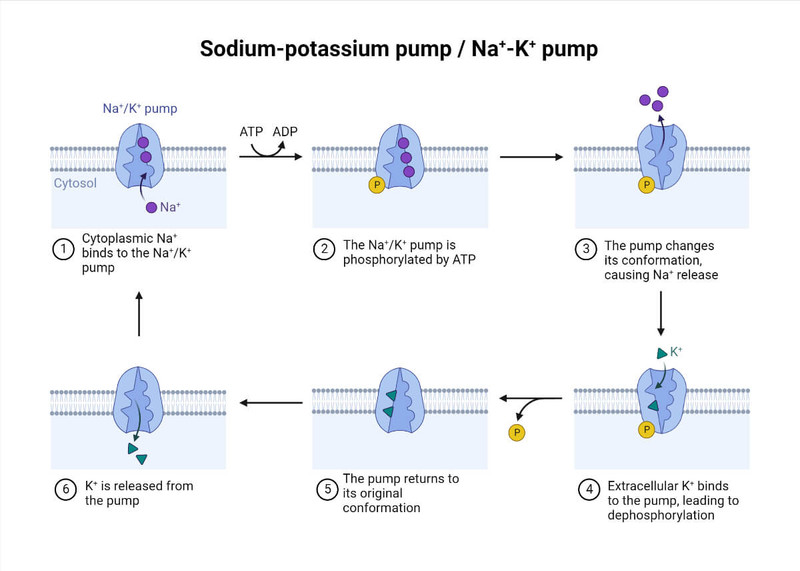
Na⁺/K⁺-ATPase transport cycle
How the cycle works
Follow the sequence in the diagram as you read through these steps.
- 3 Na⁺ bind on the inside (cytosol side).
- ATP is hydrolyzed; the protein becomes phosphorylated.
- The protein changes shape and releases 3 Na⁺ outside.
- 2 K⁺ bind from the outside (extracellular side).
- The phosphate is released.
- The protein returns to its original shape and releases 2 K⁺ inside.
This runs continuously.
Why 3 out and 2 in matters
- 3 positive charges leave.
- 2 positive charges enter.
- Net loss of 1 positive charge from the cell.
That contributes to a negative interior, which is part of the membrane potential.
If ATP production drops, this pump slows. Ion gradients weaken. Membrane potential collapses. That chain of reasoning shows up in free-response questions.
Electrochemical gradients and membrane potential
Active transport creates electrochemical gradients, which combine two things:
Chemical gradient
- Difference in ion concentration across the membrane.
- High Na⁺ outside, high K⁺ inside.
- Stores potential energy.
Electrical gradient (membrane potential)
- Difference in charge across the membrane.
- Inside of many cells is around -70 mV at rest.
- Caused by unequal ion distribution and the 3:2 pumping ratio.
Together, concentration difference + charge difference = electrochemical gradient.
That stored energy can later drive other processes. For example, Na⁺ moving back into the cell down its gradient can power secondary active transport.
Why active transport is essential
Active transport keeps the cell’s internal environment stable.
It:
- Maintains ion balance (prevents Na⁺ buildup inside)
- Helps regulate cell volume (ion imbalance changes water movement via osmosis)
- Enables electrical signaling in neurons and muscle cells
- Maintains the membrane potential
- Depends completely on ATP availability
On exams, you may see an experiment where ATP synthesis is inhibited. You should predict decreased pump activity, reduced ion gradients, and loss of membrane potential.
Key Takeaways
Active Transport
Movement of substances across a membrane against their concentration gradient using ATP.
ATP Hydrolysis in Active Transport
ATP is split into ADP and phosphate, releasing energy that powers membrane pumps.
Membrane Proteins in Active Transport
Selective transmembrane proteins bind specific solutes and change shape to move them across membranes.
ATPase
An enzyme that hydrolyzes ATP to provide energy for cellular processes such as ion pumping.
Electrochemical Gradient
A combined difference in ion concentration and electrical charge across a membrane.
Membrane Potential
The voltage difference across a membrane caused by unequal ion distribution on each side.
Na+/K+ Pump / Na+/K+-ATPase
An ATP-powered membrane protein that pumps 3 Na+ out and 2 K+ in, helping maintain membrane potential.
Notes
Active Transport
Movement of substances across a membrane against their concentration gradient using ATP.
ATP Hydrolysis in Active Transport
ATP is split into ADP and phosphate, releasing energy that powers membrane pumps.
Membrane Proteins in Active Transport
Selective transmembrane proteins bind specific solutes and change shape to move them across membranes.
ATPase
An enzyme that hydrolyzes ATP to provide energy for cellular processes such as ion pumping.
Electrochemical Gradient
A combined difference in ion concentration and electrical charge across a membrane.
Membrane Potential
The voltage difference across a membrane caused by unequal ion distribution on each side.
Na+/K+ Pump / Na+/K+-ATPase
An ATP-powered membrane protein that pumps 3 Na+ out and 2 K+ in, helping maintain membrane potential.
