Topic 7.2 Notes – Natural Selection
1. Natural Selection
Natural selection is the process where individuals with heritable traits that increase fitness leave more offspring, causing those traits to become more common over generations.
Fitness means relative reproductive success. It is about who contributes more genes to the next generation, not who is strongest or lives longest.
For natural selection to occur, all of these must be true:
- Phenotypic variation exists in the population (differences in color, size, behavior, enzyme activity, etc.).
- The variation is heritable (based in DNA, not just environment).
- Some traits affect survival and/or reproduction.
- The environment creates selective pressures.
Here is the core relationship you need to keep straight:
- Natural selection acts on phenotypes (what is expressed).
- Evolution is a change in allele frequencies in a population over time.
That phenotype-to-allele connection is huge on AP questions. They often describe visible traits and expect you to explain how allele frequencies shift across generations.
2. Phenotypic Variation and Why It Matters
A phenotype is any observable characteristic: morphology, physiology, or behavior.
Examples:
- Flowering time in plants
- Fur color in mammals
- Enzyme efficiency
- Resistance to a toxin
If every individual were genetically identical, environmental change would affect them all the same way. No one would have an advantage. No advantage means no selection.
Greater variation = greater chance that some individuals survive a new challenge.
Environmental Change Creates Selective Pressure
A selective pressure is any factor that affects survival or reproduction.
Abiotic pressures
- Temperature shifts (climate change)
- Drought or salinity
- Pollution (like DDT)
Biotic pressures
- Predators
- Disease (malaria)
- Competition
- Pollinator availability
As environments change, which phenotype has the highest fitness can change.
Example: Flowering Time and Climate Change
If springs become warmer earlier:
- Plants that flower earlier may avoid heat stress.
- But flowering too early risks frost damage.
- Plants with heritable variation in flowering time allow selection to favor the timing that best matches new conditions.
On a test, you might be shown flowering dates over time and asked to predict how allele frequencies will change. Always tie it back to heritable variation affecting reproductive success.
3. How Variations Affect Fitness
A trait can:
- Increase fitness in one environment
- Decrease fitness in another
- Benefit one genotype more than others
The environment determines what is advantageous.
Peppered Moths
This classic example shows how the same trait can be helpful or harmful depending on environmental conditions.
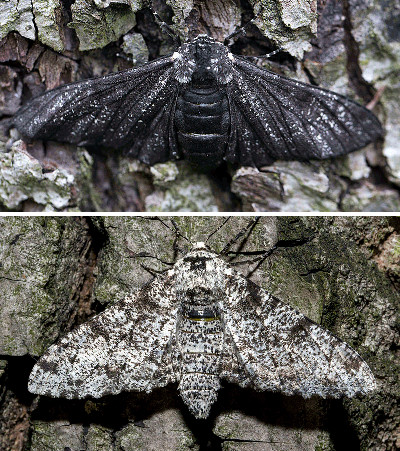
Light and dark morphs of the peppered moth on tree bark
What happened:
- Light and dark moths already existed.
- Industrial soot darkened trees.
- Dark moths were better camouflaged against the darker bark.
- Birds ate more visible moths.
- The dark allele frequency increased.
When pollution decreased and trees became lighter again, the trend reversed because light moths were less visible.
Important detail: pollution did not create the dark allele. It selected for it.
Sickle Cell Anemia
This example connects genotype, phenotype, and environment perfectly.
| Genotype | Phenotype | Fitness with Malaria | Fitness without Malaria |
|---|---|---|---|
| AA | Normal hemoglobin | Lower (susceptible) | High |
| AS | Sickle cell trait | Highest (resistant) | High |
| SS | Sickle cell disease | Very low | Very low |
In malaria regions, heterozygote advantage keeps the S allele in the population. This is called balanced polymorphism.
Change the environment, and the allele frequency shifts.
DDT Resistance in Insects
- Rare resistant individuals already exist.
- DDT kills susceptible insects.
- Resistant insects survive and reproduce.
- Resistance allele frequency increases.
Students often say the pesticide “caused” resistance. It did not. It selected from existing variation.
4. Molecular Variation Connects to Fitness
All phenotypic variation traces back to molecular variation.
DNA differences can change:
- Protein structure
- Enzyme efficiency
- Gene expression levels
- Number or types of molecules in cells
That molecular difference changes cell function, which changes phenotype, which affects fitness.
For example:
- A hemoglobin mutation changes protein shape.
- This alters red blood cell behavior.
- This changes malaria resistance.
- This affects reproductive success.
Populations with greater genetic diversity have more molecular variants. That increases the probability that some individuals will survive environmental change.
Low diversity means fewer options when conditions shift, which raises extinction risk.
Key Takeaways
Phenotypic Variation
Differences in observable traits among individuals in a population.
Natural Selection
Differential survival and reproduction of individuals with heritable traits in a given environment.
Heritable Variation
Trait differences that can be passed from parents to offspring genetically.
Selective Pressure
An environmental factor that causes some phenotypes to survive or reproduce more successfully.
Biotic and Abiotic Selective Pressures
Biotic pressures come from living factors; abiotic pressures come from nonliving conditions.
Fitness
Relative ability to survive and produce fertile offspring in a specific environment.
Molecular Variation and Fitness
Differences in cellular molecules can change function and affect survival and reproduction.
Genetic Diversity
The variety of alleles and genotypes present within a population.
Peppered Moth Example
Industrial soot favored dark moths over light moths by changing camouflage against predators.
Flowering Time and Climate Change
Warmer conditions can favor plants that flower earlier if timing improves reproduction.
DDT Resistance in Insects
Rare resistant insects survive insecticide exposure and pass resistance alleles to offspring.
Sickle Cell Trait and Heterozygote Advantage
In malarial regions, heterozygotes have the highest fitness, maintaining both alleles in the population.
Phenotype
An organism's observable traits produced by gene expression and environmental influences.
Notes
Phenotypic Variation
Differences in observable traits among individuals in a population.
Natural Selection
Differential survival and reproduction of individuals with heritable traits in a given environment.
Heritable Variation
Trait differences that can be passed from parents to offspring genetically.
Selective Pressure
An environmental factor that causes some phenotypes to survive or reproduce more successfully.
Biotic and Abiotic Selective Pressures
Biotic pressures come from living factors; abiotic pressures come from nonliving conditions.
Fitness
Relative ability to survive and produce fertile offspring in a specific environment.
Molecular Variation and Fitness
Differences in cellular molecules can change function and affect survival and reproduction.
Genetic Diversity
The variety of alleles and genotypes present within a population.
Peppered Moth Example
Industrial soot favored dark moths over light moths by changing camouflage against predators.
Flowering Time and Climate Change
Warmer conditions can favor plants that flower earlier if timing improves reproduction.
DDT Resistance in Insects
Rare resistant insects survive insecticide exposure and pass resistance alleles to offspring.
Sickle Cell Trait and Heterozygote Advantage
In malarial regions, heterozygotes have the highest fitness, maintaining both alleles in the population.
Phenotype
An organism's observable traits produced by gene expression and environmental influences.
