Topic 1.4 Notes – Carbohydrates
1. What Carbohydrates Are
Carbohydrates are organic molecules made of carbon, hydrogen, and oxygen, often in a ratio close to (like glucose, ).
They include:
- Sugars (small, simple carbohydrates)
- Complex carbohydrates (long chains of sugars)
All carbohydrates are built from monosaccharide monomers that link together to form larger molecules.
Their major roles:
- Energy storage
- Quick energy (glucose in blood)
- Stored energy (starch in plants, glycogen in animals)
- Structural support
- Cell walls in plants (cellulose)
- Cell recognition
- Short carbohydrate chains attached to proteins/lipids on cell membranes help cells identify each other
The unifying theme is simple: the way sugar units are arranged and bonded determines what the carbohydrate can do.
2. Monosaccharides and How They Form Polymers
Monosaccharides
These are the building blocks of all carbohydrates.
Common examples:
- Glucose
- Fructose
- Galactose
Inside cells, monosaccharides usually form ring structures rather than straight chains. Glucose, for example, commonly forms a six-membered ring like the one shown below.
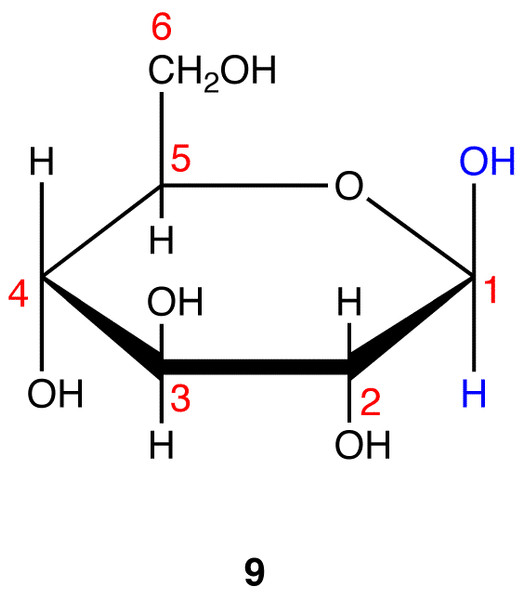
Haworth projection of glucose
Important features:
- Many hydroxyl (-OH) groups → makes them polar and water-soluble
- Used for immediate energy
- Can be rearranged slightly to form different sugars (same formula, different structure)
That structural flexibility is why glucose, fructose, and galactose have the same formula but behave differently.
Glycosidic Bonds
Monosaccharides connect via glycosidic bonds, which are covalent bonds.
They form through:
- Dehydration synthesis
- Removes a water molecule
- Links two sugars together
- They are broken by hydrolysis
- Adds water
- Splits the bond
The orientation of this bond matters a lot. An alpha linkage and a beta linkage create very different 3D shapes.
This is where many students lose points. The sugars can be identical, but if the bond orientation changes, the entire function changes.
Disaccharides
Two monosaccharides joined together.
Examples:
- Sucrose = glucose + fructose (transport sugar in plants)
- Lactose = glucose + galactose (milk sugar)
- Maltose = glucose + glucose
They are often used for short-term energy or transport.
Polysaccharides
Long chains of monosaccharides.
They can be:
- Linear
- Branched
Function depends on:
- Type of linkage (alpha or beta)
- Degree of branching
Now we can look at the major ones you must know.
3. Major Polysaccharides and Their Functions
All three below are made of glucose. What changes is how the glucose units are connected.
| Feature | Starch | Glycogen | Cellulose |
|---|---|---|---|
| Organism | Plants | Animals | Plants |
| Function | Energy storage | Energy storage | Structural support |
| Glucose linkage | Alpha | Alpha | Beta |
| Branching | Some | Highly branched | None |
| Human digestion | Yes | Yes | No |
Starch
- Plant energy storage
- Two forms:
- Amylose (mostly linear)
- Amylopectin (branched)
- Humans can digest it because we have enzymes for alpha linkages
Glycogen
- Animal energy storage
- Stored in liver and muscle
- Highly branched
- More branch points = more ends
- More ends = faster glucose release
On exams, branching is often tied to rate of energy mobilization.
Cellulose
- Structural component of plant cell walls
- Made of beta-glucose
- Forms straight chains
- Chains hydrogen-bond to each other → strong fibers
Humans lack the enzyme to break beta linkages, so cellulose passes as fiber.
Same monomer. Completely different function. All because of bond orientation.
4. How Structure Determines Function in Carbohydrates
Everything comes back to three structural features:
1. Bond Type
- Alpha linkages
- Bent or helical
- Good for compact energy storage
- Beta linkages
- Straight chains
- Allow tight packing and hydrogen bonding
- Strong and rigid
2. Branching
- More branching → more enzyme access → faster glucose release
- Less branching → stronger, more rigid structure
3. Hydrogen Bonding
- Cellulose chains form many hydrogen bonds between strands
- This gives plant cell walls high tensile strength
If you see an FRQ asking why glycogen allows rapid response to changing energy demands, mention branching and many available ends for enzymes. That wording earns points.
5. Why Carbohydrates Matter in Biological Systems
Carbohydrates:
- Store and release energy for metabolism
- Maintain energy balance in organisms
- Provide structural integrity in plants
- Help cells recognize and communicate with one another (surface carbohydrates)
Small molecular differences scale up to system-level effects. A tiny change in bond orientation can determine whether a molecule fuels your cells or builds a tree trunk.
That connection between molecular structure and large-scale biological function is exactly what this unit wants you to see.
Key Takeaways
Carbohydrates
Organic molecules of sugars and sugar polymers used for energy storage and structural support.
Monosaccharides
Single sugar units that act as monomers for larger carbohydrate molecules.
Polysaccharides
Long chains of monosaccharides linked by covalent bonds, forming linear or branched polymers.
Glycosidic Linkage
A covalent bond that joins monosaccharides together in carbohydrates.
Linear vs. Branched Polysaccharides
Some sugar polymers form straight chains, while others have side branches off the main chain.
Starch
A plant storage polysaccharide made of glucose monomers.
Glycogen
A highly branched glucose storage polysaccharide found in animals and fungi.
Cellulose
A structural polysaccharide in plant cell walls made of glucose monomers.
Notes
Carbohydrates
Organic molecules of sugars and sugar polymers used for energy storage and structural support.
Monosaccharides
Single sugar units that act as monomers for larger carbohydrate molecules.
Polysaccharides
Long chains of monosaccharides linked by covalent bonds, forming linear or branched polymers.
Glycosidic Linkage
A covalent bond that joins monosaccharides together in carbohydrates.
Linear vs. Branched Polysaccharides
Some sugar polymers form straight chains, while others have side branches off the main chain.
Starch
A plant storage polysaccharide made of glucose monomers.
Glycogen
A highly branched glucose storage polysaccharide found in animals and fungi.
Cellulose
A structural polysaccharide in plant cell walls made of glucose monomers.
