Topic 2.10 Notes – Origins of Cell Compartmentalization
1. What Cell Compartmentalization Is
Inside a cell, not everything happens in the same place. Compartmentalization means the cell is divided into different areas that carry out specific tasks.
In eukaryotic cells, these areas are usually separated by membrane-bound organelles. Each compartment can have:
- A different pH
- Different ion concentrations
- A specific set of enzymes
- Unique structural features (folded membranes, pores, etc.)
This connects directly to a huge biology theme: structure determines function.
Membranes create controlled environments, and those environments allow reactions to run more efficiently.
Compartmentalization is also one of the biggest differences between prokaryotes and eukaryotes, and that difference reflects their evolutionary history.
2. Prokaryotic vs. Eukaryotic Organization
Both cell types are organized. The key difference is whether they use membrane-bound compartments.
| Feature | Prokaryotic Cells | Eukaryotic Cells |
|---|---|---|
| Membrane-bound organelles | Absent | Present |
| Location of DNA | Nucleoid region (no membrane) | Inside nucleus (double membrane) |
| Transcription & Translation | Occur in same space (coupled) | Separated (nucleus vs cytoplasm/rough ER) |
| Cell size | Smaller | Larger |
| Internal specialization | May have folded membranes or regions, but no true organelles | Extensive internal membrane system |
A common mistake is saying prokaryotes are “simple” or “disorganized.” They are highly organized, just without membrane-bound compartments.
On tests, you’ll often be asked to compare how separating transcription and translation in eukaryotes affects regulation. The separation allows more control over gene expression, since RNA must exit the nucleus before being translated.
3. Major Membrane-Bound Organelles and What They Do
Here’s a standard labeled animal cell so you can visualize how these compartments fit together. As you read through each organelle below, use the diagram to see where it sits relative to the others.
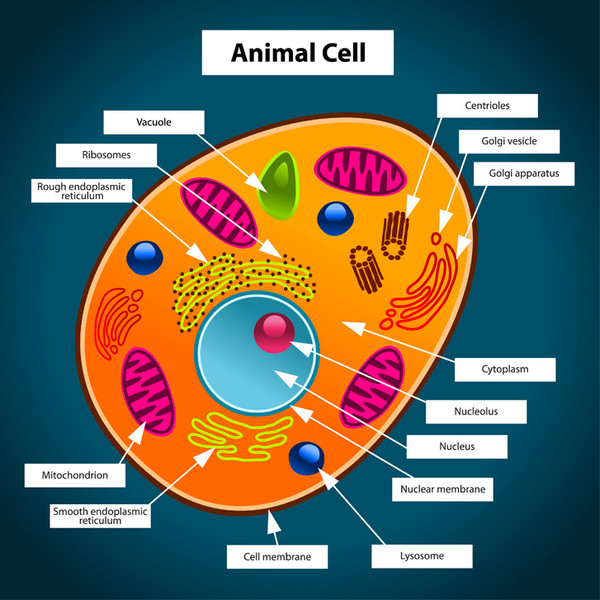
Labeled diagram of a typical animal cell
Nucleus
- Surrounded by a double membrane (nuclear envelope)
- Contains nuclear pores for transport
- Site of transcription
- Protects DNA from cytoplasmic enzymes
Endoplasmic Reticulum (ER)
Rough ER
- Ribosomes attached
- Synthesizes and folds proteins
- Sends proteins to Golgi in vesicles
Smooth ER
- Lipid synthesis
- Detoxification
- Calcium ion storage
Golgi Apparatus
- Modifies proteins (adds carbohydrate groups, etc.)
- Sorts and packages into vesicles
- Different cisternae contain different enzymes
Lysosomes
- Acidic interior (about pH 4.5)
- Digest macromolecules and worn-out organelles
- Membrane keeps digestive enzymes from damaging cytoplasm
Mitochondria
- Site of cellular respiration
- Double membrane
- Inner membrane folded into cristae (increases surface area)
- Contains its own DNA and ribosomes
Chloroplasts (plants and algae)
- Site of photosynthesis
- Double membrane
- Internal thylakoid membranes
- Own DNA and ribosomes
Those last two are especially important for evolution.
4. How Compartmentalization Increases Efficiency
Membranes are not just walls. They actively improve cell performance.
Specialized environments
- Lysosomes maintain acidic pH.
- Cytoplasm stays near neutral.
- Smooth ER stores Ca²⁺ separately from cytosol.
Enzymes work best under specific conditions. Compartments protect those conditions.
Increased surface area
Look at the inner membrane of a mitochondrion and its folded cristae.
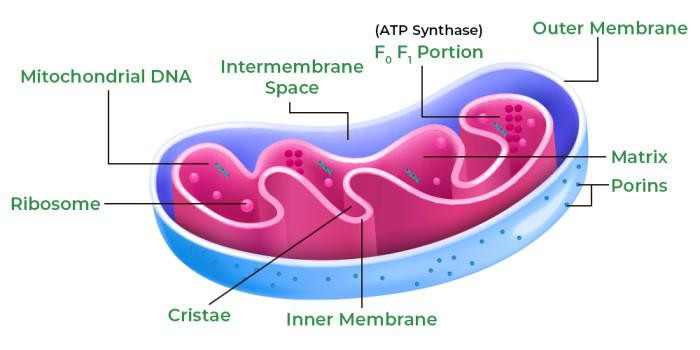
Structure of a mitochondrion
The folds labeled cristae increase membrane area. More membrane means:
- More electron transport chain proteins
- More ATP synthase
- More ATP production
Surface area questions show up often in data analysis. If cristae density increases, ATP output likely increases too.
Separation of processes
- DNA replication and transcription occur in the nucleus.
- Translation occurs in cytoplasm or rough ER.
This prevents interference and allows step-by-step regulation.
Protein localization
Different membranes contain specific proteins.
Example: ATP synthase is embedded in the inner mitochondrial membrane, not floating randomly. Location allows function.
5. Endosymbiotic Theory
This theory explains how mitochondria and chloroplasts originated.
The sequence
- An ancestral eukaryotic cell engulfed an aerobic bacterium.
- Instead of digesting it, a symbiotic relationship formed.
- The bacterium became a mitochondrion.
- Later, some cells engulfed a photosynthetic bacterium → chloroplast.
Evidence you must know
- Double membranes
- Circular DNA
- 70S ribosomes (prokaryote-like)
- Replicate by binary fission
- Similar size to bacteria
If you see a question asking why antibiotics sometimes affect mitochondria, think about their bacterial ancestry.
This connects directly to Big Idea 1. Evolution explains cellular complexity. Compartmentalization did not appear randomly. It evolved through symbiosis.
Key Takeaways
Cell Compartmentalization
Division of a cell into specialized regions, often separated by internal membranes.
Prokaryotic vs. Eukaryotic Compartmentalization
Prokaryotes lack membrane-bound organelles; eukaryotes use internal membranes to separate specialized functions.
Membrane-Bound Organelles
Internal structures enclosed by membranes that isolate specific cellular processes and conditions.
Endosymbiosis
Evolutionary process in which one free-living prokaryote began living inside another cell permanently.
Endosymbiotic Theory Evidence
Mitochondria and chloroplasts have double membranes, circular DNA, and prokaryote-like ribosomes.
Nucleus
Double-membraned organelle that stores DNA and separates transcription from translation.
Nuclear Pores
Protein-lined openings in the nuclear envelope that regulate movement between nucleus and cytoplasm.
Golgi Apparatus
Stack of membranous sacs that modifies, sorts, and packages cell products into vesicles.
Lysosomes
Acidic membrane-bound sacs containing digestive enzymes that break down waste and old organelles.
Peroxisomes
Membrane-bound organelles that break down fatty acids and detoxify harmful compounds using oxidative enzymes.
Vacuoles
Membrane-bound storage compartments for water, nutrients, wastes, and other materials.
Specialized Internal Environments
Organelles maintain distinct pH and ion conditions so specific enzymes work optimally.
Increased Membrane Surface Area
Internal folding and extra membranes provide more space for enzymes and transport proteins.
Separation of Cellular Processes
Different reactions occur in different compartments, preventing interference between incompatible activities.
Protein Localization in Membranes
Specific membranes contain particular enzymes, receptors, and transport proteins matched to their functions.
Prokaryotic Specialized Regions
Non-membrane-bound areas in prokaryotes perform specific functions despite lacking true organelles.
Coupled Transcription and Translation in Prokaryotes
RNA is translated while it is still being transcribed because no nucleus separates the processes.
Endoplasmic Reticulum
Membrane network with rough regions for proteins and smooth regions for lipids and detoxification.
Mitochrondrion Structure
Double-membraned organelle whose folded inner membrane increases surface area for ATP production.
Chloroplast
Photosynthetic organelle with double membranes, circular DNA, and bacterial-like ribosomes.
Notes
Cell Compartmentalization
Division of a cell into specialized regions, often separated by internal membranes.
Prokaryotic vs. Eukaryotic Compartmentalization
Prokaryotes lack membrane-bound organelles; eukaryotes use internal membranes to separate specialized functions.
Membrane-Bound Organelles
Internal structures enclosed by membranes that isolate specific cellular processes and conditions.
Endosymbiosis
Evolutionary process in which one free-living prokaryote began living inside another cell permanently.
Endosymbiotic Theory Evidence
Mitochondria and chloroplasts have double membranes, circular DNA, and prokaryote-like ribosomes.
Nucleus
Double-membraned organelle that stores DNA and separates transcription from translation.
Nuclear Pores
Protein-lined openings in the nuclear envelope that regulate movement between nucleus and cytoplasm.
Golgi Apparatus
Stack of membranous sacs that modifies, sorts, and packages cell products into vesicles.
Lysosomes
Acidic membrane-bound sacs containing digestive enzymes that break down waste and old organelles.
Peroxisomes
Membrane-bound organelles that break down fatty acids and detoxify harmful compounds using oxidative enzymes.
Vacuoles
Membrane-bound storage compartments for water, nutrients, wastes, and other materials.
Specialized Internal Environments
Organelles maintain distinct pH and ion conditions so specific enzymes work optimally.
Increased Membrane Surface Area
Internal folding and extra membranes provide more space for enzymes and transport proteins.
Separation of Cellular Processes
Different reactions occur in different compartments, preventing interference between incompatible activities.
Protein Localization in Membranes
Specific membranes contain particular enzymes, receptors, and transport proteins matched to their functions.
Prokaryotic Specialized Regions
Non-membrane-bound areas in prokaryotes perform specific functions despite lacking true organelles.
Coupled Transcription and Translation in Prokaryotes
RNA is translated while it is still being transcribed because no nucleus separates the processes.
Endoplasmic Reticulum
Membrane network with rough regions for proteins and smooth regions for lipids and detoxification.
Mitochrondrion Structure
Double-membraned organelle whose folded inner membrane increases surface area for ATP production.
Chloroplast
Photosynthetic organelle with double membranes, circular DNA, and bacterial-like ribosomes.
