Topic 5.2 Notes – Meiosis and Genetic Diversity
1. What Meiosis Produces and Why It Matters
Meiosis is a two-division process that produces four genetically unique haploid (1n) gametes from one diploid (2n) cell.
- Diploid (2n) = two sets of chromosomes (one from each parent)
- Haploid (n) = one set of chromosomes
When fertilization happens, two haploid gametes fuse and restore the diploid number in the zygote. That reduction from 2n → n during meiosis is essential. Without it, chromosome number would double every generation.
The Two Key Separation Events
Meiosis has two rounds of division, and what separates in each one is everything.
Meiosis I
- Homologous chromosomes separate
- Chromosome number is reduced (2n → n)
- Each chromosome is still made of two sister chromatids
Meiosis II
- Sister chromatids separate
- Similar to mitosis
- Results in four haploid cells
Here’s a simple visual of that flow, from a diploid parent cell through Meiosis I and Meiosis II:
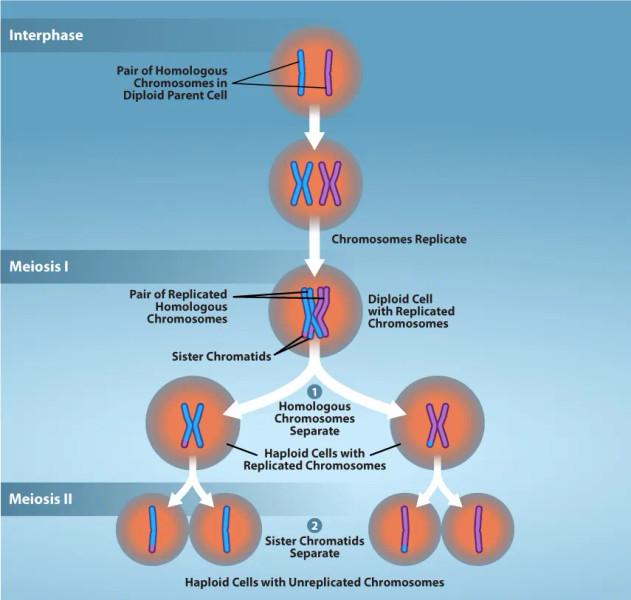
Overview of meiosis I and II
Notice that homologous chromosomes separate in Meiosis I, reducing the chromosome number, and sister chromatids separate in Meiosis II, producing four haploid cells with unreplicated chromosomes.
If homologous chromosomes and chromatids separate correctly, each gamete receives one complete set of chromosomes, containing a mix of maternal and paternal DNA.
That “mix” is where genetic diversity comes in.
2. The Three Sources of Genetic Variation in Sexual Reproduction
The College Board focuses on exactly three mechanisms. Know these cold.
a. Crossing Over
This happens in Prophase I.
- Homologous chromosomes pair up in a process called synapsis.
- Non-sister chromatids exchange corresponding DNA segments.
- No genes are added or deleted. Alleles are swapped.

Crossing over during Prophase I
In the diagram, the blue and red homologous chromosomes align, and two non-sister chromatids physically exchange matching segments. After crossing over:
- Each chromosome contains a mix of maternal and paternal alleles.
- You get recombinant chromatids alongside non-recombinant ones.
This creates variation within a single chromosome. That distinction matters because students often confuse it with independent assortment, which works at the whole-chromosome level.
On FRQs, if they ask how meiosis increases variation and you forget to mention crossing over in Prophase I, that’s usually a missed point.
b. Independent Assortment
This occurs in Metaphase I.
- Homologous chromosome pairs line up randomly at the equator.
- The orientation of one pair does not affect another.
That randomness determines which homolog goes into which gamete.
The number of possible chromosome combinations from this alone is:
where is the haploid number.
For humans, million possible combinations per gamete just from independent assortment.
This is variation at the whole chromosome level. You’re shuffling entire maternal and paternal chromosomes into new combinations.
If a question gives you a species with , you should instantly think possible combinations from assortment alone.
c. Random Fertilization
Now take two independently produced gametes and combine them.
- Any sperm can fertilize any egg.
- Each gamete is already genetically unique.
So fertilization multiplies variation again. The number of possible zygotes is enormous because you’re combining two different possibilities.
That’s why siblings (unless identical twins) have different genetic combinations.
3. How Correct Chromosome Separation Creates Haploid Gametes
Genetic diversity depends on correct separation.
- In Meiosis I, homologous chromosomes must separate.
- In Meiosis II, sister chromatids must separate.
If this happens correctly:
- Each gamete gets exactly one chromosome from each homologous pair.
- Chromosome number is reduced to n.
- The chromosomes reflect both crossing over and independent assortment.
This is what ensures a haploid set that includes an assortment of both maternal and paternal chromosomes.
When separation fails, that’s a different story.
4. Nondisjunction and Its Effects
Nondisjunction is the failure of chromosomes to separate properly.
It can happen in two places:
| Nondisjunction in Meiosis I | Nondisjunction in Meiosis II | |
|---|---|---|
| What fails to separate | Homologous chromosomes | Sister chromatids |
| Gamete outcome | All four abnormal Two n + 1 Two n − 1 | Two normal (n) One n + 1 One n − 1 |
If an abnormal gamete is fertilized, the zygote may have:
- Trisomy (2n + 1)
- Monosomy (2n − 1)
A common example is Trisomy 21 (Down syndrome).
Important distinction:
- Normal genetic diversity = reshuffling of alleles.
- Nondisjunction = change in chromosome number.
On exams, they often describe abnormal chromosome numbers in offspring and ask you to identify where the error occurred. Look at how many gametes would be affected.
5. Why Genetic Diversity Is Essential
Sexual reproduction increases genetic variation through:
- Crossing over
- Independent assortment
- Random fertilization
Genetic diversity provides the raw material for natural selection. In changing environments, some individuals are more likely to survive because they carry advantageous allele combinations.
Without these mechanisms, offspring would be genetically identical, and populations would struggle to adapt to disease, environmental stress, or new conditions.
Key Takeaways
Crossing Over / Recombination
Non-sister chromatids of homologous chromosomes exchange corresponding DNA segments during prophase I.
Independent Assortment
Homologous chromosome pairs align randomly in meiosis, producing different maternal-paternal chromosome combinations in gametes.
Homologous Chromosomes
A maternal and paternal chromosome pair with the same genes at the same loci.
Meiosis I vs. Meiosis II Separation
Meiosis I separates homologous chromosomes; meiosis II separates sister chromatids.
Nondisjunction in Meiosis I vs. Meiosis II
In meiosis I all four gametes are abnormal; in meiosis II only two are abnormal.
2^n Rule for Independent Assortment
The number of chromosome combinations in gametes equals 2^n, where n is haploid number.
Haploid Gamete Formation
Correct meiosis produces haploid gametes containing one chromosome from each homologous pair.
Nondisjunction
Failure of chromosome separation in meiosis produces gametes with extra or missing chromosomes.
Aneuploidy
An abnormal chromosome number caused by chromosome gain or loss, including trisomy or monosomy.
Sexual Reproduction and Genetic Variation
Crossing over, independent assortment, and random fertilization increase genetic variation in offspring.
Prophase I
The first meiotic stage when homologous chromosomes pair and crossing over occurs.
Sister Chromatids
Identical copies of a chromosome joined together until they separate in meiosis II.
Notes
Crossing Over / Recombination
Non-sister chromatids of homologous chromosomes exchange corresponding DNA segments during prophase I.
Independent Assortment
Homologous chromosome pairs align randomly in meiosis, producing different maternal-paternal chromosome combinations in gametes.
Homologous Chromosomes
A maternal and paternal chromosome pair with the same genes at the same loci.
Meiosis I vs. Meiosis II Separation
Meiosis I separates homologous chromosomes; meiosis II separates sister chromatids.
Nondisjunction in Meiosis I vs. Meiosis II
In meiosis I all four gametes are abnormal; in meiosis II only two are abnormal.
2^n Rule for Independent Assortment
The number of chromosome combinations in gametes equals 2^n, where n is haploid number.
Haploid Gamete Formation
Correct meiosis produces haploid gametes containing one chromosome from each homologous pair.
Nondisjunction
Failure of chromosome separation in meiosis produces gametes with extra or missing chromosomes.
Aneuploidy
An abnormal chromosome number caused by chromosome gain or loss, including trisomy or monosomy.
Sexual Reproduction and Genetic Variation
Crossing over, independent assortment, and random fertilization increase genetic variation in offspring.
Prophase I
The first meiotic stage when homologous chromosomes pair and crossing over occurs.
Sister Chromatids
Identical copies of a chromosome joined together until they separate in meiosis II.
