Topic 6.7 Notes – Mutations
1. What a Mutation Is and Why It Matters
A mutation is a permanent change in the DNA nucleotide sequence.
Because information flows
DNA → RNA → Protein,
a change in DNA can lead to:
- A different amino acid sequence
- A different amount of protein (if regulation is affected)
- A protein with altered structure and function
- A change in phenotype
Think in a chain:
Genotype change → gene product change → phenotype change
The effect depends on:
- Where the mutation occurs (coding vs regulatory vs noncoding)
- How it alters transcription or translation
- The environment
Mutations can be:
- Beneficial
- Detrimental
- Neutral
Same mutation, different environment, different outcome. That idea shows up often in FRQs.
Examples you should recognize:
- CFTR mutation → disrupted ion transport → cystic fibrosis.
- MC1R mutation in pocket mice → darker fur → camouflage advantage on dark lava rock.
You do not need to memorize specific diseases beyond examples like these, but you must explain the mechanism: altered gene → altered protein → altered trait.
2. Types of Gene Mutations
Point Mutations (Substitutions)
One nucleotide is replaced with another.
They can cause:
- Missense → different amino acid
- Nonsense → premature stop codon → shortened protein
- Silent → same amino acid (genetic code redundancy)
Silent does not change the amino acid sequence, but it can sometimes affect mRNA stability or expression level.
Nonsense mutations often cause loss of function because the protein is truncated.
Insertions and Deletions
Nucleotides are added or removed.
If the number added/removed is not a multiple of 3, you get a frameshift mutation.
A frameshift mutation occurs when a nucleotide is inserted or deleted early in a sequence, shifting the grouping of codons so that all downstream codons are read incorrectly, often leading to a premature stop codon.
A frameshift:
- Shifts the reading frame
- Changes all downstream amino acids
- Often creates a premature stop
- Usually produces a nonfunctional protein
Quick comparison:
| Feature | Point Mutation | Frameshift Mutation |
|---|---|---|
| DNA change | One base substituted | Base inserted or deleted |
| Reading frame | Unchanged | Shifted |
| Protein impact | One codon affected | All downstream codons affected |
| Severity | Sometimes mild | Often severe |
Mutations by Functional Effect
Regardless of type:
- Loss-of-function → reduced or no protein activity
- Gain-of-function → increased or new activity
- Neutral mutation → no measurable phenotype change
Environment determines whether a mutation is helpful or harmful. The classic example is sickle cell. The mutation changes hemoglobin structure. In malaria regions, heterozygotes have increased survival. Outside those regions, the mutation is mostly harmful.
That environmental dependence is a favorite testing angle.
3. Changes in Chromosome Number and Structure
Mutations are not limited to single genes.
Changes in Chromosome Number
Usually caused by nondisjunction during meiosis or mitosis. In the diagram below, notice how chromosomes fail to separate properly in meiosis I versus meiosis II and how that changes the types of gametes produced.
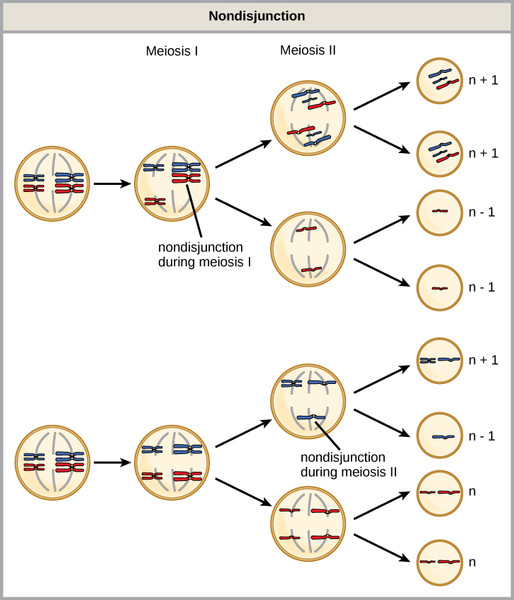
Nondisjunction in meiosis I vs. meiosis II
If nondisjunction happens in meiosis I, all four gametes are abnormal, either n + 1 or n − 1. If it happens in meiosis II, two gametes are normal (n) and two are abnormal.
Results include:
- Aneuploidy → extra or missing chromosome
- Polyploidy → extra full sets of chromosomes
Effects:
- In animals, often developmental limitations
- In plants, polyploidy can increase vigor
- Triploidy often causes sterility
The key concept is gene dosage. More copies of a chromosome mean more copies of genes, which changes protein amounts.
Changes in Chromosome Structure
Structural rearrangements include:
- Deletion → segment lost
- Duplication → segment repeated
- Inversion → segment reversed
- Translocation → segment moved to another chromosome
These can:
- Disrupt genes
- Alter regulation
- Create fusion proteins (common in some cancers)
You are not expected to memorize specific syndromes. Focus on mechanism.
4. Where Mutations Come From
Mutations arise randomly due to:
Internal causes
- DNA replication errors
- Failure of DNA repair
External mutagens
- UV radiation
- X-rays
- Reactive chemicals
Important:
Mutations occur randomly with respect to fitness. Natural selection does not cause mutations. It filters them after they happen.
5. Mutations and Natural Selection
Mutations create genetic variation, the raw material for evolution.
If a mutation:
- Increases survival or reproduction → frequency increases
- Decreases fitness → selected against
- Has no effect → may persist by genetic drift
Horizontal Gene Transfer in Prokaryotes
Increases variation without reproduction:
- Transformation → uptake of free DNA
- Transduction → viral DNA transfer
- Conjugation → plasmid transfer via pilus
- Transposition → DNA segments move within genome
These mechanisms spread traits like antibiotic resistance rapidly.
Viral Recombination
If related viruses infect the same cell, their genomes can mix, forming new viral strains.
Across life, variation-increasing processes are conserved:
- All organisms experience mutations
- Prokaryotes use horizontal gene transfer
- Eukaryotes use meiosis and crossing over
Populations survive change because heritable variation exists first. Selection acts second.
Key Takeaways
Mutation
A heritable change in DNA sequence that can alter gene product or phenotype.
Point Mutation
A change in one nucleotide pair, usually by substitution of one base for another.
Insertion, Deletion, and Frameshift Mutations
Insertion adds bases, deletion removes bases, and frameshift shifts codon reading when bases are not in threes.
Nonsense Mutation
A base substitution that creates a premature stop codon, producing a shortened polypeptide.
Silent Mutation
A DNA change that does not alter the amino acid sequence of the protein.
Genotype Change and Phenotype Change
Altered DNA can change RNA or protein type or amount, producing different observable traits.
Coding vs Regulatory Region Mutations
Coding changes can alter protein sequence, while regulatory changes can alter when or how much is made.
Replication and DNA Repair Errors
Mistakes during copying or correction of DNA can introduce random sequence changes.
Mutagens
External agents such as radiation and reactive chemicals that increase the rate of DNA mutations.
Nondisjunction
Failure of homologous chromosomes or sister chromatids to separate properly during cell division.
Aneuploidy and Triploidy
Aneuploidy is an abnormal chromosome number; triploidy is three complete chromosome sets.
Polyploidy
Having more than two complete sets of chromosomes, often affecting vigor or fertility.
Chromosomal Structural Alterations
Deletions remove segments, duplications repeat them, inversions reverse them, and translocations move them elsewhere.
Transformation, Transduction, Conjugation, and Transposition
DNA uptake, viral DNA transfer, direct cell-to-cell DNA transfer, and movement of DNA segments.
Viral Recombination
Mixing of genetic material between related viruses that infect the same host cell.
Variation-Increasing Reproductive Processes
Conserved mechanisms like mutation, meiosis, crossing over, and gene transfer that generate heritable diversity.
Cystic Fibrosis and CFTR
A disorder caused by CFTR mutations that disrupt ion transport across cell membranes.
Adaptive Melanism in Pocket Mice
A dark-fur phenotype caused by mutation that improves camouflage in dark environments.
Sickle Cell Anemia
A beta-globin mutation causing sickled red blood cells, harmful overall but advantageous against malaria when heterozygous.
Mutation Effects and Environmental Context
A DNA change may be beneficial, harmful, or neutral depending on environmental conditions.
Mutations, Genetic Variation, and Natural Selection
Heritable DNA changes create variation that natural selection can increase or decrease.
Missense Mutation
A base substitution that changes one amino acid in a polypeptide sequence.
Notes
Mutation
A heritable change in DNA sequence that can alter gene product or phenotype.
Point Mutation
A change in one nucleotide pair, usually by substitution of one base for another.
Insertion, Deletion, and Frameshift Mutations
Insertion adds bases, deletion removes bases, and frameshift shifts codon reading when bases are not in threes.
Nonsense Mutation
A base substitution that creates a premature stop codon, producing a shortened polypeptide.
Silent Mutation
A DNA change that does not alter the amino acid sequence of the protein.
Genotype Change and Phenotype Change
Altered DNA can change RNA or protein type or amount, producing different observable traits.
Coding vs Regulatory Region Mutations
Coding changes can alter protein sequence, while regulatory changes can alter when or how much is made.
Replication and DNA Repair Errors
Mistakes during copying or correction of DNA can introduce random sequence changes.
Mutagens
External agents such as radiation and reactive chemicals that increase the rate of DNA mutations.
Nondisjunction
Failure of homologous chromosomes or sister chromatids to separate properly during cell division.
Aneuploidy and Triploidy
Aneuploidy is an abnormal chromosome number; triploidy is three complete chromosome sets.
Polyploidy
Having more than two complete sets of chromosomes, often affecting vigor or fertility.
Chromosomal Structural Alterations
Deletions remove segments, duplications repeat them, inversions reverse them, and translocations move them elsewhere.
Transformation, Transduction, Conjugation, and Transposition
DNA uptake, viral DNA transfer, direct cell-to-cell DNA transfer, and movement of DNA segments.
Viral Recombination
Mixing of genetic material between related viruses that infect the same host cell.
Variation-Increasing Reproductive Processes
Conserved mechanisms like mutation, meiosis, crossing over, and gene transfer that generate heritable diversity.
Cystic Fibrosis and CFTR
A disorder caused by CFTR mutations that disrupt ion transport across cell membranes.
Adaptive Melanism in Pocket Mice
A dark-fur phenotype caused by mutation that improves camouflage in dark environments.
Sickle Cell Anemia
A beta-globin mutation causing sickled red blood cells, harmful overall but advantageous against malaria when heterozygous.
Mutation Effects and Environmental Context
A DNA change may be beneficial, harmful, or neutral depending on environmental conditions.
Mutations, Genetic Variation, and Natural Selection
Heritable DNA changes create variation that natural selection can increase or decrease.
Missense Mutation
A base substitution that changes one amino acid in a polypeptide sequence.
