Topic 2.3 Notes – Plasma Membrane
1. What the Plasma Membrane Is
Every cell has a plasma membrane that separates the inside of the cell from the outside environment. Its main job is maintaining homeostasis, which means keeping internal conditions stable even when the outside changes.
The membrane is selectively permeable. Some substances cross easily, others cannot cross at all without help.
It also:
- Regulates transport in and out
- Allows cells to communicate
- Helps cells recognize each other
- Provides structural support
The key idea you’ll see over and over is this:
Structure determines function.
How the membrane is built explains everything it can do.
2. Components of the Plasma Membrane
a. Phospholipids and the Bilayer
Phospholipids form the structural foundation.
Each phospholipid is amphipathic, meaning it has two different regions:
- Hydrophilic phosphate head → polar, interacts with water
- Hydrophobic fatty acid tails → nonpolar, avoid water
In water, they arrange themselves into a bilayer:
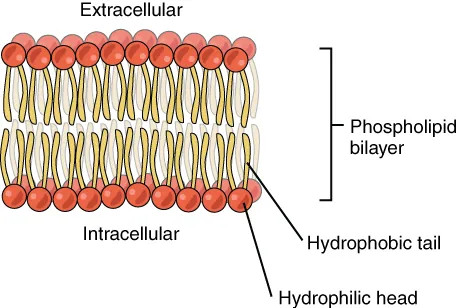
Phospholipid bilayer structure
Heads face the watery cytosol and extracellular fluid, as labeled in the diagram. Tails face inward toward each other.
This creates a hydrophobic interior barrier.
What that means functionally:
- Small nonpolar molecules (O₂, CO₂) pass easily
- Small uncharged polar molecules (like water, slowly) may pass
- Ions and large polar molecules cannot cross without help
That hydrophobic core is the physical basis of selective permeability.
b. Membrane Proteins
Proteins are embedded within or attached to the bilayer. Their structure matches the membrane’s structure.
Integral (Transmembrane) Proteins
These span the entire membrane.
- Hydrophobic amino acids face outward toward the fatty acid tails
- Hydrophilic amino acids face the cytosol, extracellular fluid, or line channels
They function in:
- Transport (channels, carriers, pumps)
- Receptors for signaling molecules
- Cell adhesion
Peripheral Proteins
- Loosely attached to the membrane surface
- Often connected to integral proteins or phospholipid heads
- Involved in signaling or structural support
A common exam move is giving you a mutated protein and asking why it no longer embeds properly. If hydrophobic regions are altered, it may not interact correctly with the lipid tails.
c. Steroids and Cholesterol
In animal cells, cholesterol sits between phospholipids.
It acts as a fluidity buffer:
- High temperature → reduces excessive movement
- Low temperature → prevents tight packing
It stabilizes the membrane so it doesn’t become too rigid or too fluid.
d. Glycoproteins and Glycolipids
These are carbohydrates attached to proteins or lipids on the extracellular surface.
Together they form the glycocalyx.
Functions:
- Cell recognition (like blood type markers)
- Cell-to-cell adhesion
- Immune identification
- Protection
On exams, if immune cells recognize “self” vs “non-self,” think membrane carbohydrates.
3. The Fluid Mosaic Model
Singer and Nicolson proposed this model in 1972.
It describes the membrane as:
Fluid
- Phospholipids move laterally
- Many proteins also drift within the membrane
This movement allows:
- Self-repair
- Redistribution of proteins
- Vesicle fusion
Mosaic
- Patchwork of lipids, proteins, steroids, carbohydrates
- Proteins “float” in a sea of lipids
The diagram below shows the phospholipid bilayer with embedded integral and peripheral proteins, cholesterol within the hydrophobic interior, and carbohydrate chains attached to proteins and lipids on the outer surface.
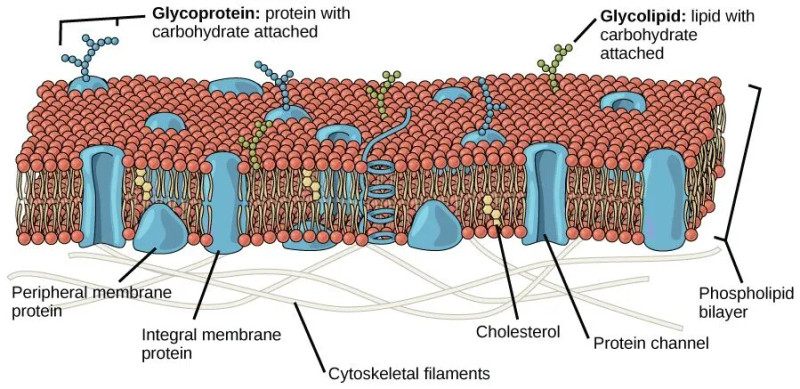
Fluid mosaic model of the plasma membrane
The membrane is dynamic, not rigid. That dynamic quality is essential for transport and signaling.
4. Membrane Fluidity
Fluidity depends on three main factors:
Temperature
- Higher temperature → more fluid
- Lower temperature → less fluid
Fatty Acid Composition
- Unsaturated tails (double bonds, kinks) → prevent tight packing → increase fluidity
- Saturated tails (straight) → pack tightly → decrease fluidity
Cholesterol
Buffers extremes in fluidity.
If a question asks how a cell adapts to cold, increasing unsaturated fatty acids is a classic answer.
5. How the Plasma Membrane Maintains Homeostasis
Selective Permeability
| Pass Easily | Do Not Pass Easily |
|---|---|
| Small nonpolar molecules (O₂, CO₂) | Ions (Na⁺, K⁺, Ca²⁺) |
| Some small uncharged polar molecules | Large polar molecules |
| Limited water | Most water-soluble substances |
Substances that cannot diffuse require membrane proteins.
Transport and Communication
Membrane proteins allow:
- Channel proteins → create hydrophilic pores
- Carrier proteins → change shape to move molecules
- Pumps → use ATP to move substances against gradients
- Receptor proteins → bind signaling molecules
- Cell adhesion molecules → connect cells
Membrane Dynamics
Because it’s fluid, the membrane can:
- Form vesicles in endocytosis
- Fuse with vesicles in exocytosis
- Merge membranes during cell processes
Without fluidity, none of that would work.
Key Takeaways
Phospholipid Bilayer
Two layers of amphipathic phospholipids with heads outward and tails inward.
Integral and Peripheral Proteins
Integral proteins penetrate the bilayer; peripheral proteins attach loosely to the membrane surface.
Cholesterol
A steroid in animal membranes that stabilizes the bilayer and buffers fluidity changes.
Fluid Mosaic Model
A membrane model describing a fluid phospholipid bilayer with mobile, diverse embedded components.
Factors Affecting Membrane Fluidity
Higher temperature and unsaturated tails increase fluidity; cholesterol buffers fluidity across temperatures.
Selective Permeability
Allowing some substances to cross easily while restricting others based on size and polarity.
Transport Proteins
Channel, carrier, and pump proteins move specific substances across the membrane.
Amphipathic Phospholipids
Phospholipids have hydrophilic phosphate heads and hydrophobic fatty acid tails.
Membrane Proteins
Embedded or attached proteins have hydrophobic regions in the bilayer and hydrophilic regions exposed to water.
Glycoproteins, Glycolipids, and Glycocalyx
Carbohydrate-tagged membrane molecules form an outer coat used for recognition, adhesion, and protection.
Unsaturated Fatty Acids
Fatty acid tails with double bonds create kinks that increase membrane fluidity.
Saturated Fatty Acids
Straight fatty acid tails pack tightly together and decrease membrane fluidity.
Notes
Phospholipid Bilayer
Two layers of amphipathic phospholipids with heads outward and tails inward.
Integral and Peripheral Proteins
Integral proteins penetrate the bilayer; peripheral proteins attach loosely to the membrane surface.
Cholesterol
A steroid in animal membranes that stabilizes the bilayer and buffers fluidity changes.
Fluid Mosaic Model
A membrane model describing a fluid phospholipid bilayer with mobile, diverse embedded components.
Factors Affecting Membrane Fluidity
Higher temperature and unsaturated tails increase fluidity; cholesterol buffers fluidity across temperatures.
Selective Permeability
Allowing some substances to cross easily while restricting others based on size and polarity.
Transport Proteins
Channel, carrier, and pump proteins move specific substances across the membrane.
Amphipathic Phospholipids
Phospholipids have hydrophilic phosphate heads and hydrophobic fatty acid tails.
Membrane Proteins
Embedded or attached proteins have hydrophobic regions in the bilayer and hydrophilic regions exposed to water.
Glycoproteins, Glycolipids, and Glycocalyx
Carbohydrate-tagged membrane molecules form an outer coat used for recognition, adhesion, and protection.
Unsaturated Fatty Acids
Fatty acid tails with double bonds create kinks that increase membrane fluidity.
Saturated Fatty Acids
Straight fatty acid tails pack tightly together and decrease membrane fluidity.
