Topic 1.2 Notes – Elements of Life
1. The Chemical Building Blocks of Life
Everything in biology is made of matter, and matter is made of atoms.
An atom is the smallest unit of an element that still has that element’s properties. Atoms contain:
- Protons (+) and neutrons (0) in the nucleus
- Electrons (-) in energy levels (shells) around the nucleus
The atomic number tells you how many protons an atom has. That number defines the element. Carbon always has 6 protons. Oxygen always has 8.
Isotopes are atoms of the same element with different numbers of neutrons.
- Example: Carbon-12 vs. Carbon-14
- Some isotopes are radioactive, meaning they decay over time
- Carbon-14 is used in dating once-living material
What matters most for biology is not the neutrons. It’s the electrons.
Electrons determine how atoms bond. Atoms form bonds by sharing or transferring electrons to fill their valence shell (outer shell). Most biologically important atoms follow the octet rule, meaning they become stable with 8 valence electrons.
The way atoms bond determines molecular structure, and structure determines function. That idea shows up constantly on tests and FRQs.
Living organisms must constantly take in atoms and molecules from the environment and rearrange them to build the macromolecules required for growth, reproduction, and homeostasis.
2. The Six Essential Elements CHNOPS
Almost all biological macromolecules are built from six elements:
Carbon, Hydrogen, Oxygen, Nitrogen, Phosphorus, Sulfur
(CHNOPS)
The most prevalent overall are C, H, and O.
Carbon (C)
Carbon is the backbone of life.
- Has 4 valence electrons
- Can form four covalent bonds
- Can build:
- Chains
- Rings
- Double and triple bonds
This bonding flexibility allows enormous molecular diversity.
Hydrogen (H)
- Forms single covalent bonds
- Common in organic molecules
- Important in energy transfer and pH (H⁺ concentration)
Oxygen (O)
- Highly electronegative
- Creates polar molecules
- Key component of water and many functional groups
Nitrogen (N)
- Found in amino groups (-NH₂)
- Required for:
- Proteins
- Nucleic acids
- Can act as a base by accepting H⁺
Phosphorus (P)
- Found in:
- Phosphate groups
- DNA/RNA backbone
- Phospholipids
- Often carries negative charge
- Central in energy molecules like ATP
Sulfur (S)
- Present in certain amino acids (cysteine, methionine)
- Forms disulfide bonds, stabilizing protein shape
A common quiz move is asking which element distinguishes one macromolecule from another. That pattern matters.
3. How CHNOPS Build the Four Macromolecules
Each macromolecule has a characteristic elemental composition.
| Macromolecule | Elements Present | Notes |
|---|---|---|
| Carbohydrates | C, H, O | Often ~1:2:1 ratio (CH₂O) Energy and structure |
| Lipids | C, H, O (+ P in phospholipids) | Nonpolar overall Long-term energy, membranes |
| Proteins | C, H, O, N (sometimes S) | Built from amino acids Enzymes, structure, signaling |
| Nucleic Acids | C, H, O, N, P | Sugar-phosphate backbone Store genetic information |
Patterns to lock in:
- Nitrogen → proteins and nucleic acids
- Phosphorus → nucleic acids and phospholipids
- Sulfur → some proteins only
- C, H, O → in all four
On data questions, they may give you elemental percentages and ask which macromolecule it is. High nitrogen suggests protein or nucleic acid. Presence of phosphorus strongly suggests DNA, RNA, or phospholipids.
4. Functional Groups
A functional group is a specific group of atoms attached to a carbon skeleton. It changes a molecule’s polarity, reactivity, and behavior.
Here’s a visual reference of the main ones you need to recognize for AP Biology:
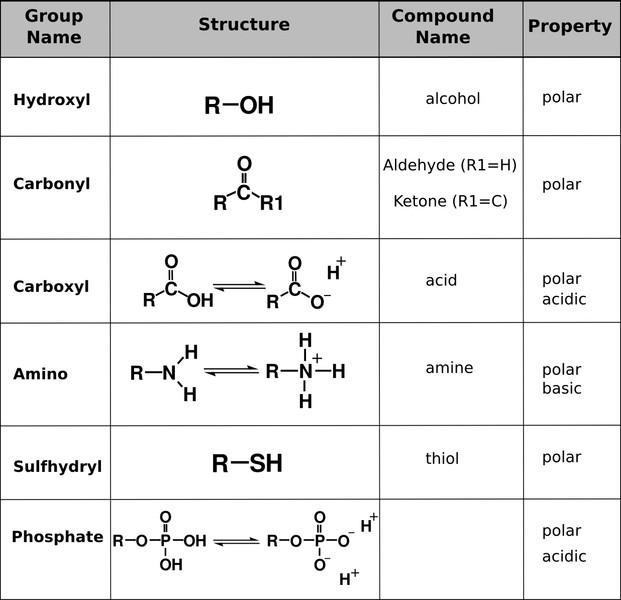
Major biological functional groups
Notice that some groups can switch forms depending on pH, which is why the chart shows both neutral and charged versions for carboxyl, amino, and phosphate groups.
Hydroxyl (-OH)
- Polar
- Forms hydrogen bonds
- Found in sugars and alcohols
Carbonyl (C=O)
- Polar
- Aldehyde if at end
- Ketone if in middle
Carboxyl (-COOH)
- Acts as an acid
- Releases H⁺
- Found in amino acids and fatty acids
Amino (-NH₂)
- Acts as a base
- Accepts H⁺
- Present in all amino acids
Phosphate (-PO₄)
- Negatively charged
- Acidic
- In nucleotides and phospholipids
Sulfhydryl (-SH)
- Contains sulfur
- Forms disulfide bridges in proteins
If a question asks how a mutation changes protein structure, think about whether a functional group changed. That can alter charge, polarity, and folding.
5. Why Carbon Is Central to Life
Carbon can:
- Form four stable covalent bonds
- Bond with C, H, O, N, P, S
- Create complex 3D structures
Because carbon forms four bonds arranged in a tetrahedral shape, it can build stable three-dimensional frameworks.
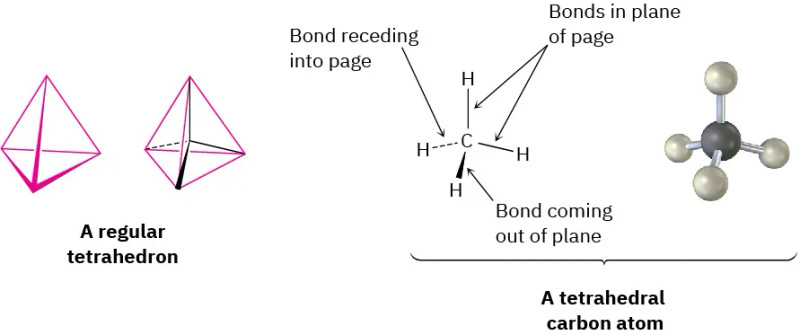
Tetrahedral geometry of a carbon atom
That tetra-valence lets carbon build the four macromolecules required for life. Without carbon’s bonding capacity, biological complexity would not exist.
At the core of this topic is a simple chain of ideas:
Atoms from the environment → rearranged into molecules → molecules built from CHNOPS → structure determines function.
--- END SECTION ---Key Takeaways
CHNOPS
Carbon, hydrogen, nitrogen, oxygen, phosphorus, and sulfur are the six key elements of life.
Carbon, Hydrogen, and Oxygen in Biological Molecules
These are the most prevalent elements in carbohydrates, lipids, proteins, and nucleic acids.
Macromolecule Element Composition
Carbohydrates: CHO; proteins: CHONS; lipids: mostly CHO, phospholipids include P; nucleic acids: CHONP.
Carbon Tetravalence
Carbon has four valence electrons and can form four covalent bonds.
Carbon Skeleton
A chain or ring of bonded carbon atoms that forms an organic molecule's framework.
Nitrogen in Biological Molecules
Nitrogen is found in amino groups and is required in proteins and nucleic acids.
Phosphorus in Biological Molecules
Phosphorus is part of phosphate groups in nucleic acids and phospholipids.
Sulfur in Biological Molecules
Sulfur occurs in some amino acids and is used in building proteins.
Functional Groups
Specific atom groups attached to carbon skeletons that determine molecular properties and include hydroxyl, carbonyl, carboxyl, amino, phosphate, and sulfhydryl.
Notes
CHNOPS
Carbon, hydrogen, nitrogen, oxygen, phosphorus, and sulfur are the six key elements of life.
Carbon, Hydrogen, and Oxygen in Biological Molecules
These are the most prevalent elements in carbohydrates, lipids, proteins, and nucleic acids.
Macromolecule Element Composition
Carbohydrates: CHO; proteins: CHONS; lipids: mostly CHO, phospholipids include P; nucleic acids: CHONP.
Carbon Tetravalence
Carbon has four valence electrons and can form four covalent bonds.
Carbon Skeleton
A chain or ring of bonded carbon atoms that forms an organic molecule's framework.
Nitrogen in Biological Molecules
Nitrogen is found in amino groups and is required in proteins and nucleic acids.
Phosphorus in Biological Molecules
Phosphorus is part of phosphate groups in nucleic acids and phospholipids.
Sulfur in Biological Molecules
Sulfur occurs in some amino acids and is used in building proteins.
Functional Groups
Specific atom groups attached to carbon skeletons that determine molecular properties and include hydroxyl, carbonyl, carboxyl, amino, phosphate, and sulfhydryl.
