Topic 1.3 Notes – Introduction to Macromolecules
1. Monomers, Polymers, and Macromolecules
Life builds complexity from small parts.
- Monomer = a small molecular building block
- Polymer = a large molecule made of many repeating monomers joined by covalent bonds
- Polymerization = the process of linking monomers together
Those covalent bonds are strong intramolecular bonds. They create the backbone of biological macromolecules.
The Four Biological Macromolecules
Each major macromolecule has characteristic building blocks and functions.
| Macromolecule | Monomer (Building Block) | Polymer / Structure | Main Functions |
|---|---|---|---|
| Carbohydrates | Monosaccharides (e.g., glucose) | Polysaccharides (e.g., starch, cellulose) | Energy storage, structural support in plants |
| Proteins | Amino acids | Polypeptides (folded into proteins) | Enzymes, transport, signaling, structure |
| Nucleic Acids | Nucleotides | DNA or RNA | Store and transmit genetic information |
| Lipids | Glycerol + fatty acids (not true repeating monomers) | Triglycerides, phospholipids, etc. | Long-term energy, membranes, signaling |
Lipids are different. They are large molecules, but most are not true polymers because they are not made of long repeating chains of identical monomers.
Keep this pattern in your head: small subunits → covalent bonds → large functional molecules.
2. Covalent Bonds and Molecular Interactions
Polymers are held together by covalent bonds, where atoms share electrons.
Types of Covalent Bonds
- Nonpolar covalent
- Electrons shared equally
- No partial charges
- Common in C-C and C-H bonds
- Contributes to hydrophobic behavior
- Polar covalent
- Electrons shared unequally
- Creates partial charges (δ⁺ and δ⁻)
- Due to differences in electronegativity
- Makes molecules polar and often water-soluble
Inside a molecule, these are intramolecular forces.
Between molecules, weaker attractions matter too.
Hydrogen Bonds
- Attraction between a hydrogen bonded to N, O, or F and another electronegative atom
- Weak compared to covalent bonds
- Crucial for:
- DNA base pairing
- Protein folding
- Properties of water
Hydrogen bonds are intermolecular, not covalent. That distinction shows up in multiple-choice questions.
Covalent bonds build the structure. Hydrogen bonds stabilize shape.
3. Dehydration Synthesis Builds Polymers
Dehydration synthesis is how cells connect monomers.
Two monomers join through a covalent bond. During the reaction:
- One monomer loses a hydrogen (H⁺)
- The other loses a hydroxyl group (OH⁻)
- These combine to form H₂O
- A new covalent bond forms between the monomers
Water is removed, which is why it’s called “dehydration.” In the top half of the diagram below, notice how an OH from one monomer and an H from the other combine to form water, leaving the two monomers linked by a covalent bond.
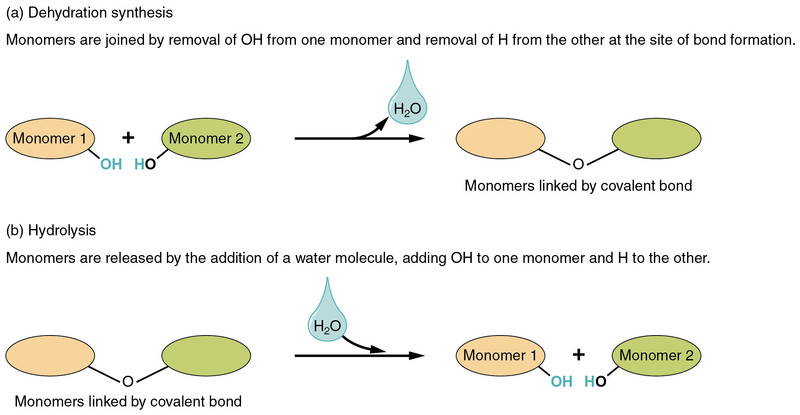
Dehydration synthesis and hydrolysis overview
Important characteristics:
- Builds larger molecules from smaller ones
- Forms polymers (polymerization)
- Requires enzymes in cells
- Requires energy input (endergonic)
- An anabolic process (increases complexity)
Examples:
- Amino acids joining to form a polypeptide
- Glucose molecules linking to form starch
- Nucleotides forming DNA
If a question describes water being produced while a larger molecule forms, that’s dehydration synthesis.
4. Hydrolysis Breaks Polymers
Hydrolysis is the reverse reaction.
Water is added to break a covalent bond between monomers.
- A water molecule splits into H⁺ and OH⁻
- H attaches to one monomer
- OH attaches to the other
- The covalent bond is cleaved
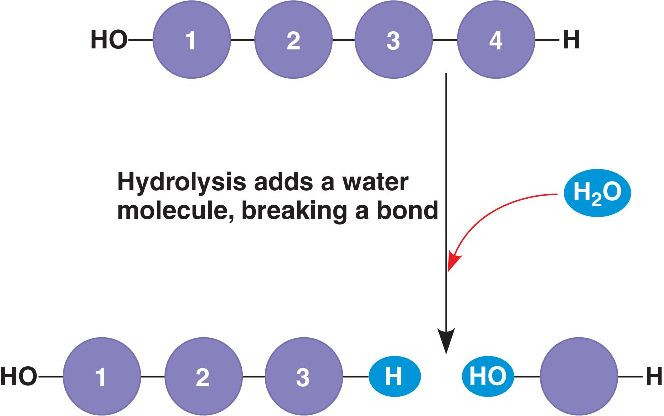
Hydrolysis reaction breaking a polymer
In the diagram, a water molecule is added to the chain, splitting one bond so that one fragment gains an H and the other gains an OH.
Key features:
- Breaks polymers into monomers
- Uses water
- Releases energy (exergonic overall in biological systems)
- Requires enzymes
- A catabolic process (reduces complexity)
This is what happens during digestion. Proteins, carbohydrates, and nucleic acids in food are hydrolyzed into their monomers so your cells can reuse them.
If a passage mentions water being consumed while a bond breaks, think hydrolysis.
5. How These Reactions Support Biological Systems
Cells constantly balance building and breaking.
- Dehydration synthesis builds macromolecules for growth and repair.
- Hydrolysis recycles molecules and releases usable components.
- Enzymes regulate both processes to maintain homeostasis.
This connects to a core AP idea: biological systems depend on regulated molecular interactions. Change the structure of a molecule and you change how it behaves in the whole system.
Even a single broken bond can alter shape, which can change function, which can affect an entire pathway.
Key Takeaways
Dehydration Synthesis / Condensation Reaction
Joins monomers by removing H and OH to form water and a covalent bond.
Hydrolysis
Breaks covalent bonds by adding water, splitting polymers into smaller molecules or monomers.
Covalent Bond
A chemical bond formed when atoms share one or more pairs of electrons.
Lipids
Hydrophobic molecules such as fats and phospholipids that usually are not true polymers.
Structure Determines Function
A molecule's shape and bonding pattern determine what it can do in cells.
Monomer, Polymer, and Polymerization
Small subunits covalently join to form large molecules through repeated bonding reactions.
Carbohydrates, Monosaccharides, and Polysaccharides
Sugars and their polymers function in energy storage and structural support.
Proteins, Amino Acids, and Polypeptides
Amino acid monomers link by peptide bonds to form functional protein polymers.
Nucleic Acids, Nucleotides, and Polynucleotides
Nucleotide monomers bond together to form DNA or RNA that stores information.
Notes
Dehydration Synthesis / Condensation Reaction
Joins monomers by removing H and OH to form water and a covalent bond.
Hydrolysis
Breaks covalent bonds by adding water, splitting polymers into smaller molecules or monomers.
Covalent Bond
A chemical bond formed when atoms share one or more pairs of electrons.
Lipids
Hydrophobic molecules such as fats and phospholipids that usually are not true polymers.
Structure Determines Function
A molecule's shape and bonding pattern determine what it can do in cells.
Monomer, Polymer, and Polymerization
Small subunits covalently join to form large molecules through repeated bonding reactions.
Carbohydrates, Monosaccharides, and Polysaccharides
Sugars and their polymers function in energy storage and structural support.
Proteins, Amino Acids, and Polypeptides
Amino acid monomers link by peptide bonds to form functional protein polymers.
Nucleic Acids, Nucleotides, and Polynucleotides
Nucleotide monomers bond together to form DNA or RNA that stores information.
