Topic 4.1 Notes – Cell Communication
1. What Cell Communication Is
Every communication event has two key players:
- Signal-sending cell → releases or presents a signal
- Target cell → receives the signal and responds
- The target cell must have the correct receptor (usually a protein) to respond
If the receptor is missing, nothing happens. Same signal, different cells, different outcomes depending on receptors.
Cells communicate in two broad ways:
- Direct physical contact
- Chemical signaling (signals travel through fluid or blood)
This communication allows organisms to:
- Maintain homeostasis
- Coordinate growth and development
- Defend against pathogens
- Regulate metabolism and reproduction
Without signaling, organs wouldn’t coordinate. Your pancreas wouldn’t influence your liver. Immune cells wouldn’t know when to activate.
2. The Three Main Ways Cells Communicate
a. Direct Cell-to-Cell Contact (Contact-Dependent Signaling)
Here, cells must physically touch.
This usually involves:
- Membrane-bound proteins on one cell
- Matching receptor proteins on the other cell
- Very high specificity
A classic AP example is the immune response. In the diagram below, notice that immune cells must bind directly to each other before activation or killing occurs.
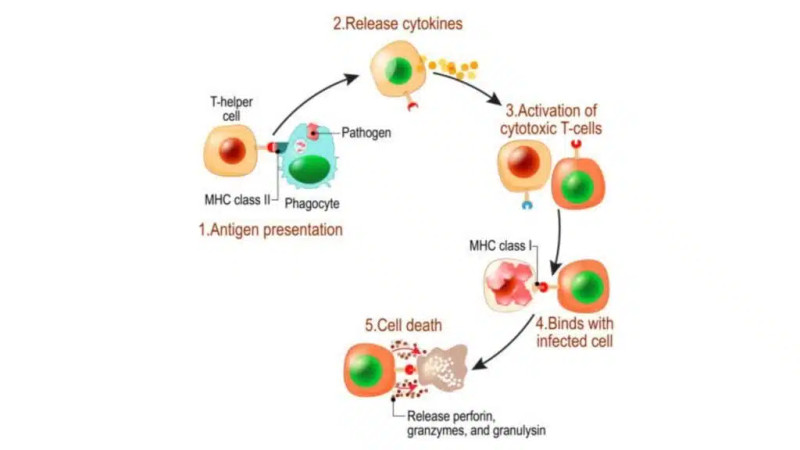
T-cell activation and cytotoxic response
How this works in immunity:
- Antigen-Presenting Cells (APCs)
- Engulf pathogens
- Display antigen fragments on their surface using MHC class II proteins
- Helper T-cells
- Bind directly to the antigen-MHC complex on APCs
- Release cytokines that activate other immune cells
- Killer (Cytotoxic) T-cells
- Recognize infected cells displaying antigen on MHC class I
- Bind directly and release perforin and granzymes
- Trigger apoptosis
This contact ensures immune cells activate only when the correct antigen is present. That precision prevents random immune attacks.
Direct contact signaling is immediate and extremely specific.
b. Local Signaling (Short-Distance Chemical Signaling)
Here, cells release local regulators that diffuse to nearby cells.
The signal:
- Travels through extracellular fluid
- Affects cells in the immediate area
- Produces fast, localized responses
Examples you need to recognize:
- Neurotransmitters
- Released from neurons
- Cross the synaptic cleft
- Bind receptors on nearby neuron or muscle cell
- Plant immune response
- Infected plant cells release chemicals
- Nearby cells activate defense genes
- Quorum sensing (bacteria)
- Bacteria release signaling molecules
- As population increases, signal concentration increases
- Once a threshold is reached → coordinated behavior (like biofilm formation)
- Morphogens (embryonic development)
- Form concentration gradients
- Different concentrations trigger different gene expression patterns
That gradient idea is important. Cells “read” concentration to determine their developmental fate.
Local signaling = short range, quick, area-specific control.
c. Long-Distance Signaling (Endocrine Signaling)
Now the signal travels far, usually through the bloodstream.
These signals are hormones:
- Released by endocrine glands
- Circulate through blood
- Only cells with the correct receptor respond
Examples you must know:
- Insulin
- Released by pancreas
- Promotes glucose uptake in liver, muscle, fat cells
- Human Growth Hormone (HGH)
- Stimulates growth and cell division
- Thyroid hormones
- Regulate metabolic rate
- Affect most body cells
- Testosterone and Estrogen
- Control development and reproduction
Even though hormones circulate throughout the body, only target cells with receptors respond. That’s a common AP trick. The hormone reaches many cells. Response depends on receptor presence.
Long-distance signaling is generally slower than local signaling but can produce widespread effects.
3. How Distance Affects Speed and Specificity
| Type | Distance | Speed | Specificity | Example |
|---|---|---|---|---|
| Direct Contact | Touching cells | Immediate | Very high | T-cell activation |
| Local Signaling | Nearby cells | Fast | Moderate (receptor-dependent) | Neurotransmitters |
| Long-Distance | Entire organism | Slower | High (receptor-dependent) | Insulin |
Patterns to notice:
- Shorter distance usually means faster response.
- Specificity always depends on receptor-ligand binding, not distance alone.
- Hormones are widespread but selective.
On exams, they often describe a scenario and ask you to identify which type of signaling is occurring. Pay attention to distance, transport method, and whether physical contact is required.
4. Why Cell Communication Matters
Cell communication connects directly to Big Idea 3: living systems store, transmit, and respond to information.
These pathways allow organisms to:
- Regulate blood glucose (insulin)
- Coordinate immune defense (T-cells)
- Control development (morphogens)
- Adjust metabolism (thyroid hormones)
- Synchronize bacterial behavior (quorum sensing)
When signaling fails:
- Diabetes involves insulin signaling problems
- Cancer often involves disrupted growth signaling
- Immune disorders involve faulty recognition signaling
The unifying idea is simple but powerful. Distance determines how the signal travels. Receptors determine who listens.
Key Takeaways
Cell Communication
The process by which cells detect, send, and respond to information.
Direct Cell-to-Cell Contact
Communication that occurs when neighboring cells physically touch and exchange information.
Chemical Signaling
Communication in which cells release signaling molecules that bind to target cells.
Local Signaling and Long-Distance Signaling
Nearby targets respond to local regulators; distant targets respond to signals carried farther, often in blood.
Local Regulators
Short-range signaling molecules that affect cells close to the releasing cell.
Antigen-Presenting Cells (APCs)
Immune cells that display antigen fragments on their surface to activate other immune cells.
Helper T-Cells
Immune cells that recognize presented antigens and coordinate other parts of the immune response.
Killer T-Cells
Immune cells that directly contact and destroy infected or abnormal body cells.
Neurotransmitters
Chemical messengers released by neurons that signal across short distances to nearby cells.
Plant Immune Response
Chemical signaling by plant cells that alerts nearby cells to pathogens or herbivore attack.
Quorum Sensing
Bacterial communication using secreted molecules to detect population density and coordinate behavior.
Morphogens
Local signaling molecules that form concentration gradients and guide embryonic development.
Hormones
Chemical signals released by one cell type that travel long distances to target cells.
Insulin
A hormone that promotes glucose uptake by body cells and lowers blood sugar.
Human Growth Hormone
A hormone that stimulates growth, cell division, and protein synthesis in target tissues.
Thyroid Hormones
Hormones that regulate metabolic rate, growth, and development throughout the body.
Testosterone and Estrogen
Sex hormones that regulate reproductive development, function, and secondary sex characteristics.
Notes
Cell Communication
The process by which cells detect, send, and respond to information.
Direct Cell-to-Cell Contact
Communication that occurs when neighboring cells physically touch and exchange information.
Chemical Signaling
Communication in which cells release signaling molecules that bind to target cells.
Local Signaling and Long-Distance Signaling
Nearby targets respond to local regulators; distant targets respond to signals carried farther, often in blood.
Local Regulators
Short-range signaling molecules that affect cells close to the releasing cell.
Antigen-Presenting Cells (APCs)
Immune cells that display antigen fragments on their surface to activate other immune cells.
Helper T-Cells
Immune cells that recognize presented antigens and coordinate other parts of the immune response.
Killer T-Cells
Immune cells that directly contact and destroy infected or abnormal body cells.
Neurotransmitters
Chemical messengers released by neurons that signal across short distances to nearby cells.
Plant Immune Response
Chemical signaling by plant cells that alerts nearby cells to pathogens or herbivore attack.
Quorum Sensing
Bacterial communication using secreted molecules to detect population density and coordinate behavior.
Morphogens
Local signaling molecules that form concentration gradients and guide embryonic development.
Hormones
Chemical signals released by one cell type that travel long distances to target cells.
Insulin
A hormone that promotes glucose uptake by body cells and lowers blood sugar.
Human Growth Hormone
A hormone that stimulates growth, cell division, and protein synthesis in target tissues.
Thyroid Hormones
Hormones that regulate metabolic rate, growth, and development throughout the body.
Testosterone and Estrogen
Sex hormones that regulate reproductive development, function, and secondary sex characteristics.
