Topic 6.1 Notes – DNA and RNA Structure
1. DNA and RNA as Hereditary Material
Every living system has to store information, copy it, and pass it on. That information is encoded in nucleic acids.
- DNA (deoxyribonucleic acid)
- Primary hereditary material in almost all organisms
- Passed from parent cell to daughter cell during cell division
- Passed from parents to offspring in reproduction
- RNA (ribonucleic acid)
- Serves as genetic material in some viruses
- In cells, helps express genetic information (you’ll go deeper into this later)
What actually carries the information?
The sequence of nitrogenous bases. Changing the order of bases changes the instructions.
For something to work as hereditary material, it must:
- Be stable enough to store information long-term
- Be accurately copied
- Be transmitted to the next generation
The structure of DNA makes all of that possible.
2. The Structure of Nucleic Acids
Nucleotides - The Building Blocks
DNA and RNA are polymers made of nucleotides. Each nucleotide has:
- A phosphate group
- A 5-carbon sugar
- Deoxyribose in DNA
- Ribose in RNA
- A nitrogenous base
Nucleotides connect through phosphodiester bonds, forming a repeating sugar-phosphate backbone.
Think of it like this:
- The backbone = structural support
- The bases = information
If you ever see a question asking what part varies between individuals, it’s the base sequence, not the backbone.
Nitrogenous Bases and Their Structures
There are two structural categories of bases:
- Purines (double-ring structure)
- Adenine (A)
- Guanine (G)
- Pyrimidines (single-ring structure)
- Cytosine (C)
- Thymine (T) - DNA only
- Uracil (U) - RNA only
Purines are larger. Pyrimidines are smaller. That size difference matters for pairing.
Students sometimes memorize letters but forget structure. On harder questions, the AP may describe “a double-ring nitrogenous base” instead of saying “adenine.” That’s a purine.
Complementary Base Pairing
Bases pair in a specific, predictable way:
- In DNA:
- A pairs with T
- G pairs with C
- In RNA:
- A pairs with U
- G pairs with C
Here’s how those base pairs fit within the overall structure of DNA:
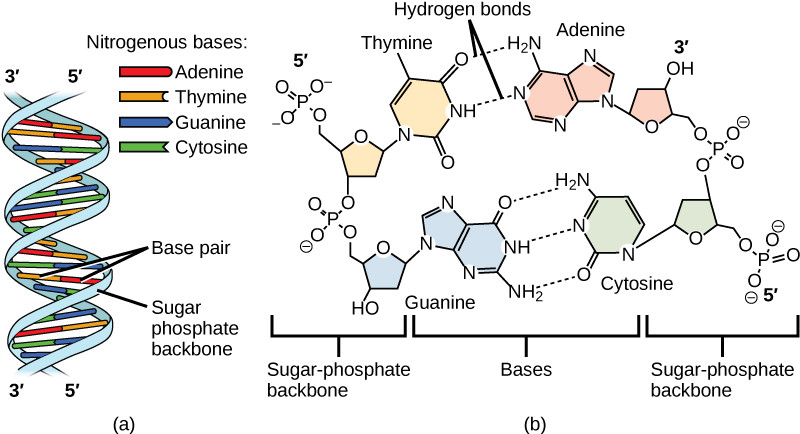
DNA double helix showing complementary base pairing and hydrogen bonds
Notice in the close-up that the sugar-phosphate backbones run along the outside of the molecule, while the nitrogenous bases point inward and pair through hydrogen bonds.
Why this pairing rule matters:
- A purine always pairs with a pyrimidine, keeping the helix a constant width.
- Base pairs are held together by hydrogen bonds.
- If you know one strand, you can determine the other.
That last point is huge. Complementary pairing allows each strand to act as a template during replication, which is how information is copied accurately.
DNA vs. RNA Structure
| Feature | DNA | RNA |
|---|---|---|
| Strands | Double-stranded (double helix) | Usually single-stranded |
| Sugar | Deoxyribose | Ribose |
| Bases | A, T, C, G | A, U, C, G |
| Stability | More stable (long-term storage) | Less stable (short-term roles) |
| Main role | Information storage | Gene expression (and viral genomes) |
DNA’s double-stranded structure and chemical stability make it ideal for long-term inheritance.
3. How DNA Structure Enables Inheritance
DNA has several structural features that make heredity possible:
- Complementary strands → enable accurate copying
- Hydrogen bonding → holds strands together but allows separation during replication
- Stable sugar-phosphate backbone → protects encoded information
- Variable base sequence → allows genetic diversity without changing overall structure
This balance is important. DNA must be stable enough to preserve information, but flexible enough to allow mutations, which generate variation for evolution.
On exams, you may see a question asking why complementary base pairing increases replication accuracy. The key idea is that pairing rules allow mismatches to be detected and corrected.
4. How Genetic Information Is Organized in Cells
The molecular structure stays the same, but how DNA is packaged differs.
Prokaryotic Genomes
- Typically one circular chromosome
- Located in the nucleoid region (no nucleus)
- Often contain plasmids
- Small, circular, extra-chromosomal DNA
- Replicate independently
- Often carry beneficial genes such as antibiotic resistance
- Can be transferred between cells
Plasmids show up in experimental scenarios involving gene transfer.
Eukaryotic Genomes
- Multiple linear chromosomes
- Located inside the nucleus
- DNA is wrapped around histone proteins
- Forms chromatin
- Allows DNA to condense
- Plays a role in gene regulation
In eukaryotes, DNA wraps around histone proteins to form nucleosomes, often described as “beads on a string.” These nucleosomes coil and fold into chromatin fibers, which further condense into visible chromosomes during cell division.
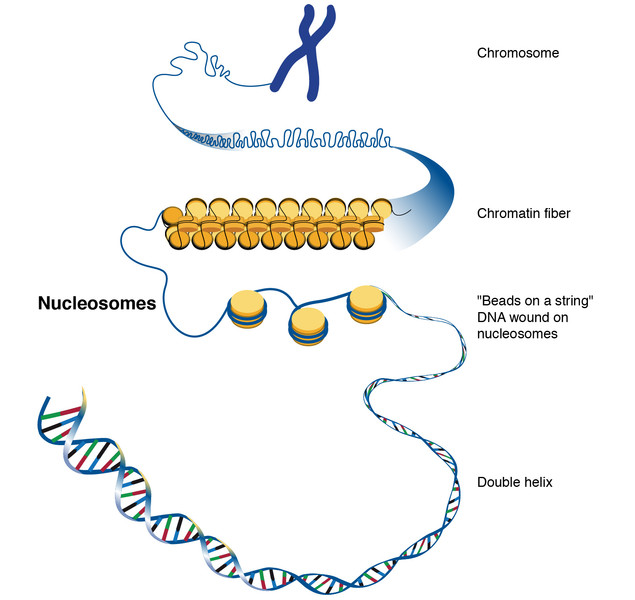
Levels of DNA packaging in eukaryotic cells
Eukaryotic cells also contain:
- Mitochondrial DNA
- Chloroplast DNA (in plants)
These are separate from nuclear chromosomes.
Plasmids in Both Domains
Plasmids are most common in prokaryotes but can exist in some eukaryotes. They are:
- Circular
- Extra-chromosomal
- Independently replicated
When a question describes DNA that is “separate from the main chromosome,” think plasmid.
Key Takeaways
DNA and RNA as Hereditary Material
DNA stores hereditary information; some organisms and viruses use RNA instead.
Chromosomes in Prokaryotes vs. Eukaryotes
Prokaryotes usually have one circular chromosome; eukaryotes usually have multiple linear chromosomes.
Histones and Associated Proteins
Proteins that package and condense eukaryotic DNA into organized chromosomes.
Plasmids
Small extra-chromosomal circular DNA molecules found in prokaryotes and some eukaryotes.
Complementary Base Pairing
Nitrogenous bases pair specifically: A with T or U, and G with C.
Purines vs. Pyrimidines
Purines, A and G, have two rings; pyrimidines, C, T, and U, have one.
Sugar-Phosphate Backbone
Alternating sugar and phosphate groups form the structural sides of a nucleic acid strand.
Base Sequence
The order of nucleotides along a strand that encodes genetic information.
DNA and RNA Structure
DNA is double-stranded with A, T, G, C; RNA is single-stranded with A, U, G, C.
Nucleotide
A nucleic acid monomer made of a sugar, phosphate group, and nitrogenous base.
Notes
DNA and RNA as Hereditary Material
DNA stores hereditary information; some organisms and viruses use RNA instead.
Chromosomes in Prokaryotes vs. Eukaryotes
Prokaryotes usually have one circular chromosome; eukaryotes usually have multiple linear chromosomes.
Histones and Associated Proteins
Proteins that package and condense eukaryotic DNA into organized chromosomes.
Plasmids
Small extra-chromosomal circular DNA molecules found in prokaryotes and some eukaryotes.
Complementary Base Pairing
Nitrogenous bases pair specifically: A with T or U, and G with C.
Purines vs. Pyrimidines
Purines, A and G, have two rings; pyrimidines, C, T, and U, have one.
Sugar-Phosphate Backbone
Alternating sugar and phosphate groups form the structural sides of a nucleic acid strand.
Base Sequence
The order of nucleotides along a strand that encodes genetic information.
DNA and RNA Structure
DNA is double-stranded with A, T, G, C; RNA is single-stranded with A, U, G, C.
Nucleotide
A nucleic acid monomer made of a sugar, phosphate group, and nitrogenous base.
