Topic 5.3 Notes – Mendelian Genetics
1. What Mendelian Inheritance Is
Mendelian inheritance describes how alleles move from parents to offspring.
First, the core vocabulary needs to be solid:
- Gene = segment of DNA that codes for a trait
- Alleles = different versions of the same gene (A vs a)
- Genotype = allele combination (AA, Aa, aa)
- Homozygous = same alleles (AA or aa)
- Heterozygous = different alleles (Aa)
- Phenotype = observable trait
- Dominant allele = expressed if at least one copy is present
- Recessive allele = expressed only if homozygous
Now connect this to meiosis:
- Homologous chromosomes separate in meiosis I
- Each gamete gets one allele per gene (haploid)
- Fertilization fuses two haploid gametes → restores diploid number
- This creates new allele combinations, increasing genetic variation
That separation during meiosis leads directly to Mendel’s laws.
2. Mendel’s Two Laws
Law of Segregation
Each organism has two alleles for a gene. Those alleles separate during gamete formation, so each gamete carries only one.
If a parent is Aa:
- 50% of gametes carry A
- 50% carry a
When fertilization happens, alleles pair up again randomly.
This explains why Aa × Aa gives a 1 AA : 2 Aa : 1 aa genotypic ratio.
Students often forget this law is literally describing what homologous chromosomes do in meiosis I.
Law of Independent Assortment
Genes on different chromosomes assort independently during meiosis.
If a parent is AaBb, possible gametes are:
- AB
- Ab
- aB
- ab
All equally likely.
Important limit: this applies to genes on different chromosomes (or far apart on the same one). If genes are linked, this ratio changes.
3. Types of Genetic Crosses and Expected Ratios
Monohybrid Cross
Example: Aa × Aa
Each parent produces gametes A and a, leading to four possible offspring genotypes.
Results:
- Genotype ratio: 1 AA : 2 Aa : 1 aa
- Phenotype ratio: 3 dominant : 1 recessive
On tests, they often give phenotype counts and expect you to infer whether the parents were heterozygous.
Dihybrid Cross
Example: AaBb × AaBb (unlinked genes)
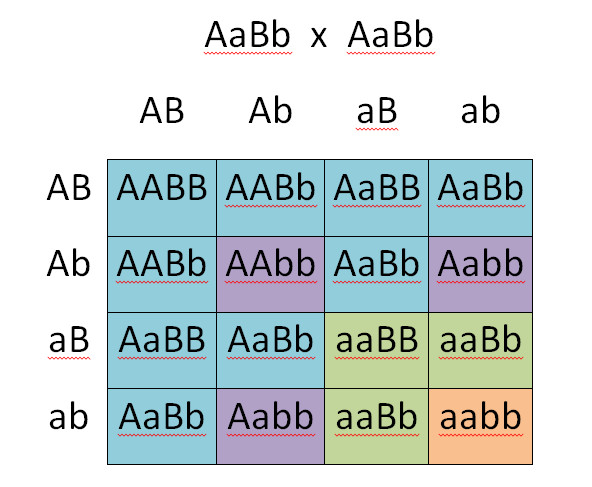
Dihybrid Punnett square (AaBb × AaBb)
Each parent produces four gametes: AB, Ab, aB, and ab. The 4 × 4 grid shows all 16 genotype combinations.
Phenotypic ratio:
- 9 A_B_
- 3 A_bb
- 3 aaB_
- 1 aabb
The 9:3:3:1 ratio only works if genes assort independently.
Test Cross
Used to determine genotype of an individual with a dominant phenotype.
Cross unknown (A_) with aa.
- If any offspring are recessive → unknown is Aa
- If all offspring are dominant → likely AA
This shows up a lot in FRQs where you must justify genotype from offspring data.
4. Probability Rules in Genetics
Punnett squares are visual tools. Probability rules are faster once you understand them.
Multiplication Rule (Independent Events)
If events are independent:
Example: AaBb × AaBb
Probability of aa = 1/4
Probability of bb = 1/4
Probability of aabb:
Addition Rule (Mutually Exclusive Events)
If events cannot happen at the same time:
Example: dominant phenotype in Aa × Aa
AA or Aa
On exams, they love asking about probability across multiple children. Each child is an independent event.
5. Patterns of Inheritance and How to Recognize Them
Autosomal Inheritance
- Gene on non-sex chromosome
- Males and females equally affected
Pedigree clue: equal distribution across sexes.
Sex-Linked Inheritance (Usually X-linked)
- Gene on X chromosome
- Males (XY) express recessive traits more often
- No father-to-son transmission (for X-linked traits)
If you see mostly affected males in a pedigree, think X-linked recessive.
Genetically Linked Genes
- Located on same chromosome
- Do not assort independently
- Inherited together more often than expected
- Crossing over can separate them
If offspring ratios deviate from 9:3:3:1, linkage is a possibility.
Big Picture Connection
Mendel’s laws explain inheritance for genes on different chromosomes.
Meiosis (segregation + independent assortment) and random fertilization generate variation.
That variation is the raw material for evolution, tying this topic back to Big Idea 1.
Key Takeaways
Law Of Segregation
The two alleles for a gene separate during gamete formation, one per gamete.
Law Of Independent Assortment
Alleles of different genes assort independently into gametes when the genes are on different chromosomes.
Haploid And Diploid
Haploid cells have one chromosome set; diploid cells have two chromosome sets.
Fertilization
Fusion of two haploid gametes that restores diploidy and combines parental alleles.
Punnett Square
A grid used to predict possible offspring genotypes and phenotypes from parental alleles.
Test Cross
Cross an individual showing a dominant phenotype with a homozygous recessive to reveal its genotype.
Probability Rules In Genetics
Use addition for mutually exclusive events and multiplication for independent events.
Pedigree Analysis
Using family inheritance charts to infer genotypes and identify inheritance patterns.
Autosomal Inheritance
Inheritance of a gene located on a non-sex chromosome.
Sex-Linked Inheritance
Inheritance of a gene located on a sex chromosome, usually the X chromosome.
Genetically Linked Genes
Genes on the same chromosome that tend to be inherited together.
Genotype And Phenotype
An organism’s alleles make up its genotype, while its observable traits are its phenotype.
Homozygous, Heterozygous, Dominant, And Recessive
Identical or different allele pairs affect whether dominant or recessive traits are expressed.
Monohybrid Cross
A one-gene cross that often produces 1:2:1 genotypic and 3:1 phenotypic ratios.
Dihybrid Cross
A two-gene cross that can produce a 9:3:3:1 phenotypic ratio.
Gamete
A haploid sex cell that carries one allele for each gene.
Zygote
A diploid cell formed when two haploid gametes fuse during fertilization.
Notes
Law Of Segregation
The two alleles for a gene separate during gamete formation, one per gamete.
Law Of Independent Assortment
Alleles of different genes assort independently into gametes when the genes are on different chromosomes.
Haploid And Diploid
Haploid cells have one chromosome set; diploid cells have two chromosome sets.
Fertilization
Fusion of two haploid gametes that restores diploidy and combines parental alleles.
Punnett Square
A grid used to predict possible offspring genotypes and phenotypes from parental alleles.
Test Cross
Cross an individual showing a dominant phenotype with a homozygous recessive to reveal its genotype.
Probability Rules In Genetics
Use addition for mutually exclusive events and multiplication for independent events.
Pedigree Analysis
Using family inheritance charts to infer genotypes and identify inheritance patterns.
Autosomal Inheritance
Inheritance of a gene located on a non-sex chromosome.
Sex-Linked Inheritance
Inheritance of a gene located on a sex chromosome, usually the X chromosome.
Genetically Linked Genes
Genes on the same chromosome that tend to be inherited together.
Genotype And Phenotype
An organism’s alleles make up its genotype, while its observable traits are its phenotype.
Homozygous, Heterozygous, Dominant, And Recessive
Identical or different allele pairs affect whether dominant or recessive traits are expressed.
Monohybrid Cross
A one-gene cross that often produces 1:2:1 genotypic and 3:1 phenotypic ratios.
Dihybrid Cross
A two-gene cross that can produce a 9:3:3:1 phenotypic ratio.
Gamete
A haploid sex cell that carries one allele for each gene.
Zygote
A diploid cell formed when two haploid gametes fuse during fertilization.
