Topic 6.5 Notes – Regulation of Gene Expression
1. Gene Expression and Why It Determines Phenotype
Every somatic cell in your body has essentially the same DNA. What makes a neuron different from a muscle cell is which genes are expressed and how much they are expressed.
Gene expression = transcription + translation → gene product (usually protein).
Only expressed genes affect phenotype.
Phenotype depends on:
- Which genes are turned on
- How much protein is made
- The function of that protein
A small change in expression level can change a trait. On exams, they love giving data showing increased mRNA levels and asking you to predict the phenotypic effect. Always think: more mRNA → usually more protein → stronger effect of that protein’s function.
Constitutive vs Regulated Genes
Not all genes are controlled the same way.
- Constitutive genes
- Always on
- Encode proteins needed for basic cell function
- Often called “housekeeping genes” (e.g., enzymes for glycolysis)
- Regulated genes
- Turned on or off depending on conditions
- May be inducible (turned on by a signal) or repressible (turned off by a signal)
Gene Expression and Cell Differentiation
Differentiation happens because different cell types express different sets of genes.
Examples of tissue-specific proteins:
- Muscle cells → actin and myosin (contraction)
- Neurons → ion channels and neurotransmitter receptors
- Pancreatic beta cells → insulin
Observable differences come from selective gene expression, not different DNA. That distinction shows up constantly in multiple choice questions.
Sequential Gene Expression in Development
Development follows a gene activation cascade.
- Early transcription factors are expressed.
- Those activate other transcription factors.
- Downstream genes are turned on in sequence.
- Cells progressively specialize.
The order matters. If an early transcription factor is mutated, every downstream gene in that pathway can be affected. When the AP gives you a mutation in a “master regulator,” expect widespread developmental effects.
Big idea: Phenotype = combination of genes expressed + level of expression.
2. Regulatory Sequences and Transcription Factors
Most regulation happens at transcription. DNA has specific noncoding regions that control whether RNA polymerase can transcribe a gene.
Regulatory DNA Sequences
These are binding sites for regulatory proteins.
Promoters
- Located directly upstream of a gene
- RNA polymerase binding site
- Required to start transcription
If a promoter is mutated, transcription usually drops or stops entirely.
Enhancers
- Increase transcription rate
- Can be far from the gene (upstream, downstream, or within introns)
- Work through DNA looping
- Bind activator transcription factors
In the diagram below, an activator protein is bound to a distant enhancer. DNA bends so that this activator can interact with RNA polymerase at the promoter of the gene.
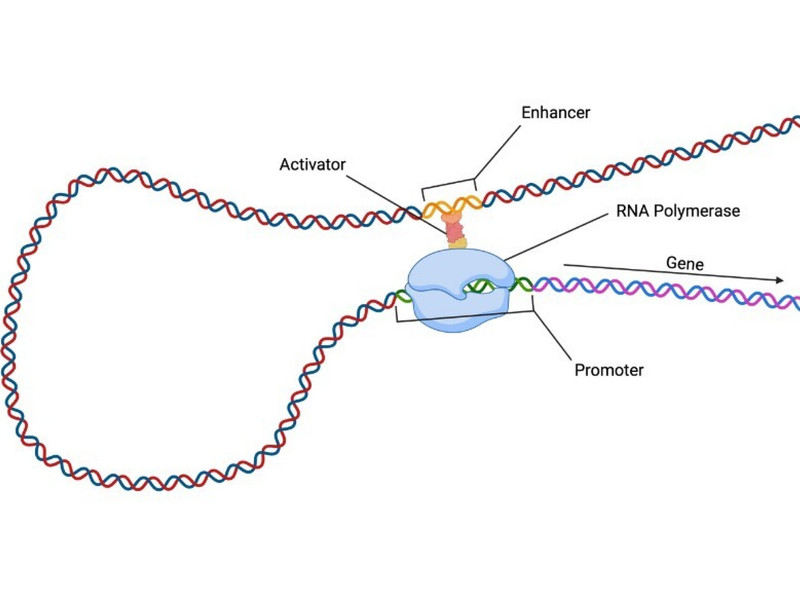
Enhancer-promoter interaction through DNA looping
Distance does not matter as long as DNA looping brings enhancer-bound proteins to the promoter.
Silencers
- Decrease transcription
- Bind repressor proteins
Operators (prokaryotes)
- Located within operons
- Repressor binding site
- Positioned to physically block RNA polymerase
Location connects to function.
Promoters sit right next to genes because they are the start site. Enhancers can be far away because looping solves the distance problem. Operators sit where they can physically block transcription.
Mutations in regulatory sequences can:
- Increase expression (e.g., stronger enhancer)
- Decrease expression
- Eliminate expression entirely
These mutations often change phenotype without changing the protein’s amino acid sequence.
3. Epigenetic Regulation of Gene Expression
Epigenetics changes gene expression without changing the DNA sequence.
It works by changing how tightly DNA is packaged.
DNA Methylation
- Adds -CH₃ groups to cytosine
- Usually silences genes
- Blocks transcription factor binding
- Often long-term but reversible
- Can be inherited through cell division
Histone Modifications
DNA wraps around histones to form chromatin. The degree of packing determines whether genes are accessible for transcription.
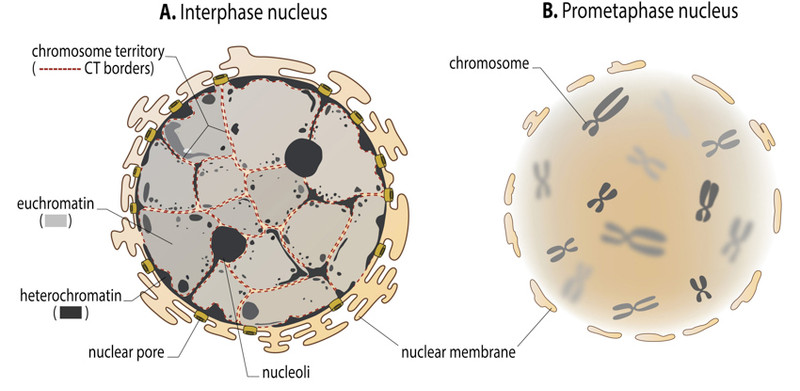
Euchromatin and heterochromatin in an interphase nucleus
- Acetylation → loosens chromatin → increases transcription
- Deacetylation → tightens chromatin → decreases transcription
- Histone methylation can activate or repress depending on location
Key pattern to memorize:
- Loose chromatin (euchromatin) → high transcription
- Tight chromatin (heterochromatin) → low transcription
Environmental factors can influence epigenetic marks. On FRQs, they often describe an environmental exposure and ask you to explain changes in gene expression without DNA mutation.
4. Coordinated Gene Regulation in Prokaryotes and Eukaryotes
Cells often regulate groups of genes together.
Prokaryotes Use Operons
An operon is a cluster of genes transcribed as one mRNA.
Components:
- Promoter
- Operator
- Structural genes
- Regulatory gene (makes repressor)
All genes turn on or off together.
Inducible vs Repressible Operons
| Feature | Inducible (lac operon) | Repressible (trp operon) |
|---|---|---|
| Default state | OFF | ON |
| Signal molecule | Substrate inactivates repressor | End product activates repressor |
| Common pathway type | Catabolic (breakdown) | Anabolic (synthesis) |
Pattern to remember:
Cells avoid wasting energy. If the product is already present, shut down synthesis.
Eukaryotes Use Shared Transcription Factors
Eukaryotes do not use operons.
Instead:
- Genes in the same pathway share common enhancer sequences
- The same transcription factor can activate multiple genes across the genome
- Coordination happens through shared regulatory proteins, not physical clustering
Examples include hormone-responsive genes, heat shock genes, and cell cycle genes.
Prokaryotes cluster genes physically.
Eukaryotes coordinate genes functionally through shared control elements.
Key Takeaways
Gene Regulation
Control of which genes are expressed, when they are expressed, and at what levels.
Regulatory Sequences
DNA stretches that bind regulatory proteins and control transcription of nearby or distant genes.
Promoter
DNA site where RNA polymerase and transcription factors bind to begin transcription.
Enhancers and Silencers
DNA elements that increase or decrease transcription when bound by regulatory proteins.
Operator
Prokaryotic DNA sequence where a repressor binds to block transcription of an operon.
Transcription Factors
Regulatory proteins that bind specific DNA sequences to activate or repress transcription.
Constitutive vs. Inducible Expression
Constitutive genes are always expressed; inducible genes are activated only under certain conditions.
Epigenetics
Heritable changes in gene expression caused by chromatin or DNA modifications, not DNA sequence changes.
DNA Methylation
Addition of methyl groups to DNA, usually reducing transcription and silencing genes.
Histone Modifications
Chemical changes to histone proteins that loosen or tighten chromatin and alter transcription.
Phenotype and Gene Expression
Traits result from which genes are expressed and the amount of each gene product made.
Sequential Gene Expression During Development
Ordered activation of genes during development, often triggered by earlier transcription factors.
Operon
Cluster of prokaryotic genes transcribed together from one promoter and regulated as a unit.
Inducible vs. Repressible Operons
Inducible systems are usually off and turned on; repressible systems are usually on and turned off.
Lac Operon
An inducible operon for lactose metabolism that is activated when lactose inactivates the repressor.
Trp Operon
A repressible operon for tryptophan synthesis that is shut off when tryptophan activates the repressor.
Coordinated Gene Regulation
Control of multiple related genes so they are expressed together in response to shared signals.
Shared Transcription Factors in Eukaryotes
Common regulatory proteins that bind similar control sequences in multiple genes to coordinate expression.
Cell Differentiation and Tissue-Specific Proteins
Cells become specialized by expressing tissue-specific proteins needed for their particular functions.
Notes
Gene Regulation
Control of which genes are expressed, when they are expressed, and at what levels.
Regulatory Sequences
DNA stretches that bind regulatory proteins and control transcription of nearby or distant genes.
Promoter
DNA site where RNA polymerase and transcription factors bind to begin transcription.
Enhancers and Silencers
DNA elements that increase or decrease transcription when bound by regulatory proteins.
Operator
Prokaryotic DNA sequence where a repressor binds to block transcription of an operon.
Transcription Factors
Regulatory proteins that bind specific DNA sequences to activate or repress transcription.
Constitutive vs. Inducible Expression
Constitutive genes are always expressed; inducible genes are activated only under certain conditions.
Epigenetics
Heritable changes in gene expression caused by chromatin or DNA modifications, not DNA sequence changes.
DNA Methylation
Addition of methyl groups to DNA, usually reducing transcription and silencing genes.
Histone Modifications
Chemical changes to histone proteins that loosen or tighten chromatin and alter transcription.
Phenotype and Gene Expression
Traits result from which genes are expressed and the amount of each gene product made.
Sequential Gene Expression During Development
Ordered activation of genes during development, often triggered by earlier transcription factors.
Operon
Cluster of prokaryotic genes transcribed together from one promoter and regulated as a unit.
Inducible vs. Repressible Operons
Inducible systems are usually off and turned on; repressible systems are usually on and turned off.
Lac Operon
An inducible operon for lactose metabolism that is activated when lactose inactivates the repressor.
Trp Operon
A repressible operon for tryptophan synthesis that is shut off when tryptophan activates the repressor.
Coordinated Gene Regulation
Control of multiple related genes so they are expressed together in response to shared signals.
Shared Transcription Factors in Eukaryotes
Common regulatory proteins that bind similar control sequences in multiple genes to coordinate expression.
Cell Differentiation and Tissue-Specific Proteins
Cells become specialized by expressing tissue-specific proteins needed for their particular functions.
