Topic 3.2 Notes – Environmental Impacts on Enzyme Function
1. How Enzyme Structure Determines Function
Enzymes are proteins, and like all proteins, their function depends on their three-dimensional shape.
Each enzyme has an active site, a specific pocket where the substrate binds. The shape and chemical properties of this site determine which substrate fits.
The classic lock-and-key model illustrates this idea: the substrate fits into the active site, forms an enzyme-substrate complex, is converted to products, and the enzyme is free to work again.
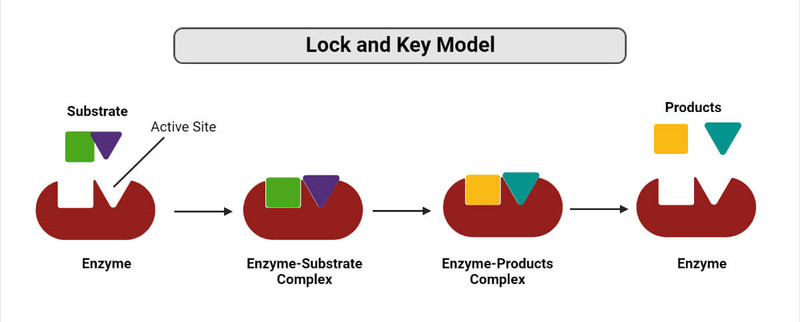
Lock-and-key model of enzyme action
What holds that 3D shape together?
- Hydrogen bonds
- Ionic bonds
- Hydrophobic interactions
- Disulfide bridges (covalent bonds between cysteines)
These interactions maintain the enzyme’s tertiary structure. If they are disrupted, the active site changes shape.
If the active site changes → substrate no longer fits properly → reaction rate decreases or stops.
This is the core principle for this whole topic:
Change the structure → change the function.
Denaturation
Denaturation means the protein loses its specific 3D shape and therefore its function.
Common causes:
- High temperature
- Extreme pH
- Chemical changes in environment
What actually happens?
Hydrogen bonds and ionic interactions are disrupted, so the protein unfolds or refolds incorrectly.
Denaturation can be:
- Irreversible (like cooking egg white)
- Reversible if conditions return to normal and the protein can refold (renaturation)
On exams, if you see “enzyme activity decreased after heat treatment,” your brain should immediately connect: heat → disrupted hydrogen bonds → altered tertiary structure → altered active site.
2. The Major Environmental Factors That Affect Enzyme Activity
a. Temperature
Temperature changes how fast molecules move.
Here’s the pattern you need to recognize:
| Temperature Condition | Molecular Effect | Effect on Enzyme Activity |
|---|---|---|
| Low temperature | Molecules move slowly | Fewer collisions → slower reaction rate |
| Increasing temperature (toward optimum) | Faster movement | More collisions → increased rate |
| Above optimal temperature | Hydrogen bonds break | Denaturation → sharp drop in activity |
Up to the optimal temperature, increased kinetic energy means more enzyme-substrate collisions.
Above the optimum, structure starts to break down. The typical graph rises gradually to a peak, then drops steeply once denaturation begins.
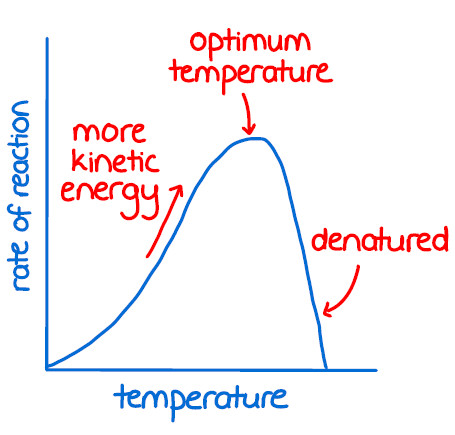
Enzyme activity vs. temperature
Human enzymes usually peak around 37°C, but enzymes in thermophiles have much higher optima.
A common AP-style question gives you a graph and asks why activity drops sharply after a peak. The answer is structural disruption, not “substrate runs out.”
b. pH
pH measures hydrogen ion concentration.
- Low pH = high (acidic)
- High pH = low (basic)
Changes in pH affect the ionization of amino acid side chains, which disrupts:
- Hydrogen bonds
- Ionic bonds
That alters the enzyme’s tertiary structure and active site shape.
Each enzyme has an optimal pH:
- Most human enzymes ≈ pH 7
- Pepsin works best around pH 2
- Lysosomal enzymes function in acidic environments
Extreme pH can cause denaturation.
When writing explanations, always connect:
pH change → altered charges on R groups → disrupted bonds → altered shape → reduced activity.
c. Substrate and Product Concentration
Reaction rate depends on the relative concentrations of substrates and enzymes.
If substrate concentration increases:
- More collisions
- Higher rate
- Until all active sites are occupied
At that point, enzymes are saturated, and the rate plateaus (maximum rate).
If you increase enzyme concentration:
- More active sites available
- Higher possible maximum rate
If substrate is scarce, it becomes the limiting factor.
Product concentration also matters:
- Product buildup can slow the forward reaction
- In reversible reactions, high product can drive the reaction backward
On data-based questions, look for a plateau in rate. That usually signals enzyme saturation.
3. Enzyme Inhibition
Inhibitors reduce enzyme activity without necessarily denaturing the enzyme.
Competitive vs Noncompetitive Inhibition
| Feature | Competitive | Noncompetitive |
|---|---|---|
| Binding site | Active site | Allosteric site |
| Resembles substrate? | Yes | No |
| Change enzyme shape? | No permanent change | Yes, conformational change |
| Can extra substrate overcome it? | Yes | No |
Competitive inhibition
The inhibitor competes with the substrate for the active site. Binding is often reversible.
Noncompetitive inhibition
The inhibitor binds elsewhere (an allosteric site) and changes the enzyme’s shape. The substrate may still bind, but catalysis is reduced.
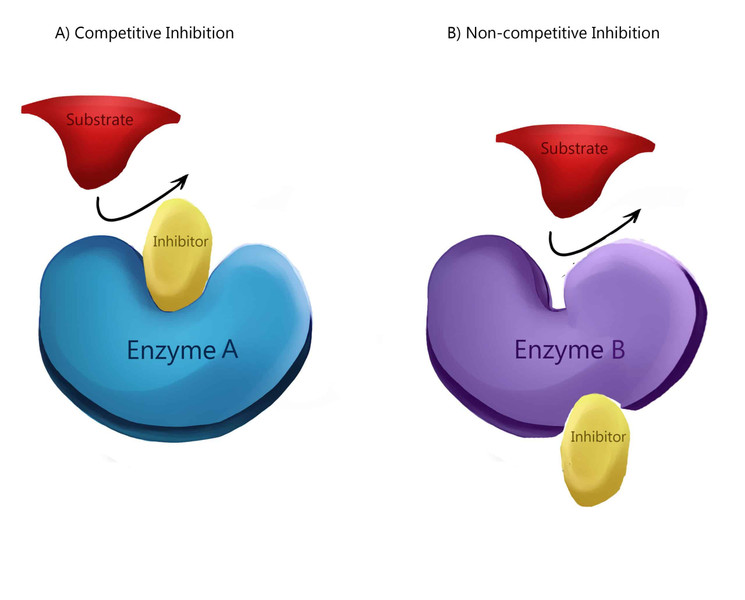
Competitive and noncompetitive enzyme inhibition
In the left panel, the inhibitor sits in the active site and blocks the substrate. In the right panel, the inhibitor binds at a separate site and alters the enzyme’s shape.
A frequent test trap: if increasing substrate restores reaction rate, it’s competitive.
4. How Cells Maintain Optimal Enzyme Function
Cells maintain homeostasis to keep enzymes working efficiently.
They regulate:
- Temperature
- pH
- Substrate availability
- Product removal
If conditions move outside optimal ranges:
- Enzyme structure changes
- Reaction rates decrease
- Metabolic pathways slow
- Severe denaturation can lead to cell or organism death
This connects to Big Idea 2. Maintaining internal conditions keeps enzymatic reactions efficient enough to sustain life.
Key Takeaways
Denaturation
Loss of a protein's functional shape caused by disrupted bonds from heat, pH, or chemicals.
Renaturation
Refolding back into an active shape after denaturing conditions are removed, restoring activity in some cases.
Optimal Temperature and Temperature Effects on Enzymes
Low temperatures slow collisions; rising temperatures increase rate until an optimum, then denaturation reduces activity.
Optimal pH and pH Effects on Enzymes
Each enzyme works best at a specific pH; deviations disrupt hydrogen bonds and reduce activity.
Substrate and Product Concentration Effects
Reaction efficiency depends on relative amounts of reactants and products; more substrate usually speeds forward reactions.
Competitive vs. Noncompetitive Inhibition
Competitive inhibitors block the active site, while noncompetitive inhibitors bind elsewhere and change enzyme shape.
Notes
Denaturation
Loss of a protein's functional shape caused by disrupted bonds from heat, pH, or chemicals.
Renaturation
Refolding back into an active shape after denaturing conditions are removed, restoring activity in some cases.
Optimal Temperature and Temperature Effects on Enzymes
Low temperatures slow collisions; rising temperatures increase rate until an optimum, then denaturation reduces activity.
Optimal pH and pH Effects on Enzymes
Each enzyme works best at a specific pH; deviations disrupt hydrogen bonds and reduce activity.
Substrate and Product Concentration Effects
Reaction efficiency depends on relative amounts of reactants and products; more substrate usually speeds forward reactions.
Competitive vs. Noncompetitive Inhibition
Competitive inhibitors block the active site, while noncompetitive inhibitors bind elsewhere and change enzyme shape.
