Topic 1.5 Notes – Lipids
1. What Lipids Are
Lipids are large biological molecules made mostly of carbon and hydrogen. That means lots of nonpolar C-H bonds.
Because they are nonpolar, lipids are:
- Hydrophobic → they do not mix with water
- Not true polymers like proteins or nucleic acids
- Built from hydrocarbon subcomponents (long chains or ring structures)
The overall behavior of a lipid comes from those hydrocarbon regions. Long chains and rings full of C-H bonds repel water, which is polar. That single fact explains most lipid functions.
When you see a question asking you to predict how a lipid behaves in water, always think:
Nonpolar structure → hydrophobic behavior.
That idea becomes clearer when we zoom in on fatty acids.
2. Fatty Acids and How Their Structure Affects Properties
A fatty acid has:
- A long hydrocarbon chain
- A terminal carboxyl group (-COOH)
They differ in:
- Chain length
- Number of double bonds
That second difference is huge for the AP exam.
Saturated Fatty Acids
- Only single bonds between carbons
- Straight hydrocarbon chains
- Pack tightly together
- Stronger intermolecular interactions
- Usually solid at room temperature (common in animal fats)
Straight chains stack neatly, like uncooked spaghetti in a box. Tight packing means less movement, which means solidity.
Unsaturated Fatty Acids
- At least one double bond
- Double bond creates a kink
- Cannot pack tightly
- Often liquid at room temperature (many plant oils)
The more double bonds, the more kinks.
Here’s the comparison clearly:
| Feature | Saturated | Unsaturated |
|---|---|---|
| Bonds | All single bonds | At least one double bond |
| Shape | Straight | Kinked at double bond |
| Packing | Tight | Loose |
| Room temp | Solid | Liquid |
Trend to memorize:
More double bonds → more unsaturated → less packing → more fluid → lower melting point.
On tests, they love giving you a membrane with more unsaturated tails and asking what happens to fluidity. It increases.
3. Major Types of Lipids and Their Functions
Now connect structure to actual biological roles.
Fats (Triglycerides)
Structure:
- Glycerol + 3 fatty acids
- Long nonpolar tails
Functions:
- Long-term energy storage
- Insulation in mammals
- Cushioning organs
- Support cell function and transport fat-soluble vitamins (A, D, E, K)
Why so good for energy?
- Tons of C-H bonds → high potential energy
- Hydrophobic → stored without drawing in water (compact storage)
Carbohydrates are short-term energy. Fats are long-term.
Phospholipids
Structure:
- Glycerol
- 2 fatty acids
- Phosphate group
They are amphipathic:
- Polar, hydrophilic head
- Nonpolar, hydrophobic tails
In water, they self-assemble into bilayers, with hydrophilic heads facing the aqueous environments and hydrophobic tails tucked inside.
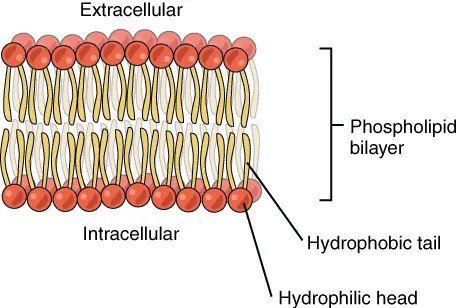
Phospholipid bilayer structure
This arrangement forms the plasma membrane and internal membranes. The hydrophobic interior acts as a barrier to many substances, allowing cells to maintain homeostasis.
If the fatty acid tails are more unsaturated, the membrane becomes more fluid. Organisms adjust this in response to temperature changes.
Steroids
Structure:
- Four fused carbon rings
- Mostly nonpolar
Functions:
- Many act as hormones
- Regulate growth and development
- Control energy metabolism
- Maintain homeostasis
Because they are nonpolar, steroid hormones can pass directly through cell membranes and bind to intracellular receptors, often affecting gene expression.
Cholesterol
Cholesterol is a specific steroid.
Functions:
- Maintains membrane stability in animal cells
- Regulates membrane fluidity
- Precursor to other steroids
It fits between phospholipids in membranes. At low temperatures, it prevents the membrane from becoming too rigid. At high temperatures, it prevents it from becoming too fluid.
That balancing act shows up often in data-based questions.
4. How Lipid Structure Determines Biological Function
Everything ties back to structure:
- Many C-H bonds → high energy storage
- Hydrophobic tails → membrane formation
- Amphipathic structure → bilayer self-assembly
- Ring structure in steroids → membrane permeability + signaling
- Degree of unsaturation → membrane fluidity
When you see a structural change in a lipid, immediately predict the functional consequence. That’s how FRQs are often framed.
Key Takeaways
Saturated vs. Unsaturated Fatty Acids
Saturated have only single bonds; unsaturated have one or more double bonds that create kinks.
Degree of Unsaturation and Fluidity
More double bonds increase kinks and make a lipid more liquid at room temperature.
Fats and Oils
Energy-storing lipids that can also provide insulation, cushioning, and support for cell function.
Phospholipids
Amphipathic lipids with hydrophilic heads and hydrophobic tails that form membranes.
Amphipathic
Having both a hydrophilic region and a hydrophobic region in the same molecule.
Lipid Bilayer
A double layer of phospholipids with tails inward and heads facing watery environments.
Steroids
Lipids with four fused carbon rings, often functioning as hormones in regulation.
Cholesterol
A steroid in animal membranes that stabilizes structure and helps regulate fluidity.
Structure Determines Function in Lipids
The arrangement of fatty acids and other parts determines a lipid's properties and roles.
Lipids
Mostly nonpolar, hydrophobic molecules used for energy storage, membranes, and signaling.
Notes
Saturated vs. Unsaturated Fatty Acids
Saturated have only single bonds; unsaturated have one or more double bonds that create kinks.
Degree of Unsaturation and Fluidity
More double bonds increase kinks and make a lipid more liquid at room temperature.
Fats and Oils
Energy-storing lipids that can also provide insulation, cushioning, and support for cell function.
Phospholipids
Amphipathic lipids with hydrophilic heads and hydrophobic tails that form membranes.
Amphipathic
Having both a hydrophilic region and a hydrophobic region in the same molecule.
Lipid Bilayer
A double layer of phospholipids with tails inward and heads facing watery environments.
Steroids
Lipids with four fused carbon rings, often functioning as hormones in regulation.
Cholesterol
A steroid in animal membranes that stabilizes structure and helps regulate fluidity.
Structure Determines Function in Lipids
The arrangement of fatty acids and other parts determines a lipid's properties and roles.
Lipids
Mostly nonpolar, hydrophobic molecules used for energy storage, membranes, and signaling.
