Topic 6.3 Notes – Transcription and RNA Processing
1. The Central Dogma and How Information Flows
At the core of molecular biology is the central dogma:
DNA → RNA → Protein
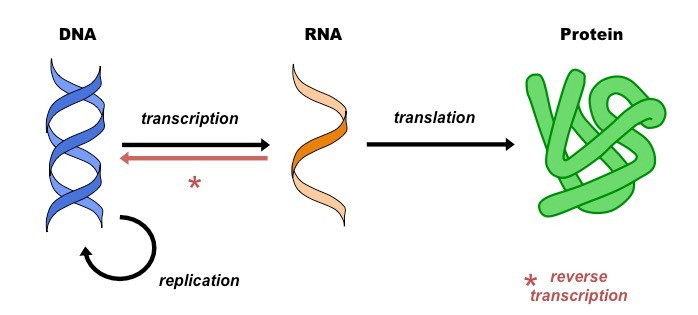
The central dogma: DNA → RNA → Protein
DNA is transcribed into RNA, and RNA is translated into protein. The diagram also shows DNA replication and reverse transcription, but for AP Biology, focus on the main forward flow of information.
Here’s what that means in plain terms:
- DNA stores genetic information as a sequence of nucleotides.
- RNA is a working copy of a gene.
- Protein is built from amino acids whose order is determined by the RNA sequence.
The crucial idea for this topic is this:
The sequence of RNA bases, together with the structure of the RNA molecule, determines RNA function.
That sequence:
- Is read in codons (three bases at a time).
- Determines the amino acid sequence of a protein.
- Which determines the protein’s shape.
- Which determines the protein’s function.
If the RNA sequence changes, the protein can change. That connection shows up constantly in AP questions, especially when mutations are involved.
2. Transcription
Transcription is the process of making RNA from a DNA template.
It is carried out by the enzyme RNA polymerase.
What RNA Polymerase Does
- Binds to a promoter (start region of a gene).
- Uses one DNA strand as a template.
- Builds a complementary RNA strand.
Only one strand is used. Students often assume both strands are copied. They aren’t.
Template vs Coding Strand
There are two DNA strands:
- Template strand
- Also called antisense or noncoding strand
- Read by RNA polymerase
- Runs 3′ → 5′
- Coding strand
- Same sequence as mRNA (except T is replaced by U)
That “T → U” detail matters when you’re asked to predict mRNA from DNA.
Directionality
This is tested constantly.
- RNA polymerase reads DNA 3′ → 5′
- RNA is synthesized 5′ → 3′
- New nucleotides are added to the 3′ end
Base pairing during transcription:
- A → U
- T → A
- C → G
- G → C
If a question gives you a DNA sequence labeled 5′ to 3′, slow down and check whether it’s the template or coding strand before answering. That’s a common trap.
3. The Three Types of RNA
All RNA is made by transcription, but not all RNA does the same thing.
mRNA
Messenger RNA carries information from DNA (in the nucleus) to ribosomes (in the cytoplasm).
- Contains codons
- Determines the primary structure of a protein
- Its sequence directly determines amino acid order
If the mRNA changes, the protein sequence may change.
tRNA
Transfer RNA brings amino acids to the ribosome.
Each tRNA:
- Binds a specific amino acid
- Contains an anticodon that base-pairs with an mRNA codon

tRNA structure: cloverleaf (2D) and folded (3D)
The cloverleaf diagram shows the anticodon loop at the bottom pairing with an mRNA codon, and the 3′ end at the top where a specific amino acid attaches. In the cell, the molecule folds into the compact L-shape shown on the right.
The 3D L-shape allows tRNA to:
- Carry an amino acid on one end
- Pair with mRNA at the anticodon
- Fit into the ribosome
If the anticodon sequence changes, the wrong amino acid could be inserted.
rRNA
Ribosomal RNA forms the core of the ribosome.
- Structural component
- Positions mRNA and tRNA correctly
- Catalyzes peptide bond formation
rRNA acts as a ribozyme. That means RNA itself performs catalytic activity. This is a favorite conceptual test question.
4. RNA Processing in Eukaryotes
In eukaryotes, the initial transcript is pre-mRNA.
It must be modified before it leaves the nucleus.
There are three major modifications:
5′ GTP Cap
- Added to the 5′ end
- Helps ribosome recognize mRNA
- Protects from degradation
Poly-A Tail
- Added to the 3′ end
- Series of adenine nucleotides
- Increases stability
- Helps with nuclear export
RNA Splicing
Pre-mRNA contains:
- Introns (noncoding regions)
- Exons (coding regions)
The spliceosome:
- Removes introns
- Joins exons together
During splicing, the intron is cut out as a looped structure called a lariat, and the two surrounding exons are ligated together.
Only exons remain in mature mRNA.
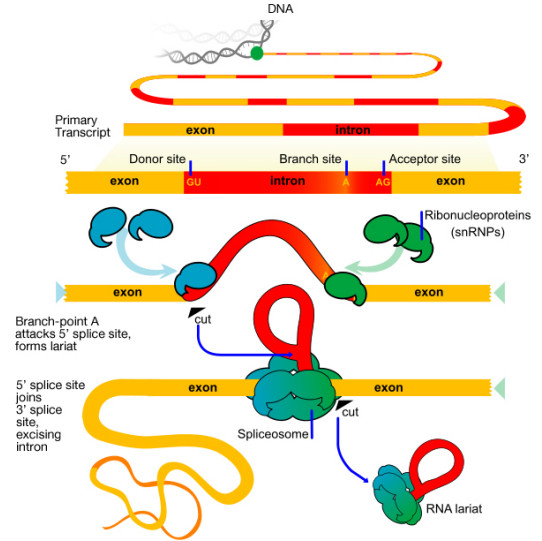
Spliceosome-mediated removal of an intron as a lariat
Alternative Splicing
Different combinations of exons can be joined.
Result:
- One gene → multiple mRNA versions → multiple proteins
This increases protein diversity and is a major reason humans can have far fewer genes than proteins.
If an exam question shows two tissues producing different protein versions from the same gene, alternative splicing is often the explanation.
Key Takeaways
Transcription
Synthesis of an RNA molecule from a DNA template by RNA polymerase.
RNA Polymerase
Enzyme that reads template DNA and builds complementary RNA in the 5' to 3' direction.
Promoter
Specific DNA sequence where RNA polymerase binds to begin transcription.
Template Strand / Noncoding Strand / Antisense Strand
DNA strand read during transcription to make complementary RNA; read 3' to 5'.
RNA Structure and Function
An RNA molecule's base sequence and shape determine what role it performs.
mRNA
Carries genetic information copied from DNA to ribosomes for protein synthesis.
tRNA
Transfers specific amino acids to the ribosome using anticodons that pair with mRNA codons.
rRNA
Forms the structural and functional core of ribosomes.
Codon and Anticodon
A codon is a three-base mRNA sequence; an anticodon is the complementary tRNA sequence.
5' Cap / GTP Cap
Modified guanine added to the 5' end of eukaryotic mRNA for ribosome recognition and stability.
Poly-A Tail
String of adenines added to the 3' end of eukaryotic mRNA that increases stability.
Alternative Splicing
Different exon combinations from one transcript produce multiple mature mRNAs from one gene.
Primary RNA Transcript and RNA Processing
Initial eukaryotic RNA is enzymatically modified into mature mRNA before translation.
RNA Splicing: Introns and Exons
Introns are removed and exons are joined to form mature eukaryotic mRNA.
Notes
Transcription
Synthesis of an RNA molecule from a DNA template by RNA polymerase.
RNA Polymerase
Enzyme that reads template DNA and builds complementary RNA in the 5' to 3' direction.
Promoter
Specific DNA sequence where RNA polymerase binds to begin transcription.
Template Strand / Noncoding Strand / Antisense Strand
DNA strand read during transcription to make complementary RNA; read 3' to 5'.
RNA Structure and Function
An RNA molecule's base sequence and shape determine what role it performs.
mRNA
Carries genetic information copied from DNA to ribosomes for protein synthesis.
tRNA
Transfers specific amino acids to the ribosome using anticodons that pair with mRNA codons.
rRNA
Forms the structural and functional core of ribosomes.
Codon and Anticodon
A codon is a three-base mRNA sequence; an anticodon is the complementary tRNA sequence.
5' Cap / GTP Cap
Modified guanine added to the 5' end of eukaryotic mRNA for ribosome recognition and stability.
Poly-A Tail
String of adenines added to the 3' end of eukaryotic mRNA that increases stability.
Alternative Splicing
Different exon combinations from one transcript produce multiple mature mRNAs from one gene.
Primary RNA Transcript and RNA Processing
Initial eukaryotic RNA is enzymatically modified into mature mRNA before translation.
RNA Splicing: Introns and Exons
Introns are removed and exons are joined to form mature eukaryotic mRNA.
