Topic 1.1 Notes – Structure of Water and Hydrogen Bonding
1. What Makes Water Polar
A water molecule has two hydrogen atoms covalently bonded to one oxygen atom. Those bonds are polar covalent bonds because oxygen is more electronegative than hydrogen. It pulls the shared electrons closer to itself.
That creates:
- Oxygen → partial negative charge (δ-)
- Each hydrogen → partial positive charge (δ+)
If water were linear, those charges might cancel. But it isn’t.
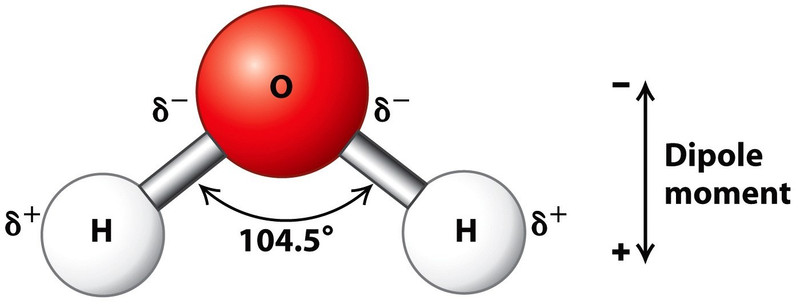
Bent structure and dipole of a water molecule
Water has a bent shape (~104.5°), so the partial charges do not cancel. The oxygen side is slightly negative and the hydrogen side is slightly positive, creating an overall dipole moment. That makes water polar.
Polarity means water can interact with other polar or charged substances. This one structural feature drives everything else in this topic.
2. Hydrogen Bonding Between Water Molecules
Because water molecules have partial charges, they attract each other.
A hydrogen bond forms between:
- A δ+ hydrogen from one water molecule
- And a δ- oxygen from a nearby water molecule
These are intermolecular attractions, not true covalent bonds. They are weaker than covalent bonds, but in liquid water there are many at once, constantly breaking and reforming.

Hydrogen bond between two water molecules
In the diagram, the dashed line represents the hydrogen bond between the δ+ hydrogen of one molecule and the δ- oxygen of another.
Keep this straight on tests:
- Polar covalent bond → within one water molecule
- Hydrogen bond → between different water molecules
Hydrogen bonding is the reason water has unusual physical properties compared to other small molecules.
3. Properties That Result from Hydrogen Bonding
Cohesion
Cohesion is water sticking to itself.
Hydrogen bonds hold water molecules together, allowing them to form continuous columns. In plants, cohesion helps pull water upward through the xylem during transpiration. If those hydrogen bonds didn’t exist, water columns would break under gravity.
Adhesion
Adhesion is water sticking to other polar or charged surfaces.
Water molecules interact with charged groups in cell walls. In plants, adhesion helps water climb thin tubes by sticking to the walls, supporting capillary action.
Cohesion + adhesion together explain water movement in plants. AP questions love to connect hydrogen bonding directly to this transport.
Surface Tension
At the surface of water, molecules form strong hydrogen bonds with neighbors beside and below them. That creates surface tension, which makes the surface resist breaking.
This explains how insects can stand on water and why droplets form spheres.
High Specific Heat
Specific heat is the energy required to raise 1 g of a substance by 1°C.
Water has a high specific heat capacity because hydrogen bonds must absorb energy before molecules can move faster. That means water changes temperature slowly.
Biological impact:
- Stabilizes body temperature
- Oceans buffer climate
- Cells resist sudden temperature swings
When you see a question about homeostasis and temperature stability, think hydrogen bonds absorbing heat.
High Heat of Vaporization
The heat of vaporization is the energy required for liquid water to become vapor.
To evaporate, water molecules must break hydrogen bonds. That requires significant energy.
Biological impact:
- Sweating cools humans
- Transpiration cools plants
- Evaporative cooling removes high-energy molecules from the surface
Energy leaves with the water vapor, lowering temperature.
4. Water as a Solvent and the Basis of pH
Hydrophilic vs Hydrophobic
Because water is polar:
- Hydrophilic substances
- Polar or ionic
- Interact with water via charges
- Dissolve in water
- Hydrophobic substances
- Nonpolar
- Do not form hydrogen bonds
- Cluster together (important in membrane formation)
This solvent ability allows biochemical reactions to occur in cells.
Dissociation of Water and pH
Water can ionize slightly:
More precisely, free H⁺ binds to another water molecule to form hydronium (H₃O⁺).
- Acids increase H⁺ concentration
- Bases decrease H⁺ (or increase OH⁻)
pH is defined as:
Each 1-unit change in pH equals a 10× change in hydrogen ion concentration.
Most biological systems operate between pH 6-8. Even small pH shifts can disrupt protein structure because hydrogen bonding helps maintain protein shape.
5. Why Water Is Essential to Life
Water’s polarity leads to hydrogen bonding.
Hydrogen bonding leads to:
- Cohesion → water transport in plants
- Adhesion → capillary action
- Surface tension → stable surfaces
- High specific heat → temperature stability
- High heat of vaporization → evaporative cooling
- Solvent ability → biochemical reactions
- Proper H⁺ balance → functional enzymes
This is a classic example of emergent properties. Molecular structure at a small scale creates system-level stability in organisms and ecosystems.
Key Takeaways
Hydrogen Bonding
Weak attraction between a partially positive hydrogen and a nearby electronegative atom.
Cohesion
Attraction between water molecules caused by hydrogen bonds.
Adhesion
Attraction between water molecules and other polar or charged substances.
Surface Tension
Resistance of a liquid surface to breaking, caused by strong cohesion among surface molecules.
Evaporative Cooling
Evaporation removes the highest-energy molecules, lowering the temperature of the remaining liquid.
Hydrophilic and Hydrophobic Substances
Hydrophilic substances interact with water; hydrophobic substances are nonpolar and avoid mixing with water.
Water as a Solvent
Its polarity allows it to surround and dissolve many ionic and polar substances.
Water Polarity and Polar Covalent Bonds
Unequal electron sharing in O-H bonds gives oxygen a partial negative charge and hydrogens partial positive charges.
High Specific Heat of Water
It resists temperature change because much energy is needed to disrupt hydrogen bonds.
High Heat of Vaporization of Water
A large amount of energy is required for evaporation because many hydrogen bonds must break.
Notes
Hydrogen Bonding
Weak attraction between a partially positive hydrogen and a nearby electronegative atom.
Cohesion
Attraction between water molecules caused by hydrogen bonds.
Adhesion
Attraction between water molecules and other polar or charged substances.
Surface Tension
Resistance of a liquid surface to breaking, caused by strong cohesion among surface molecules.
Evaporative Cooling
Evaporation removes the highest-energy molecules, lowering the temperature of the remaining liquid.
Hydrophilic and Hydrophobic Substances
Hydrophilic substances interact with water; hydrophobic substances are nonpolar and avoid mixing with water.
Water as a Solvent
Its polarity allows it to surround and dissolve many ionic and polar substances.
Water Polarity and Polar Covalent Bonds
Unequal electron sharing in O-H bonds gives oxygen a partial negative charge and hydrogens partial positive charges.
High Specific Heat of Water
It resists temperature change because much energy is needed to disrupt hydrogen bonds.
High Heat of Vaporization of Water
A large amount of energy is required for evaporation because many hydrogen bonds must break.
