Topic 7.7 Notes – Common Ancestry
1. Common Ancestry of Eukaryotes
All eukaryotes belong to the domain Eukarya, and the reason we group them together is not appearance. It is shared complex cellular features.
When many different organisms share the same detailed, integrated structures, the most logical explanation is inheritance from a common ancestor.
A few key terms to ground this:
- Common ancestry = different species descended from the same ancestral species.
- Homology = similarity due to shared ancestry (not just similar function).
- The more complex and specific a shared feature is, the stronger the evidence that it evolved once and was passed down.
A membrane-bound nucleus, linear chromosomes wrapped in histones, and genes with introns are not simple traits. They involve coordinated systems inside the cell. That matters.
2. The Three Shared Eukaryotic Features
These are the three traits AP expects you to know as evidence for common ancestry of all eukaryotes.
a. Membrane-Bound Organelles
Eukaryotic cells contain internal compartments surrounded by membranes.
Examples:
- Nucleus (stores DNA)
- Mitochondria (ATP production)
- Endoplasmic reticulum
- Golgi apparatus
- Chloroplasts (in plants and some protists)
Here’s a standard diagram of a eukaryotic cell showing many of these organelles:
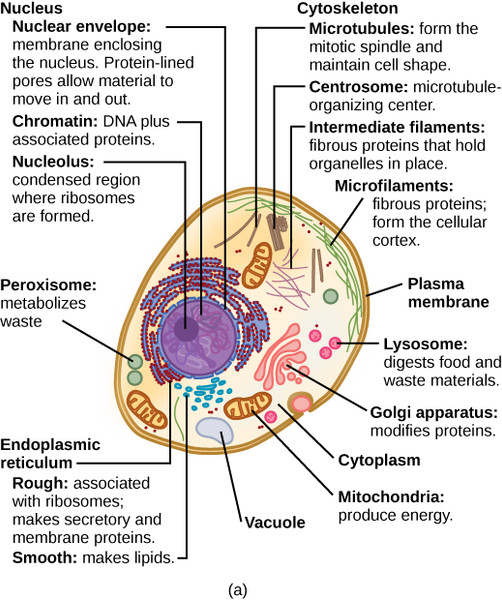
General structure of a eukaryotic cell with membrane-bound organelles
Prokaryotes (bacteria and archaea) do not have these membrane-bound organelles.
Why this matters for evolution:
- Compartmentalization requires complex internal membrane systems.
- These systems coordinate transport, protein processing, energy production, and gene regulation.
- It is highly unlikely that plants, animals, fungi, and protists all independently evolved the same internal membrane architecture.
The simpler explanation is that an ancestral eukaryotic cell evolved this organization once, and all modern eukaryotes inherited it.
Functionally, compartmentalization:
- Increases efficiency
- Separates incompatible reactions
- Allows larger, more complex cells
Structure and function both support common ancestry.
b. Linear Chromosomes
Eukaryotes store DNA as multiple linear chromosomes inside a nucleus.
Compare that to prokaryotes:
| Feature | Prokaryotes | Eukaryotes |
|---|---|---|
| Chromosome shape | Usually circular | Linear |
| Location | Cytoplasm (no nucleus) | Inside nucleus |
| DNA packaging | Minimal protein association | Wrapped around histones |
| Number | Usually one main chromosome | Multiple chromosomes |
Key shared eukaryotic features:
- Histone proteins (DNA wraps around them)
- Telomeres (protect chromosome ends)
- Multiple linear chromosomes
That entire system of DNA organization is conserved across all eukaryotes. The probability that this exact setup evolved independently in every lineage is extremely low.
On exams, you might see a question comparing chromosome structure in bacteria versus animals and be asked to justify grouping animals with plants rather than bacteria. Linear chromosomes with histones is a strong justification.
c. Genes Containing Introns
Eukaryotic genes are structured differently from most prokaryotic genes.
They contain:
- Exons → coding regions
- Introns → noncoding regions removed before translation
The process looks like this:
- DNA is transcribed into pre-mRNA (contains introns and exons).
- RNA splicing removes introns.
- Exons are joined to form mature mRNA.
- mRNA is translated into protein.
This diagram walks through that sequence from DNA to protein:
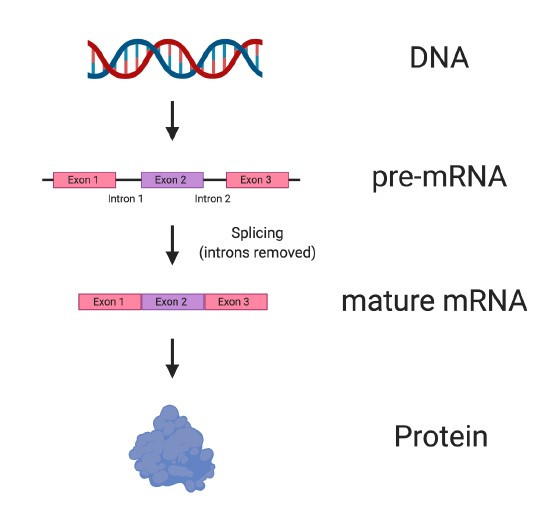
RNA splicing: from pre-mRNA to mature mRNA to protein
Why this supports common ancestry:
- Introns are widespread in eukaryotes.
- The cellular machinery that removes introns is shared.
- This system is rare in prokaryotes.
Introns also allow alternative splicing, which lets one gene produce multiple proteins. That increases protein diversity and supports complex multicellular life.
If different eukaryotic groups evolved separately, we would not expect them all to share the same gene structure and splicing mechanisms.
3. Why These Traits Are Strong Evidence
These three traits are:
- Present in all eukaryotes
- Complex and integrated into essential cellular processes
- Distinct from prokaryotic organization
The most parsimonious explanation is that one ancestral eukaryotic cell evolved:
- Membrane-bound organelles
- Linear chromosomes with histones
- Intron-containing genes
All modern eukaryotes inherited these features.
When you explain this on a quiz or FRQ, make sure you:
- Identify the shared structure.
- Describe what it is.
- Explain why its complexity makes independent evolution unlikely.
- Connect it to inheritance from a shared ancestor.
That connection step is what earns full credit.
Key Takeaways
Structural And Functional Evidence For Common Ancestry Of Eukaryotes
Shared eukaryotic traits include membrane-bound organelles, linear chromosomes, and genes containing introns.
Membrane-Bound Organelles
Internal cell compartments surrounded by membranes, such as the nucleus, mitochondria, and chloroplasts.
Linear Chromosomes
DNA molecules arranged as straight chromosomes rather than the circular form typical of prokaryotes.
Introns
Noncoding gene sequences transcribed into RNA and removed before the mature mRNA is translated.
Notes
Structural And Functional Evidence For Common Ancestry Of Eukaryotes
Shared eukaryotic traits include membrane-bound organelles, linear chromosomes, and genes containing introns.
Membrane-Bound Organelles
Internal cell compartments surrounded by membranes, such as the nucleus, mitochondria, and chloroplasts.
Linear Chromosomes
DNA molecules arranged as straight chromosomes rather than the circular form typical of prokaryotes.
Introns
Noncoding gene sequences transcribed into RNA and removed before the mature mRNA is translated.
