Topic 8.6 Notes – Biodiversity
1. What Biodiversity Is
Biodiversity = the variety of life in an ecosystem.
It exists at more than one level, and each level affects how stable the system is.
Genetic Diversity
This is variation in alleles within a population.
- Individuals in a population are not genetically identical.
- Different alleles → different traits (disease resistance, drought tolerance, etc.).
- Natural selection acts on this variation.
Why it matters:
- If a disease hits, some individuals may survive because they carry resistant alleles.
- If conditions change, some genotypes may be better suited.
- Higher genetic diversity reduces inbreeding depression (fewer harmful recessive traits expressed).
Think of it this way: more genetic variation means a higher chance that some individuals survive a disturbance → the population continues.
On FRQs, if you’re asked why a population survived a change, connect it directly to existing genetic variation that allowed natural selection to act.
Species Diversity
This is the number and distribution of species in an ecosystem.
It includes:
- Species richness = how many species are present
- Relative abundance = how evenly individuals are distributed among species
An ecosystem with 20 species where one dominates 95% of individuals has lower effective diversity than one where individuals are more evenly distributed.
Why it matters:
- Different species fill different ecological roles.
- Energy flows through multiple pathways.
- Nutrients are recycled by many types of organisms.
More species = more interacting parts = more stability.
2. Key Components That Maintain Ecosystem Diversity
Biodiversity doesn’t just “happen.” Certain components help maintain it.
Producers
Producers (autotrophs) form the base of all food webs.
- Plants, algae, some bacteria
- Convert solar or chemical energy into organic molecules
Energy enters ecosystems through producers and then moves up through consumers and decomposers.
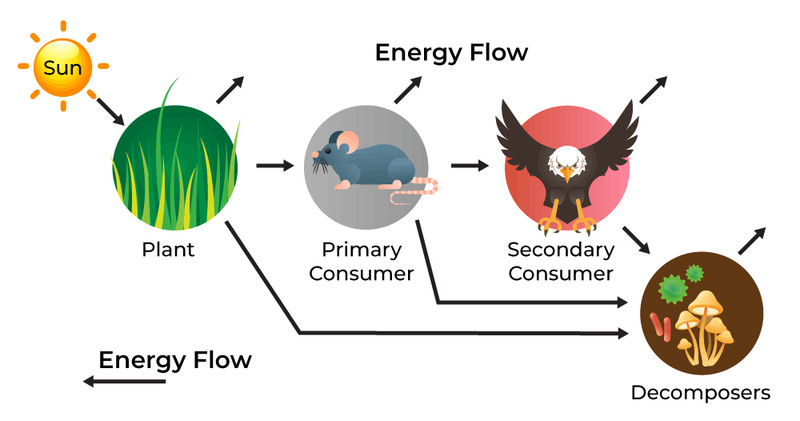
Energy flow through trophic levels
Without producers:
- No energy enters the ecosystem
- Consumers cannot survive
- The entire system collapses
Any time you analyze ecosystem stability, always identify the producers first. They support everything else.
Keystone Species
A keystone species has a disproportionately large effect relative to its abundance.
Even if there aren’t many of them, removing them causes major change.
Common types:
- Predators
- Control prey populations
- Prevent overgrazing
- Their removal can cause a trophic cascade
- Ecosystem engineers
- Physically modify the environment
- Create habitats used by other species
- Mutualists
- Critical interactions like pollination
- Support reproduction of many species
A classic trophic cascade involves a top predator affecting herbivores, which then affects plant communities and other organisms.
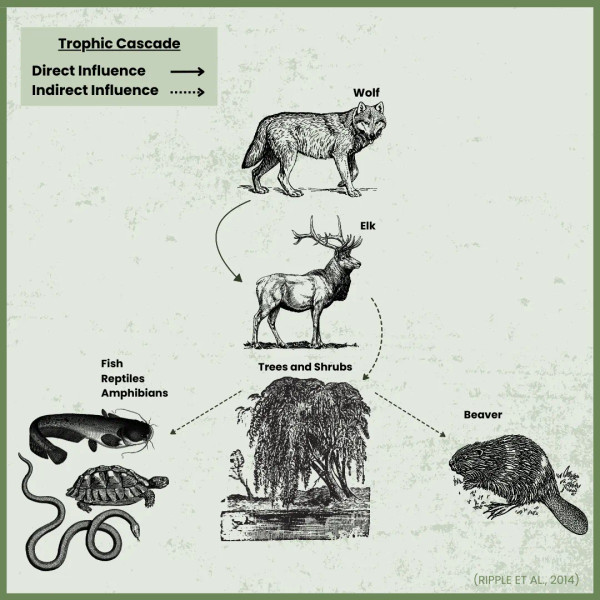
Example of a trophic cascade
When keystone species are removed:
- Effects ripple through multiple trophic levels
- Biodiversity often decreases
- Ecosystem structure may permanently shift
The AP loves asking you to predict what happens when a top predator disappears. Always think several steps down the food web.
Essential Abiotic and Biotic Factors
Abiotic (nonliving) factors:
- Temperature
- Water availability
- Soil composition
- Nutrient levels
- pH and oxygen
Biotic (living) factors:
- Competition
- Predation
- Disease
- Symbiosis
These determine which species can survive. Change one factor, and community composition shifts.
3. How Biodiversity Increases Resistance and Resilience
Two key terms:
- Resistance = ability to withstand disturbance without major change
- Resilience = ability to recover after disturbance
They are related but not identical.
Why More Diversity = More Stability
- Functional redundancy
- Multiple species perform similar roles.
- If one declines, others can compensate.
- Different stress responses
- Not all species respond the same way to drought, disease, or temperature shifts.
- Multiple energy pathways
- More complex food webs buffer disruptions.
Artificial systems like monoculture farms have:
- Low genetic diversity
- Low species diversity
- High vulnerability
One pathogen can wipe out the entire crop. That’s low resilience.
On data-based questions, if you see a graph showing faster recovery in a diverse system, connect it to redundancy and variation in response.
4. Effects of Adding or Removing Ecosystem Components
Ecosystems are networks. Changing one part affects others.
Short-Term Effects
- Rapid population increases or decreases
- Resource availability shifts
- Altered competition or predation
- Immediate food web disruption
Example chain:
Remove predator → prey increases → vegetation declines.
Long-Term Effects
- Trophic cascades
- Species migration or extinction
- Altered nutrient cycling
- Formation of a new stable state
Keystone species removal is especially dramatic. Because their effect is disproportionate, their loss can restructure the entire ecosystem.
When answering, think in layers:
- Immediate population change
- Effects on other species
- Long-term structural consequences
That full chain earns points.
Key Takeaways
Biodiversity
The variety of life in an ecosystem, including genetic and species differences.
Genetic Diversity
Variation in alleles among individuals of the same species within a population.
Species Diversity
The variety and relative abundance of different species in an ecosystem.
Low Biodiversity and Reduced Resilience
Ecosystems with few species or little variation are less able to resist and recover from change.
Functional Redundancy
Multiple species perform similar ecological roles, providing backup if one declines.
Keystone Species
A species with a disproportionately large effect on ecosystem structure relative to its abundance.
Keystone Species Removal and Ecosystem Collapse
Removing a disproportionately influential species can trigger trophic changes and community breakdown.
Producers
Autotrophs that convert light or chemical energy into organic molecules for the food web.
Abiotic and Biotic Factors
Nonliving conditions and living interactions that shape which organisms can survive in an ecosystem.
Short-Term Effects of Adding or Removing Ecosystem Components
Immediate changes include altered population sizes, resources, competition, and species interactions.
Long-Term Effects of Adding or Removing Ecosystem Components
Over time, adaptation, reorganization, and new stable community structures may develop.
Trophic Cascade
A chain reaction across feeding levels caused by changes in predator or prey populations.
Ecosystem Resistance and Resilience
The abilities of an ecosystem to withstand disturbance and recover after environmental change.
Notes
Biodiversity
The variety of life in an ecosystem, including genetic and species differences.
Genetic Diversity
Variation in alleles among individuals of the same species within a population.
Species Diversity
The variety and relative abundance of different species in an ecosystem.
Low Biodiversity and Reduced Resilience
Ecosystems with few species or little variation are less able to resist and recover from change.
Functional Redundancy
Multiple species perform similar ecological roles, providing backup if one declines.
Keystone Species
A species with a disproportionately large effect on ecosystem structure relative to its abundance.
Keystone Species Removal and Ecosystem Collapse
Removing a disproportionately influential species can trigger trophic changes and community breakdown.
Producers
Autotrophs that convert light or chemical energy into organic molecules for the food web.
Abiotic and Biotic Factors
Nonliving conditions and living interactions that shape which organisms can survive in an ecosystem.
Short-Term Effects of Adding or Removing Ecosystem Components
Immediate changes include altered population sizes, resources, competition, and species interactions.
Long-Term Effects of Adding or Removing Ecosystem Components
Over time, adaptation, reorganization, and new stable community structures may develop.
Trophic Cascade
A chain reaction across feeding levels caused by changes in predator or prey populations.
Ecosystem Resistance and Resilience
The abilities of an ecosystem to withstand disturbance and recover after environmental change.
