Topic 7.11 Notes – Variations in Populations
1. Genetic Diversity and Why It Matters
Genetic diversity means the variety of alleles (different versions of genes) in a population.
Where does that variation come from?
- Mutations → create new alleles (the original source of new genetic information)
- Meiosis
- Crossing over → swaps DNA between homologous chromosomes
- Independent assortment → random distribution of chromosomes
- Gene flow → movement of alleles between populations (migration)
Without variation, every individual is genetically similar. And if everyone is similar, they respond to environmental stress the same way.
Here’s the core principle you need locked in:
Natural selection can only act on existing variation.
If a drought hits and no one has drought-resistant traits, the population declines. If at least a few individuals already carry helpful alleles, those individuals survive and pass them on.
That’s why genetic diversity is often described as the “raw material” for evolution.
2. High vs Low Genetic Diversity
When you compare populations, you’re really comparing how much built-in flexibility they have.
| High Genetic Diversity | Low Genetic Diversity | |
|---|---|---|
| Alleles | Many different versions of genes present | Few allele differences; individuals genetically similar |
| Trait Variation | Wide range of phenotypes (size, color, disease resistance) | Traits are uniform across population |
| Response to Environmental Change | Higher chance some individuals survive | Most or all individuals affected the same way |
| Population Stability | More resilient; lower extinction risk | Higher extinction risk |
| Common Causes | Large population, gene flow | Bottleneck, founder effect, inbreeding |
Why low diversity is dangerous
Low diversity often results from:
- Bottleneck effect → drastic reduction in population size
- Founder effect → small group starts a new population
- Long-term isolation → inbreeding
This leads to inbreeding depression:
- Increased expression of harmful recessive alleles
- Reduced fertility
- Lower survival rates
On a test, they love giving a scenario where a disease spreads through a genetically similar population. The correct reasoning almost always connects uniform genetics to uniform susceptibility.
3. Alleles Depend on the Environment
An allele isn’t “good” or “bad” on its own. Its effect depends on selective pressures.
Examples:
- Thick fur
- Helpful in cold climates
- Harmful in hot climates
- Dark coloration
- Camouflage in forests
- Visible in deserts
- Drought resistance
- Helpful in dry years
- May reduce growth in wet years
So an allele that is adaptive in one environment can be deleterious in another.
This idea shows up in FRQs where environments shift. If climate changes, selection pressures change. The advantage can flip.
Maintaining many alleles means the population has options when conditions change.
4. Disease and Agriculture as Selection Models
These examples show variation in action.
Antibiotic Resistance in Bacteria
Bacterial populations already contain variation.
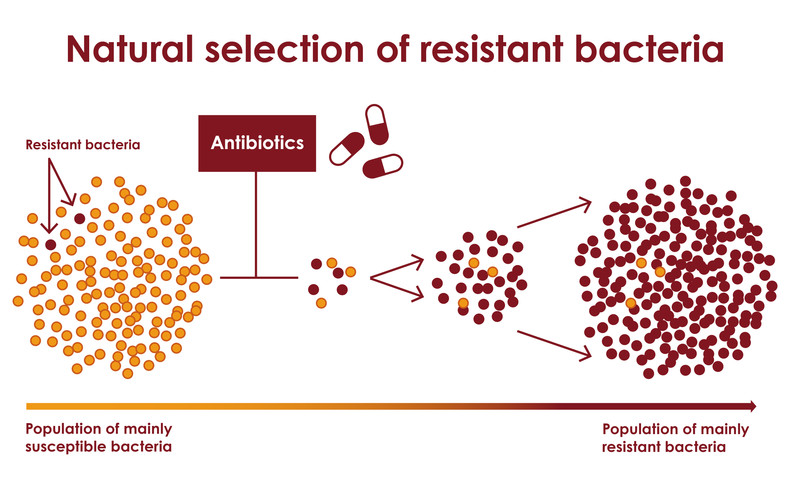
Natural selection of antibiotic-resistant bacteria
- Population has both susceptible and resistant bacteria.
- Antibiotic is applied.
- Susceptible bacteria die.
- Resistant bacteria survive and reproduce.
- Population becomes mostly resistant.
The antibiotic did not create resistance. It selected for bacteria that already had resistance alleles.
Notice the pattern: not all individuals are equally susceptible. That’s the key.
Genetic Uniformity in Crops
When crops are genetically identical (clones), they lack variation.
Real examples you should recognize:
- Irish Potato Famine → potato blight wiped out uniform crops
- Corn rust → fungal disease affecting corn
- Cavendish bananas → vulnerable to Panama disease
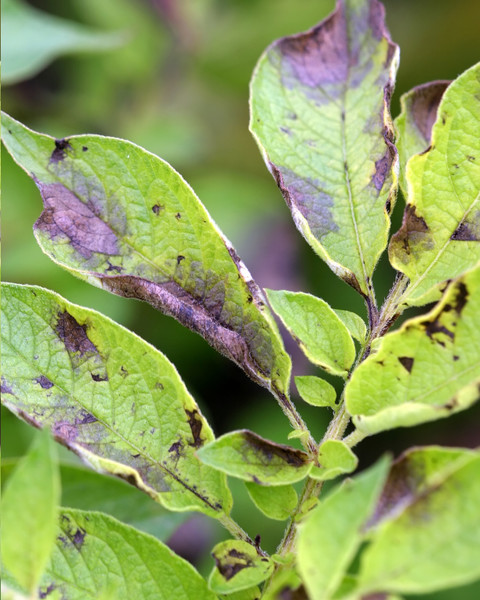
Potato late blight infection on leaves
If all plants share the same weakness, one pathogen can devastate the entire crop.
5. Conservation and Extinction Risk
Some endangered species show what happens after severe bottlenecks:
- California condors → reduced to 22 individuals
- Black-footed ferrets → descended from 7 individuals
- Prairie chickens → inbreeding depression from habitat fragmentation
Even if population size increases later, genetic diversity may remain low.
Conservation biology focuses on preserving variation, not just numbers.
Strategies include:
- Wildlife corridors → increase gene flow
- Managed breeding programs → reduce inbreeding
- Moving individuals between populations
- Cryopreservation (“frozen zoos”)
The AP exam often frames this as population dynamics. A population may rebound in size but still remain vulnerable if genetic variation is limited.
Saving a species means preserving its evolutionary potential.
Key Takeaways
Low Genetic Diversity and Extinction Risk
Genetic uniformity increases vulnerability to disease, environmental change, and population decline.
Selective Pressures and Allele Fitness
An allele can be advantageous in one environment but harmful in another.
Genetic Bottleneck
A sharp population reduction that greatly decreases allele diversity in survivors.
Inbreeding Depression
Reduced survival or reproduction caused by mating among closely related individuals.
California Condor
An endangered bird whose severe bottleneck left very low genetic variation.
Black-Footed Ferret
An endangered mammal descended from few survivors, leaving limited genetic diversity.
Prairie Chicken
A fragmented population that suffered inbreeding depression and reduced reproductive success.
Potato Blight
A plant disease that devastated genetically uniform potato crops during the Irish famine.
Corn Rust
A fungal disease whose impact is reduced by maintaining genetically diverse corn varieties.
Antibiotic Resistance in Bacteria
Resistant bacteria survive antibiotic treatment and reproduce, shifting the population's traits.
Conservation Strategies for Genetic Diversity
Wildlife corridors, managed breeding, cryopreservation, and reintroduction help preserve variation.
Genetic Diversity and Population Resilience
Heritable variation increases the chance some individuals survive and reproduce after environmental change.
Notes
Low Genetic Diversity and Extinction Risk
Genetic uniformity increases vulnerability to disease, environmental change, and population decline.
Selective Pressures and Allele Fitness
An allele can be advantageous in one environment but harmful in another.
Genetic Bottleneck
A sharp population reduction that greatly decreases allele diversity in survivors.
Inbreeding Depression
Reduced survival or reproduction caused by mating among closely related individuals.
California Condor
An endangered bird whose severe bottleneck left very low genetic variation.
Black-Footed Ferret
An endangered mammal descended from few survivors, leaving limited genetic diversity.
Prairie Chicken
A fragmented population that suffered inbreeding depression and reduced reproductive success.
Potato Blight
A plant disease that devastated genetically uniform potato crops during the Irish famine.
Corn Rust
A fungal disease whose impact is reduced by maintaining genetically diverse corn varieties.
Antibiotic Resistance in Bacteria
Resistant bacteria survive antibiotic treatment and reproduce, shifting the population's traits.
Conservation Strategies for Genetic Diversity
Wildlife corridors, managed breeding, cryopreservation, and reintroduction help preserve variation.
Genetic Diversity and Population Resilience
Heritable variation increases the chance some individuals survive and reproduce after environmental change.
