Topic 7.1 Notes – Introduction to Natural Selection
1. What Natural Selection Is
Natural selection is the process by which individuals with certain heritable traits survive and reproduce more than others in a given environment.
A few foundations have to be clear in your head:
- Evolution = change in allele frequencies in a population over time.
- Individuals do not evolve during their lifetime.
- Selection acts on phenotypes (what you can see).
- Evolution happens at the level of genotypes (allele frequencies in the population).
Darwin’s key claims
Darwin proposed three big ideas:
- Species change over time.
- All species share common ancestors.
- Natural selection drives that change.
The mechanism is simple but powerful. Individuals in a population vary. Some of that variation affects survival and reproduction. Those individuals leave more offspring. Over generations, the alleles underlying those helpful traits become more common.
That shift in allele frequency is evolution.
On tests, they love giving you a scenario and asking whether evolution occurred. If allele frequencies did not change, evolution did not occur, even if individuals struggled or died.
2. The Four Conditions Required for Natural Selection
All four must be present for natural selection to occur.
a. Variation Exists
Individuals in a population are not identical.
Sources of variation:
- Mutations (new alleles)
- Crossing over during meiosis
- Independent assortment
- Random fertilization
No variation means nothing for selection to “choose” from.
b. Traits Are Heritable
The variation must be genetic.
- Traits must be passed from parents to offspring.
- Learned or acquired traits are not inherited.
If a trait increases survival but is not genetic, it will not increase in frequency over generations.
c. Overproduction and Competition
Populations produce more offspring than can survive.
Resources are limited:
- Food
- Space
- Mates
- Light, water, nutrients (in plants)
This creates competition, which sets the stage for selection.
d. Differential Survival and Reproduction
Some individuals leave more offspring than others because of their phenotype.
This is differential reproductive success.
Over time:
- Helpful alleles increase in frequency.
- Harmful alleles decrease.
- The population becomes better adapted.
That improved fit to the environment is called an adaptation.
3. Evolutionary Fitness
In evolution, fitness means reproductive success.
It is measured by:
- Number of offspring
- Survival of those offspring
- Whether those offspring reproduce
An organism with high fitness passes more copies of its alleles to the next generation.
Fitness is always relative to the environment.
- Thick fur increases fitness in cold climates.
- The same fur decreases fitness in hot climates.
If the environment changes, the “best” phenotype can change too. That’s something the AP exam often builds into multi-part questions.
4. Environmental Pressures That Drive Selection
The environment determines which traits are favorable.
a. Biotic Factors (living)
- Predators
- Competitors
- Parasites
- Pathogens
- Available prey or food
These interactions can cause rapid evolutionary change. For example, as predators get better at hunting, prey with better defenses survive more often. That back-and-forth can shift allele frequencies quickly.
b. Abiotic Factors (nonliving)
- Temperature
- Water availability
- pH
- Light intensity
- Soil composition
- Natural disasters
Abiotic pressures often show up in data-based questions where environmental conditions shift over time.
Environmental Stability and Change
| Environment Type | Effect on Selection |
|---|---|
| Stable | Same traits favored consistently; little directional change. |
| Gradually changing | Traits shift steadily in one direction over generations. |
| Fluctuating | Different traits favored at different times; can maintain variation. |
| Sudden change | Strong selection pressure; rapid evolution or possible extinction. |
Different genetic variations may be favored in different generations if conditions shift.
5. Patterns of Natural Selection
Natural selection changes the distribution of phenotypes in predictable ways.
Here’s the classic graph you need to recognize. The dashed curve shows the original normal distribution, and the solid curve shows the population after selection.
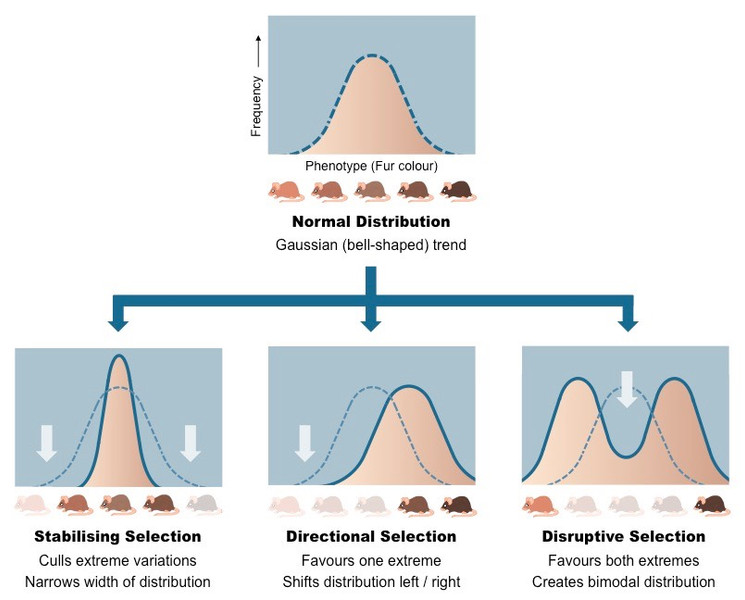
Directional, stabilizing, and disruptive selection patterns
a. Directional Selection
- One extreme phenotype is favored.
- The mean shifts left or right.
- On the graph, the entire curve moves toward one extreme.
- Example pattern: increasing resistance to a pesticide.
b. Stabilizing Selection
- Intermediate phenotype favored.
- Extremes selected against.
- Variation decreases.
- On the graph, the curve becomes narrower around the same mean.
c. Disruptive Selection
- Both extremes favored.
- Middle selected against.
- Variation increases.
- On the graph, the distribution splits into two peaks.
- Can contribute to speciation over time.
On exams, they often give you a graph of trait frequency before and after a drought or disease outbreak and ask which pattern it represents. Look at what happens to the mean and the spread.
6. How Natural Selection Affects Populations
Natural selection changes populations by altering allele frequencies.
It can:
- Increase beneficial alleles
- Decrease harmful alleles
- Reduce genetic variation (strong stabilizing selection)
- Maintain variation (changing environments)
- Increase diversity when different phenotypes are favored
One last idea that shows up constantly:
- Variation arises randomly (mutations).
- Selection is non-random. The environment consistently favors certain phenotypes.
If you can trace a path from genetic variation → phenotype differences → differential reproduction → allele frequency change, you understand this topic at the level the AP exam expects.
Key Takeaways
Evolution
Change in a population's genetic makeup across generations.
Natural Selection
Process in which heritable traits that improve survival or reproduction become more common.
Darwin's Theory of Natural Selection
Species change over time from common ancestors as favorable heritable traits spread.
Competition for Limited Resources
Struggle among organisms for scarce food, space, mates, or other necessities.
Favorable Phenotype
An observable trait that increases survival or reproductive success in a given environment.
Adaptation
A heritable trait that increases fitness in a specific environment.
Biotic Factors
Living environmental influences such as predators, competitors, parasites, disease, and food sources.
Abiotic Factors
Nonliving environmental influences such as temperature, rainfall, pH, light, and geography.
Environmental Fluctuation
Changes in biotic or abiotic conditions that alter which traits are favored.
Directional, Stabilizing, and Disruptive Selection
Directional favors one extreme, stabilizing favors intermediates, disruptive favors both extremes.
Genetic Diversity and Natural Selection
Selection can reduce, maintain, or increase variation depending on which traits are favored.
Darwin's Finches
Galapagos birds whose beak differences reflect adaptation to different food sources.
Heritable Variation
Genetic differences among individuals that can be passed from parents to offspring.
Differential Reproductive Success
Individuals with favorable phenotypes leave more surviving, reproducing offspring than others.
Selective Pressure
An environmental factor that favors some phenotypes over others in a population.
Reproductive Success
The number of viable offspring an organism produces relative to others.
Notes
Evolution
Change in a population's genetic makeup across generations.
Natural Selection
Process in which heritable traits that improve survival or reproduction become more common.
Darwin's Theory of Natural Selection
Species change over time from common ancestors as favorable heritable traits spread.
Competition for Limited Resources
Struggle among organisms for scarce food, space, mates, or other necessities.
Favorable Phenotype
An observable trait that increases survival or reproductive success in a given environment.
Adaptation
A heritable trait that increases fitness in a specific environment.
Biotic Factors
Living environmental influences such as predators, competitors, parasites, disease, and food sources.
Abiotic Factors
Nonliving environmental influences such as temperature, rainfall, pH, light, and geography.
Environmental Fluctuation
Changes in biotic or abiotic conditions that alter which traits are favored.
Directional, Stabilizing, and Disruptive Selection
Directional favors one extreme, stabilizing favors intermediates, disruptive favors both extremes.
Genetic Diversity and Natural Selection
Selection can reduce, maintain, or increase variation depending on which traits are favored.
Darwin's Finches
Galapagos birds whose beak differences reflect adaptation to different food sources.
Heritable Variation
Genetic differences among individuals that can be passed from parents to offspring.
Differential Reproductive Success
Individuals with favorable phenotypes leave more surviving, reproducing offspring than others.
Selective Pressure
An environmental factor that favors some phenotypes over others in a population.
Reproductive Success
The number of viable offspring an organism produces relative to others.
