Topic 8.7 Notes – Disruptions in Ecosystems
1. How Environmental Change Drives Evolution
Evolution happens when allele frequencies change in a population over time. The environment doesn’t “create” useful traits. It changes which traits are favored.
Populations already contain genetic variation, produced by:
- Mutations (random DNA changes)
- Recombination during meiosis
- Sexual reproduction
When the environment shifts, some phenotypes survive and reproduce more successfully. Over generations, those alleles become more common.
Random mutations vs nonrandom selection
This distinction shows up constantly on tests.
Mutations
- Random changes in DNA sequence
- Occur before selection acts
- Not caused by environmental need
- Can be beneficial, neutral, or harmful
Natural selection
- Nonrandom process
- Favors traits that increase fitness (reproductive success) in a specific environment
- Changes allele frequencies over time
If a population of bacteria becomes antibiotic resistant, the antibiotic didn’t cause resistance mutations to appear because the bacteria “needed” them. The mutation already existed. The antibiotic simply killed non-resistant bacteria, allowing resistant ones to reproduce.
That sentence structure is exactly how you’d explain it on a short-answer response.
What counts as an adaptation
An adaptation is:
- A heritable genetic variation
- That increases fitness
- In a particular environment
- And becomes more common over generations
Environment matters. Thick fur is adaptive in cold climates. It reduces fitness in hot ones. Adaptations are always context-dependent.
Heterozygote advantage
Sometimes the heterozygous genotype has the highest fitness.
Classic pattern:
- AA → lower fitness
- aa → lower fitness
- Aa → highest fitness
This is called heterozygote advantage and it maintains genetic diversity in a population. Both alleles stay in the gene pool because heterozygotes have a survival benefit. On the AP exam, they may give you relative fitness values and expect you to identify this pattern.
2. Invasive Species and Ecosystem Disruption
An invasive species is a non-native organism that spreads and causes harm.
They may be introduced:
- Intentionally (erosion control, agriculture)
- Unintentionally (ballast water, trade, travel)
Once introduced, they often exploit a new niche.
Why they spread so successfully
In their new environment, invasive species often lack:
- Predators
- Competitors
- Parasites
This removal of limiting factors allows rapid population growth, sometimes close to exponential.
Ecological effects
- Outcompete native species for food, space, light, nutrients
- Disrupt food webs
- Reduce biodiversity
- Alter nutrient cycling
Two classic examples you should recognize:
- Kudzu → grows rapidly and smothers native vegetation
- Zebra mussels → clog infrastructure and remove plankton from aquatic systems
If you see a graph showing explosive population growth after introduction into a new region, think “release from limiting factors.”
3. Human Activities That Disrupt Ecosystems
Human impact accelerates ecosystem change beyond natural rates.
Biomagnification
This involves increasing toxin concentration at higher trophic levels.
Here’s the pattern:
- Toxins (like mercury or DDT) enter water.
- Producers absorb small amounts.
- Primary consumers eat many producers.
- Concentration increases at each trophic level.
- Top predators accumulate the highest levels.
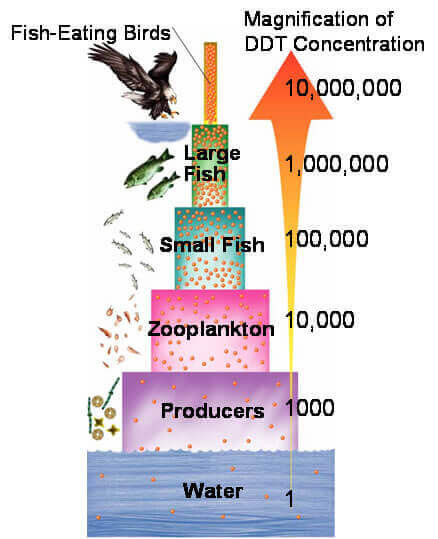
Biomagnification of DDT across trophic levels
Notice how the concentration increases from water at the bottom to fish-eating birds at the top. Each step up the food chain results in a higher toxin concentration.
Key points:
- Toxins are often fat-soluble
- Stored in tissues
- Can cause reproductive failure (ex: eggshell thinning)
Eutrophication
This is nutrient pollution in aquatic systems.
- Excess nitrogen and phosphorus enter water (runoff, sewage).
- Algal blooms form.
- Algae die.
- Decomposers break them down.
- Oxygen levels drop.
- Fish and other organisms die (hypoxic “dead zones”).
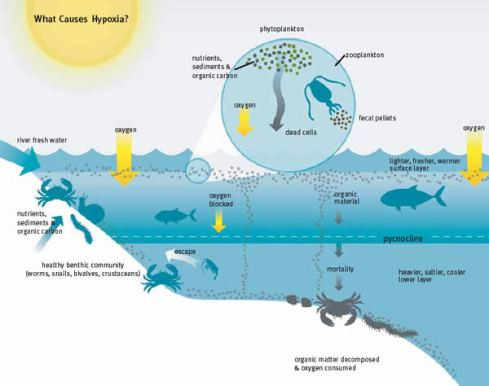
Eutrophication leading to hypoxia in aquatic systems
Focus on the lower layer in the diagram where decomposers consume oxygen as they break down sinking organic matter. This increased cellular respiration by bacteria is why dissolved oxygen drops.
You should be able to explain why oxygen drops. Decomposition increases cellular respiration by bacteria, which consumes dissolved oxygen.
New diseases
When pathogens enter populations with no resistance, mortality can be extreme.
Examples:
- Dutch elm disease → major loss of elm trees
- Potato blight → crop collapse and famine
Loss of dominant species reshapes community structure.
Habitat change
- Global climate change → shifts temperature and precipitation, coral bleaching, migration pressure
- Logging and urbanization → habitat loss and fragmentation
- Monocropping → low biodiversity, high vulnerability to pests
Reduced biodiversity often means reduced ecosystem resilience.
4. Geological and Meteorological Disruptions
Natural events also reshape ecosystems.
El Niño
A periodic warming of Pacific surface waters that shifts rainfall patterns globally. It can cause drought in some regions and flooding in others, altering marine and terrestrial ecosystems.
Continental drift
Movement of tectonic plates:
- Separates populations → speciation
- Connects landmasses → migration and competition
Biogeography is built on this.
Meteor impact
The asteroid impact 66 million years ago triggered rapid climate change and mass extinction, including non-avian dinosaurs. After mass extinction, open niches allow adaptive radiation.
5. Ecosystem Response and Recovery
Ecosystems respond to disturbance in different ways:
- Resistance → little change despite disturbance
- Resilience → recover after disturbance
- Shift to new stable state → permanent structural change
Recovery depends on:
- Biodiversity
- Severity of disturbance
- Connectivity to other ecosystems
- Rate of environmental change
Disruptions create new selective pressures. Populations must adapt, migrate, or go extinct. That connection between ecology and evolution is the heart of this topic.
Key Takeaways
Adaptation
A heritable variation favored by selection because it increases fitness in a specific environment.
Random Mutation and Natural Selection
Mutations arise by chance, but selection nonrandomly increases beneficial variants and removes harmful ones.
Heterozygote Advantage
The heterozygous genotype has higher fitness than either homozygous genotype in a given environment.
Invasive Species
A nonnative organism that spreads in a new ecosystem and disrupts native populations or ecosystem processes.
Enemy Release and Niche Exploitation
Introduced species often expand rapidly because predators, parasites, or competitors are absent in the new habitat.
Kudzu
An introduced vine in the southeastern United States that rapidly overgrows and smothers native vegetation.
Zebra Mussels
An invasive freshwater mollusk that clogs infrastructure and removes plankton from aquatic food webs.
Biomagnification
Toxin concentration increases at higher trophic levels as predators consume contaminated prey.
Eutrophication
Excess nutrients cause algal blooms whose decomposition depletes oxygen in aquatic ecosystems.
Introduced Diseases
Human movement can spread pathogens into new regions where native species lack resistance.
Dutch Elm Disease
An introduced fungal disease spread by bark beetles that killed large numbers of elm trees.
Potato Blight
A water mold disease introduced to susceptible crops, causing widespread potato failure.
Global Climate Change
Long-term shifts in temperature and precipitation that alter habitats, species ranges, and ecosystem processes.
Logging
Large-scale tree removal that destroys habitat, fragments forests, and changes community structure.
Urbanization
Conversion of natural land into cities, causing habitat fragmentation, pollution, and heat island effects.
Monocropping
Growing one crop over large areas, reducing biodiversity and simplifying ecosystem structure.
El Niño
Periodic warming of the tropical Pacific that shifts global weather, rainfall, and ecosystem conditions.
Continental Drift
Tectonic plate movement that changes landmass positions, isolating or connecting populations over time.
Meteor Impact on Dinosaurs
A mass extinction event caused by asteroid impact that drastically reshaped global ecosystems.
Notes
Adaptation
A heritable variation favored by selection because it increases fitness in a specific environment.
Random Mutation and Natural Selection
Mutations arise by chance, but selection nonrandomly increases beneficial variants and removes harmful ones.
Heterozygote Advantage
The heterozygous genotype has higher fitness than either homozygous genotype in a given environment.
Invasive Species
A nonnative organism that spreads in a new ecosystem and disrupts native populations or ecosystem processes.
Enemy Release and Niche Exploitation
Introduced species often expand rapidly because predators, parasites, or competitors are absent in the new habitat.
Kudzu
An introduced vine in the southeastern United States that rapidly overgrows and smothers native vegetation.
Zebra Mussels
An invasive freshwater mollusk that clogs infrastructure and removes plankton from aquatic food webs.
Biomagnification
Toxin concentration increases at higher trophic levels as predators consume contaminated prey.
Eutrophication
Excess nutrients cause algal blooms whose decomposition depletes oxygen in aquatic ecosystems.
Introduced Diseases
Human movement can spread pathogens into new regions where native species lack resistance.
Dutch Elm Disease
An introduced fungal disease spread by bark beetles that killed large numbers of elm trees.
Potato Blight
A water mold disease introduced to susceptible crops, causing widespread potato failure.
Global Climate Change
Long-term shifts in temperature and precipitation that alter habitats, species ranges, and ecosystem processes.
Logging
Large-scale tree removal that destroys habitat, fragments forests, and changes community structure.
Urbanization
Conversion of natural land into cities, causing habitat fragmentation, pollution, and heat island effects.
Monocropping
Growing one crop over large areas, reducing biodiversity and simplifying ecosystem structure.
El Niño
Periodic warming of the tropical Pacific that shifts global weather, rainfall, and ecosystem conditions.
Continental Drift
Tectonic plate movement that changes landmass positions, isolating or connecting populations over time.
Meteor Impact on Dinosaurs
A mass extinction event caused by asteroid impact that drastically reshaped global ecosystems.
