Topic 6.6 Notes – Gene Expression and Cell Specialization
1. How Gene Expression Is Controlled at the DNA Level
Gene expression means a gene is transcribed into mRNA and usually translated into a protein. In eukaryotes, the most important control point is transcription.
Transcription happens when:
- RNA polymerase binds to DNA
- It builds an mRNA strand complementary to the template strand
But RNA polymerase cannot just attach anywhere. It needs:
- Specific DNA sequences
- Transcription factors (proteins that help it bind and start transcription)
If transcription occurs → mRNA is made → protein can be produced → phenotype may change.
If transcription is blocked → no mRNA → no protein → different phenotype.
That direct chain from DNA → RNA → protein → trait shows up constantly in AP questions, especially when they ask how a mutation affects phenotype.
2. The DNA Regulatory Sequences and Proteins That Control Transcription
Promoters
A promoter is a DNA sequence near the transcription start site.
- Can be upstream or downstream of the start site
- Binding site for:
- RNA polymerase
- General transcription factors
- Often contains a TATA box, recognized by the TATA-binding protein
Without proper promoter binding, transcription does not begin. On tests, if they describe a mutation in a promoter and transcription decreases, you should immediately think less protein is produced.
Enhancers
Enhancers are regulatory DNA sequences that increase transcription.
- Can be far from the gene
- Can be upstream, downstream, or even within introns
- Work regardless of orientation
- Bind specific transcription factors called activators
Here’s what that interaction looks like. Focus on the top “ON” panel for enhancer action:
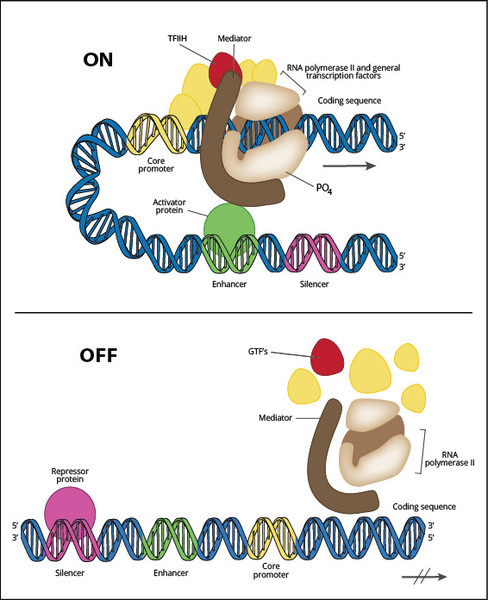
Eukaryotic gene regulation: enhancer activation and silencer repression
DNA physically loops so activators bound to enhancers interact with mediator proteins and the RNA polymerase II complex at the core promoter. That interaction increases the rate of transcription.
A common AP move is giving you data where an enhancer is deleted and transcription drops dramatically. The key idea is that enhancer-bound activators help recruit or stabilize RNA polymerase.
Silencers
Silencers are regulatory DNA sequences that decrease transcription.
- Can be located upstream, downstream, or within the gene
- Bind repressors
In the bottom “OFF” panel of the figure, a repressor is bound to a silencer. That prevents effective assembly or function of the transcription machinery, so transcription levels go down.
Transcription Factors
Two main categories matter here:
- Activators
- Bind enhancers
- Increase recruitment of RNA polymerase
- Increase transcription
- Repressors
- Bind promoters, operators, or silencers
- Block RNA polymerase directly
- Or recruit proteins that inhibit transcription
Gene expression depends on the balance between positive and negative regulatory molecules. If activators dominate, transcription increases. If repressors dominate, it decreases.
3. Negative Regulation of Gene Expression
Negative regulatory molecules inhibit transcription by binding to DNA.
They can:
- Physically block RNA polymerase from binding
- Prevent assembly of the transcription complex
- Recruit corepressors that suppress transcription
Result:
- No mRNA produced
- No protein produced
- Altered phenotype
If a repressor protein is mutated so it can’t bind DNA, transcription may increase unexpectedly. That kind of scenario shows up in free-response questions where you must connect molecular changes to phenotype.
4. Differential Gene Expression and Cell Specialization
Every cell in your body has essentially the same DNA. What makes a neuron different from a muscle cell is which genes are expressed.
This is called differential gene expression.
It works like this:
- Certain genes are transcribed in one cell type
- Specific mRNAs are produced
- Specific proteins are synthesized
- Those proteins determine structure and function
Examples:
- Muscle cells express actin and myosin → contraction
- Neurons express ion channels and neurotransmitter-related proteins → signal transmission
- Skin cells express keratin → protective barrier
Same genome. Different expression patterns. Different phenotypes.
When AP questions ask how a fertilized egg becomes many cell types, the answer is regulation of gene expression, not changes in DNA sequence.
5. Small RNA Molecules in Gene Regulation
Gene regulation also happens after transcription.
Certain small RNAs control whether mRNA gets translated.
microRNAs (miRNAs)
- Bind complementary sequences in the 3′ UTR of target mRNA
- Can:
- Block translation
- Promote mRNA degradation
Result: less protein is made.
small interfering RNAs (siRNAs)
- Bind specific mRNA sequences
- Trigger degradation
- Prevent translation
PIWI-interacting RNAs (piRNAs)
- Involved in gene silencing
- Often active in germ cells
These small RNAs fine-tune protein production and contribute to phenotypic differences without changing the DNA sequence itself.
Key Takeaways
Promoter
A DNA sequence near a gene where RNA polymerase and transcription factors bind to start transcription.
Enhancer
A regulatory DNA sequence that increases transcription when activator proteins bind, often far from the gene.
Silencer
A regulatory DNA sequence that decreases transcription when bound by inhibitory regulatory proteins.
Transcription Factors
Regulatory proteins that bind specific DNA sequences to activate or repress transcription.
RNA Polymerase and Transcription Initiation
The enzyme binds promoter DNA with transcription factors to begin RNA synthesis from a gene.
Negative Regulatory Molecules
Repressors and corepressors that inhibit transcription by binding DNA or blocking transcriptional machinery.
Differential Gene Expression
Different cells express different sets of genes from the same genome.
Gene Regulation, Cell Specialization, and Phenotype
Regulated gene expression creates different cell products, causing specialized functions and phenotypic differences.
Small Regulatory RNAs
Small RNAs such as miRNAs, siRNAs, and piRNAs reduce gene expression after transcription.
Notes
Promoter
A DNA sequence near a gene where RNA polymerase and transcription factors bind to start transcription.
Enhancer
A regulatory DNA sequence that increases transcription when activator proteins bind, often far from the gene.
Silencer
A regulatory DNA sequence that decreases transcription when bound by inhibitory regulatory proteins.
Transcription Factors
Regulatory proteins that bind specific DNA sequences to activate or repress transcription.
RNA Polymerase and Transcription Initiation
The enzyme binds promoter DNA with transcription factors to begin RNA synthesis from a gene.
Negative Regulatory Molecules
Repressors and corepressors that inhibit transcription by binding DNA or blocking transcriptional machinery.
Differential Gene Expression
Different cells express different sets of genes from the same genome.
Gene Regulation, Cell Specialization, and Phenotype
Regulated gene expression creates different cell products, causing specialized functions and phenotypic differences.
Small Regulatory RNAs
Small RNAs such as miRNAs, siRNAs, and piRNAs reduce gene expression after transcription.
