Topic 8.1 Notes – Responses to the Environment
What Responses to the Environment Are
A response to the environment is any change an organism makes after detecting a cue or change. That cue can come from outside the organism or from inside it.
Two common sources of responses:
- External cues come from the environment.
- Light can affect plant growth or when animals are active.
- Temperature can change movement or activity level.
- Predators can trigger escape behavior or warning signals.
- Food availability can change foraging behavior.
- Internal changes come from the organism’s own condition.
- Hunger can trigger food-seeking behavior.
- Stress state can trigger a fight-or-flight response.
- Reproductive condition can trigger courtship or parental care.
Those cues lead to two broad kinds of responses:
- Behavioral responses are changes in what an organism does.
- movement
- calling
- courtship
- parental care
- changing activity time
- Physiological responses are changes in internal body processes.
- plant growth changes
- fight-or-flight body preparation
- defensive chemical production
This matters in evolution because if a response improves survival or reproduction, natural selection can favor it.
Major Types of Environmental Responses
Here are the examples AP Biology uses most often. One of the easiest to visualize is phototropism, where a shoot bends toward light because auxin shifts to the shaded side and those cells elongate more.
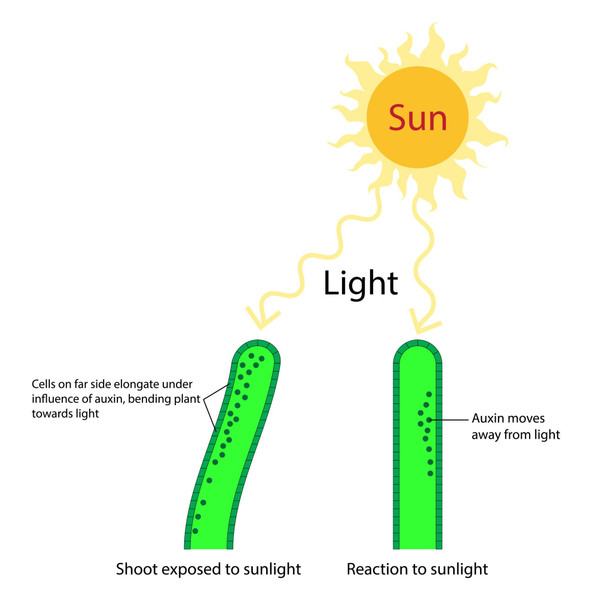
Phototropism in a plant shoot
- Photoperiodism is a response to length of day.
- Plants use it to time flowering or seasonal changes.
- The point is timing. Flowering during favorable conditions increases reproductive success.
- Phototropism is growth toward light.
- This increases light capture for photosynthesis.
- It is a physiological response because it changes growth.
- Responses to herbivory happen when a plant is damaged by an herbivore.
- The plant may produce defensive chemicals.
- It may also send signals that trigger responses in itself or nearby plants.
Animal movement responses
- Taxis is directed movement toward or away from a stimulus.
- Example: moving toward light or away from a chemical.
- Kinesis is a change in movement rate or activity level in response to a stimulus.
- The movement is not directed toward a specific source.
- This difference is tested a lot.
Activity-pattern responses
- Nocturnal organisms are active mainly at night.
- Diurnal organisms are active mainly during the day.
These patterns can help organisms find food, avoid predators, or avoid harsh conditions.
How Organisms Communicate
A signal is information sent from one organism that changes another organism’s behavior.
One easy example is a visual courtship display, where body posture and movement communicate with another individual.
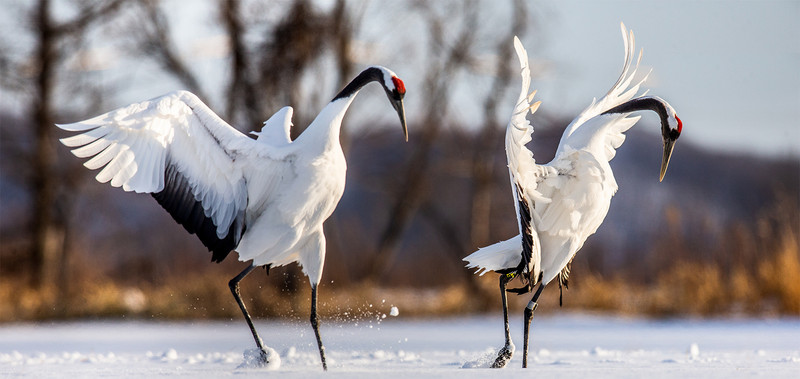
Visual courtship signaling
Signal types you should know:
- Visual signals such as coloration or displays
- Audible signals such as bird songs or alarm calls
- Tactile signals such as touch
- Electrical signals in some animals
- Chemical signals such as territorial marking or plant chemical signaling
Signals can help organisms:
- indicate dominance
- find food
- establish territory
- ensure reproductive success
- warn of predators
Common examples:
- mammals use territorial marking
- flowers and animals use coloration
- birds use songs for mates and territory
- groups use predator warnings
- packs use signals for coordinated behavior
On the AP exam, the key is the function of the signal and the behavior it changes. You do not need the detailed mechanism of how the signal is produced or detected.
How Responses and Communication Affect Fitness
This whole topic connects straight to natural selection.
- A cue or internal change occurs.
- The organism responds behaviorally or physiologically.
- That response affects survival or reproductive success.
- If fitness increases, the response can become more common over generations.
Two behavior types fit into this:
- Innate behaviors are genetically programmed.
- Learned behaviors develop through experience.
Both can be favored if they improve fitness. That is important. AP Bio does not limit natural selection to innate behavior only.
Differential reproductive success means some individuals leave more offspring than others. Better responses or more effective signals can lead to:
- more mates
- better territory
- safer offspring
- better access to resources
Cooperative Behavior and Population Success
Cooperation often raises fitness for individuals and helps population survival too.
- Parent and offspring interactions such as feeding and protection increase offspring survival.
- Group behaviors such as herding, flocking, and schooling improve vigilance and predator avoidance.
- Pack and colony behaviors can include cooperative hunting, defense, and division of tasks.
- Swarming in insects improves coordination, survival, or reproduction.
- Kin selection means helping relatives, which can increase the success of shared genes.
That last one gets confused a lot. Kin selection is not helping any member of the species. It specifically involves relatives.
Key Takeaways
Environmental Sensing
The ability to detect and respond to internal or external environmental changes.
Behavioral And Physiological Responses
Behavioral responses change actions; physiological responses change internal body processes like hormones or enzymes.
Photoperiodism
A plant response to day length that helps time seasonal events like flowering.
Phototropism
Growth of a plant toward or away from a light source.
Taxis And Kinesis
Taxis is directed movement toward or away from a stimulus; kinesis is random movement changing with stimulus intensity.
Nocturnal And Diurnal Activity
Nocturnal organisms are active at night; diurnal organisms are active during the day.
Fight-Or-Flight Response
A rapid physiological stress response that prepares the body for immediate action.
Plant Responses To Herbivory
Damage triggers chemical defenses and can signal nearby plants to activate protective responses.
Communication Mechanisms
Signals may be visual, audible, tactile, electrical, or chemical, each conveying information between organisms.
Courtship And Mating Behaviors
Behavioral displays or interactions used to attract mates and increase reproductive success.
Parent And Offspring Interactions
Signals and behaviors between parents and young that promote care, feeding, and survival.
Foraging Communication
Signals used to locate, share, or coordinate access to food resources.
Dominance And Territorial Signals
Signals used to establish social rank, defend space, and reduce direct conflict.
Innate And Learned Behaviors
Innate behaviors are inherited; learned behaviors develop through experience and practice.
Fitness
An organism's relative ability to survive and produce fertile offspring.
Cooperative Behavior
Actions by individuals that work together to improve survival or reproductive success.
Pack, Herd, Flock, And Schooling Behavior
Group behaviors that improve protection, foraging, navigation, or hunting through coordinated action.
Colony And Swarming Behavior
Large-group coordination in social organisms that supports defense, reproduction, or resource collection.
Predator Warnings
Signals that alert others to danger and trigger defensive or escape behaviors.
Kin Selection
Natural selection favoring behaviors that help relatives survive and reproduce because they share genes.
Notes
Environmental Sensing
The ability to detect and respond to internal or external environmental changes.
Behavioral And Physiological Responses
Behavioral responses change actions; physiological responses change internal body processes like hormones or enzymes.
Photoperiodism
A plant response to day length that helps time seasonal events like flowering.
Phototropism
Growth of a plant toward or away from a light source.
Taxis And Kinesis
Taxis is directed movement toward or away from a stimulus; kinesis is random movement changing with stimulus intensity.
Nocturnal And Diurnal Activity
Nocturnal organisms are active at night; diurnal organisms are active during the day.
Fight-Or-Flight Response
A rapid physiological stress response that prepares the body for immediate action.
Plant Responses To Herbivory
Damage triggers chemical defenses and can signal nearby plants to activate protective responses.
Communication Mechanisms
Signals may be visual, audible, tactile, electrical, or chemical, each conveying information between organisms.
Courtship And Mating Behaviors
Behavioral displays or interactions used to attract mates and increase reproductive success.
Parent And Offspring Interactions
Signals and behaviors between parents and young that promote care, feeding, and survival.
Foraging Communication
Signals used to locate, share, or coordinate access to food resources.
Dominance And Territorial Signals
Signals used to establish social rank, defend space, and reduce direct conflict.
Innate And Learned Behaviors
Innate behaviors are inherited; learned behaviors develop through experience and practice.
Fitness
An organism's relative ability to survive and produce fertile offspring.
Cooperative Behavior
Actions by individuals that work together to improve survival or reproductive success.
Pack, Herd, Flock, And Schooling Behavior
Group behaviors that improve protection, foraging, navigation, or hunting through coordinated action.
Colony And Swarming Behavior
Large-group coordination in social organisms that supports defense, reproduction, or resource collection.
Predator Warnings
Signals that alert others to danger and trigger defensive or escape behaviors.
Kin Selection
Natural selection favoring behaviors that help relatives survive and reproduce because they share genes.
